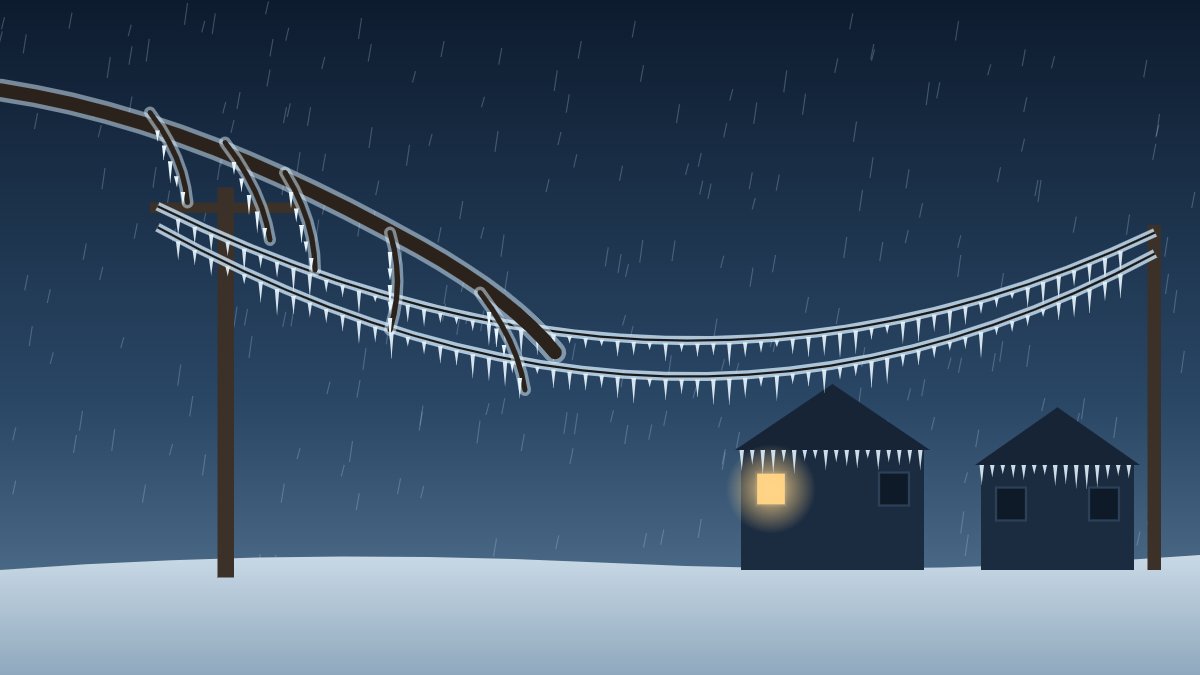
On Saturday night, January 24, 2026, Nashville Electric Service had about 50 customers without power. A day of mostly snow and some sleet had come and gone, and the city had held. Then the ice arrived early Sunday morning, and more than 230,000 customers lost power (Axios). It took the utility 12 days to bring everyone back (WSMV).
That’s the thing about ice. Snow announces itself. Freezing rain looks like an ordinary wet evening, and by morning the trees are made of glass.
If an ice storm is in your forecast, here’s what actually happens to the power, why it takes so long to come back, and a plan you can follow by the day.
Short answer
Plan for days, not hours. An ice storm doesn’t just trip the grid, it breaks it: limbs and poles come down in hundreds of places at once, and crews repair them in a fixed order that leaves single streets and single houses for last. Get ready for a week, keep one room warm safely, run any generator outdoors at least 20 feet from the house, and treat every fallen wire as live. If your neighbors get power back and you don’t, look at the spot where the wire meets your house. That part is usually yours to fix.
A quick note: this is general guidance. Your utility, your local emergency management office and the National Weather Service or Environment Canada come first.
Why freezing rain takes the power out
Freezing rain falls as liquid and freezes on whatever it touches: branches, wires, poles. The ice builds up slowly and evenly, which is exactly what makes it dangerous. A tree can hold a lot of snow because snow slides off. Ice doesn’t slide off. It holds on and adds weight hour after hour, until a limb gives way and lands on the nearest line.
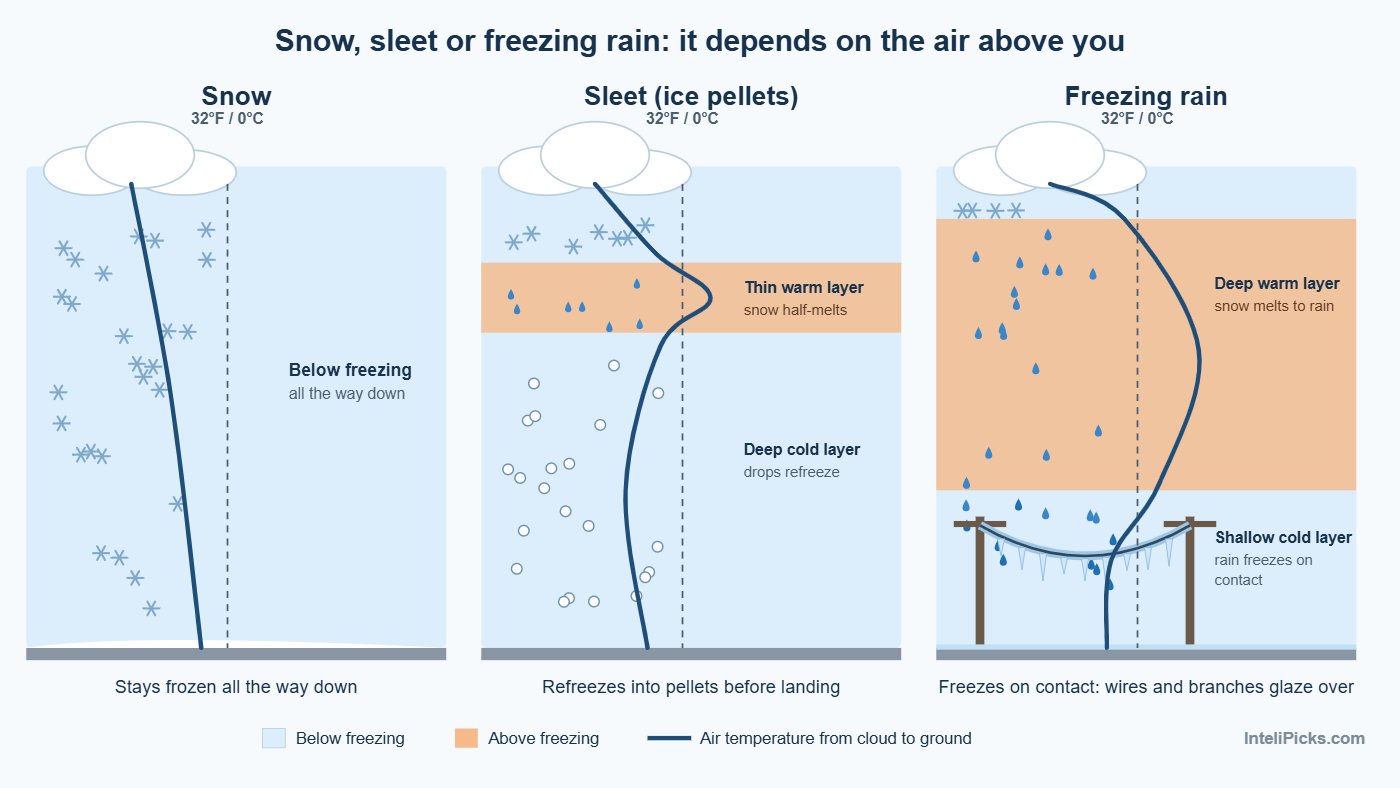
That’s why forecasters care about fractions of an inch. In the US, Ice Storm Warnings are usually issued for about a quarter inch of ice or more (NWS), though some offices use a half inch (NWS Burlington). As a rough guide, a quarter to a half inch is a disruptive storm with widespread outages, and more than half an inch is considered crippling (FOX Weather). In Canada, alerts have been colour-coded since November 26, 2025: yellow, orange and red, from least to most severe (Environment and Climate Change Canada). Red is issued only when forecasters are very confident of extreme impacts (The Weather Network).
One clarification, because it gets mixed up a lot. The February 2021 blackout in Texas wasn’t mainly an ice storm outage. That was a shortage of power on the grid itself. When Austin lost power to ice two years later, the outages were almost entirely ice bringing down lines (S&P Global). The difference matters for you. A grid shortage can end when supply comes back. A broken neighborhood has to be rebuilt, one pole at a time.
Why an ice storm outage lasts days, not hours
You’re probably thinking the crews will start on your street as soon as the rain stops. It’s a reasonable thought. Here’s what’s really going on behind the outage map.
Utilities restore power in an order designed to bring back the most people fastest: the big lines and substations first, then critical services, then the main lines through neighborhoods, then the smaller branch lines, and finally individual transformers and single houses. In an ice storm, the damage is spread across thousands of small locations, so the last stretch, the part with your house in it, is the longest.
Then there’s the damage itself. After the March 2025 ice storm in Ontario, Hydro One crews found more than 2,300 broken poles (Cottage Life). A broken pole isn’t a switch to flip. It’s a hole to dig, a pole to set and wires to restring, often on a road that’s still blocked by trees.
And the trees keep falling. Ice stays on branches after the rain stops, and wind or melting can bring down limbs onto lines that were just repaired. Hydro One warned that loose trees and limbs could cause new outages as it worked (The Weather Network).
Here’s how long recent ice storms actually lasted:
| Storm | Customers or people without power | How long it took |
|---|---|---|
| Kentucky, January 2009 | 770,000 people | More than two weeks for some (CDC) |
| Toronto, December 2013 | 416,000 Toronto Hydro customers at some point | Over the holidays (Toronto Hydro) |
| Austin, February 2023 | 173,879 customers at the peak | About 8 days to reach 99.9% (Community Impact, City of Austin) |
| Ontario, March 2025 | More than 1 million customers | 99.6% restored after two weeks (Cottage Life) |
| Nashville, January 2026 | More than 230,000 customers | 12 days (WSMV) |
What this means for you is simple: the estimated restoration time you see on the first day is a starting guess, not a promise. Hydro-Québec, for example, says its estimates are calculated from the distance between the outage and the nearest service garage (Hydro-Québec). During the 2023 Austin storm, the utility first said power would be fully restored by Friday evening, then withdrew the estimate later that day (Yahoo News). Plan as if the first number will move, because it usually does.
Your street has power and your house doesn’t
This one stings. The trucks leave, the neighbors’ porch lights come on, and your house stays dark. You call the utility, and the answer is that the problem is on your side.
It often is. On a typical overhead connection, the utility owns the wire from the pole to your house and the meter. You own the hardware the wire attaches to: the weatherhead at the top, the pipe it sits on (the service mast or riser), the meter box and the wiring into your panel (FPL, Hydro Ottawa). An ice-loaded limb that falls on the service line can bend that mast or rip it off the wall. If it does, the utility can’t reconnect you until a licensed electrician repairs it, and in many places that also means a permit and an inspection (Middle Tennessee Electric).
So once it’s light and safe, walk outside and look at where the wire meets your house, from a distance. If the pipe is bent, pulled away from the wall, or the wire is sagging to the ground, call your utility to report it and call an electrician right away. Hydro Ottawa’s advice is to start that process immediately (Hydro Ottawa), because after a big storm, electricians get booked quickly. Your homeowners or home insurance may cover the repair, so take photos first.
The two ways ice storms hurt people
Most people prepare for the cold. Fewer prepare for the fix they’ll reach for when they’re cold.
The cold itself is the bigger killer when heat fails across a whole region. Of the 246 deaths Texas confirmed after the February 2021 storm, 158 were from hypothermia (Texas DSHS). Most of those who died of hypothermia were 60 or older (Insurance Journal).
The second danger comes from the solution. After the 2009 ice storm in Kentucky, carbon monoxide was blamed for 10 deaths, and 8 of them were linked to a generator in the wrong place (Public Health Reports via Kentucky Living). When the US Consumer Product Safety Commission looked at where generators were when people died in their homes, the most common places were inside the living space, the garage and the basement (CPSC). People rarely put a generator in the living room on purpose. They put it in the garage with the door open, because it’s raining and it feels safe enough. It isn’t.
- Run a portable generator outdoors only, at least 20 feet from doors, windows and vents (CDC). Never in a garage, even with the door open. Our guide to running a generator safely in snow and cold covers the weather side.
- Never heat the house with a gas oven, grill, camp stove or charcoal.
- Put battery-powered carbon monoxide alarms on every level and near bedrooms. Here’s why a CO alarm matters most during an outage.
- Keep one room warm instead of the whole house. Here’s how to heat a room safely without power.
Your plan, by stage
When the warning goes out
- Charge everything: phones, power banks, a portable power station if you have one.
- Fill containers with drinking water and set aside extra for flushing. See how to store drinking water and how to flush a toilet when the power or water is out.
- Refill prescriptions and stock about a week of food you can eat without cooking. Canada’s baseline kit is 72 hours (Government of Canada), and the storms in the table above lasted much longer than that. Our 2-week winter pantry is a good starting list.
- Get some cash. When the power is out, card readers often are too. More in why you need emergency cash in an outage.
- Fill the car’s tank, and don’t park under trees.
- If you’re on a private well, read what happens to your well pump in an outage now, while you still have water pressure.
The first 24 hours
- Report the outage to your utility through its app, website or phone line. Call 911 only for downed or sparking wires, fires or a carbon monoxide alarm.
- Turn off appliances that were running and turn down the thermostat, but leave one light on so you know when power is back. Quebec’s government gives the same advice (Quebec government).
- Keep the fridge and freezer shut. Don’t move food outside into the snow: the sun can thaw it, the temperature swings, and animals get into it. The USDA suggests freezing water containers outside instead and using them as ice in coolers (WPTV, Food Safety News). Here’s how to tell if fridge food is still safe.
- Close off the rooms you aren’t using, and gather everyone in one.
- Stay inside while ice is still on the trees. Limbs keep falling after the rain stops.
Day three and beyond
This is where most people run out of plan. The house is cold, the novelty is gone, and the restoration estimate has moved twice.
- Watch the indoor temperature, especially in the pipes’ worst spots. If the house is heading toward 40°F with no heat coming, follow our guide to keeping pipes from freezing, which includes when to drain.
- Check on older neighbors and anyone who lives alone. They’re the people most at risk from the cold.
- Look up your local warming centers. Leaving a cold house isn’t giving up. It’s the right call, especially for babies, older adults and anyone on powered medical equipment.
- If you’re staying, ration fuel and batteries for the long haul, not for comfort tonight. The outage calculator shows how long your battery or generator will really last.
Trees and downed lines: what’s yours, what’s theirs
After an ice storm, you’ll see wires in places wires shouldn’t be. Assume every one of them is live. A downed line can energize the ground up to 35 feet away, more in wet conditions (ESFI). In Canada, BC Hydro says to stay back at least 10 metres, about the length of a city bus (BC Hydro). Keep kids and pets away, and call 911 and the utility.
Don’t trim anything near a power line yourself, and keep ladders and tools at least 10 feet from overhead lines (ESFI). Who trims the trees near the wire to your house depends on your utility, so ask them before the next storm. For a limb hanging over your roof or tangled in a fence, call a certified arborist, not a neighbor with a chainsaw.
When the lights come back
The power coming back is the moment to slow down, not speed up.
- Leave everything off for a few minutes. When thousands of homes restart heaters at once, the load can trip the system again. Newfoundland and Labrador Hydro asks customers to wait 10 minutes before turning the heat up or switching appliances on (NL Hydro).
- Turn things back on gradually, heating first (Hydro-Québec).
- If you see sparks or frayed wires, smell something hot, or anything got wet, shut off the main breaker and call an electrician.
- Check the food before you trust it.
- On a well or a septic system with a pump, follow the restart steps in our well pump guide before you run a lot of water.
- Walk the house for leaks over the next few hours. Pipes that froze often leak only once they thaw.
Quick answers
How much ice does it take to knock out power? Outages usually start when ice reaches about a quarter inch, and more than half an inch is considered crippling. Wind on top of ice makes it worse.
How long will my power be out after an ice storm? Nobody can tell you on day one. In the major storms listed above, most customers were back within a week, and the last ones waited closer to two weeks or more. Plan for a week.
Why do my neighbors have power and I don’t? Either you’re on a different line that hasn’t been repaired yet, or the equipment on your house was damaged. Check where the wire meets your house, and report it to your utility.
Should I turn off my main breaker during the outage? Turning off the appliances that were running is the usual advice. If you’ll run a generator through a transfer switch, or you’re leaving the house, follow your electrician’s instructions and the generator manual.
Is it safe to go outside after the freezing rain stops? Wait until the ice is off the trees if you can. Limbs and ice keep falling for hours, and fallen wires can be hidden under branches.
Next step. The storms on that list didn’t catch people because they were careless. They caught people who had planned for an evening, when the ice gave them a week. If you’d like the whole winter plan in one place, from heat and water to batteries and food, start with our family power outage plan.