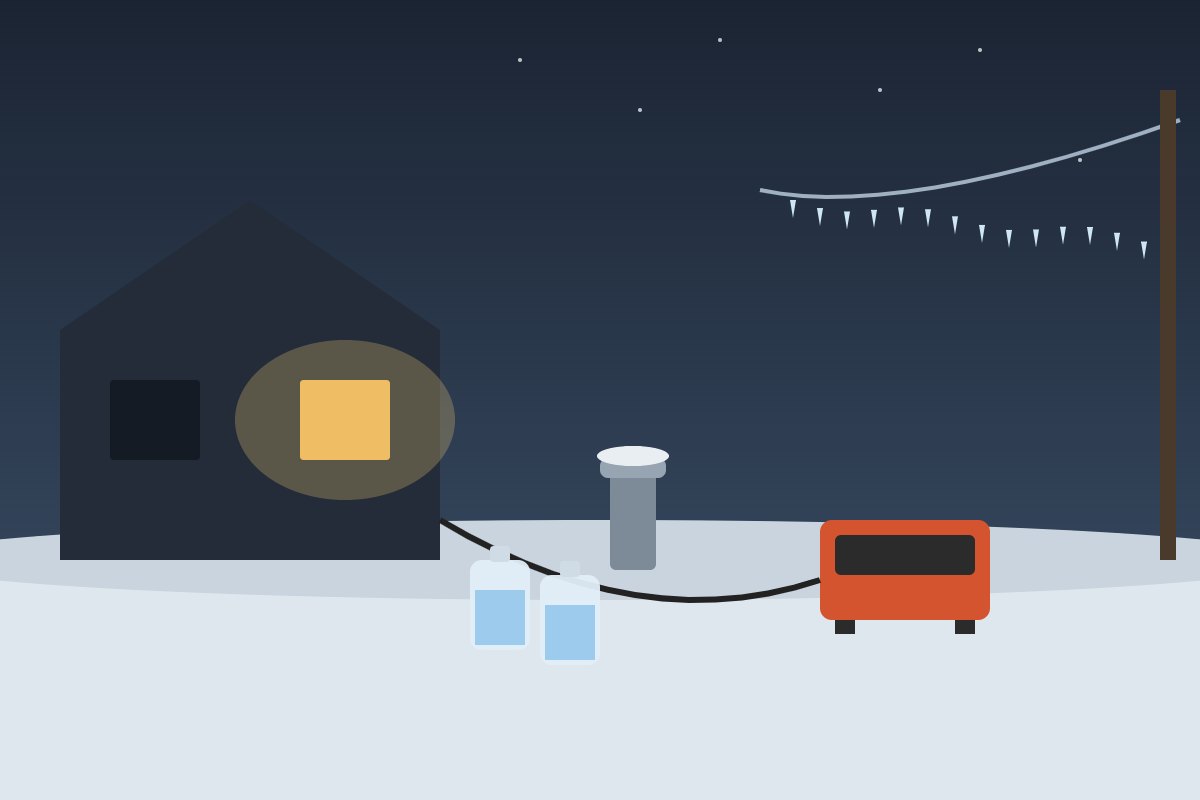
In January 1998, freezing rain fell on eastern Ontario and southern Quebec for the better part of a week. When the power lines came down, rural families learned something city families never think about: the water came down with them. A House of Commons member summed it up a few weeks later. People were without electricity, heat, food and water, and many rural communities had also lost their plumbing, septic systems, wells and sump pumps (House of Commons, February 1998).
Nobody in those houses had forgotten about water. They had simply never needed to think about where it came from. If you’re on a private well, it comes from a pump that runs on the same electricity as your lights. When one goes, so does the other.
This isn’t ancient history. During the ice storm in Ontario in the spring of 2025, the Township of Severn set up potable water stations for residents still without power and for those who rely on wells, and reminded them that a power outage will normally cause a well pump to stop (Township of Severn).
Short answer
When the power goes out, your well pump stops, and the water left in your pressure tank is meant to stay there. Health Canada advises not running taps, showering or flushing during the outage, because emptying the system can let contamination in. Live on stored water instead. If you want a generator to run the pump, size it from the pump’s horsepower and wiring, not from a generic chart: a 1 HP pump needs about 4 kW, and 50% more if it’s a 2-wire motor.
A quick note: this is general guidance. Your pump’s manual, your well contractor and your local health department come first.
Why the water in your tank isn’t your backup
You’re probably thinking the pressure tank will tide you over. It’s a big tank, after all. It’s a reasonable thought, and it’s wrong in two ways.
First, most of that tank is air. Only part of it holds water you can actually draw. Penn State Extension’s examples put it at about 8 gallons in a 42-gallon tank, 16 in an 82-gallon tank and 24 in a 120-gallon tank (Penn State Extension). If your system uses a constant-pressure controller, the tank is usually much smaller, and the taps go quiet almost as soon as the power does.
Second, the pressure itself is doing a job. Normally the pump keeps your pipes under pressure, and that pressure keeps contaminants out. Health Canada says that during a power outage you should not open faucets, take showers or flush toilets: the system may still hold several litres, but using them depressurizes it and raises the chance of contamination (Health Canada). Michigan gives the same advice for extended outages (Michigan DEQ).
What that means for you: the water you’ll use in an outage is the water you stored before it, not the water in the pipes.
How much water to store
The baseline in the US is at least 1 gallon per person per day, for at least 3 days (CDC). In Canada it’s about 4 litres per person per day, for at least 72 hours (Public Safety Canada). That’s for drinking, cooking and basic hygiene. It doesn’t cover toilets, which need far more; we worked out the numbers in how to flush a toilet when the power or water is out.
Well owners have one extra step. Well water has no chlorine in it, so if you’re filling containers from your own tap rather than buying bottled water, treat it before you store it. Our guide to storing drinking water for a winter outage walks through containers, treatment and rotation.
The small detail that decides whether a generator will run your pump
Here’s where most people get caught. A well pump looks like a modest appliance, maybe 1,000 watts while it runs. But electric motors pull several times their running power for the first moment they start, and generator sizing has to cover that moment (Generac). Size the generator for the running watts and it will stall, or trip its breaker, every time the pressure switch clicks on.
Pump motor makers publish their own minimums, and they’re higher than most people expect. Franklin Electric, one of the largest makers of submersible well motors, lists these minimum generator ratings for its motors with a standard (externally regulated) generator:
| Pump motor | 3-wire motor | 2-wire motor (50% more) |
|---|---|---|
| 1/3 HP | 1.5 kW | about 2.3 kW |
| 1/2 HP | 2.0 kW | 3.0 kW |
| 3/4 HP | 3.0 kW | 4.5 kW |
| 1 HP | 4.0 kW | 6.0 kW |
| 1.5 HP | 5.0 kW | 7.5 kW |
Notice the second column. It’s the detail almost nobody checks. A 2-wire motor has its starting parts down in the well, so it pulls a harder kick from the generator; a 3-wire motor has a separate control box above ground, usually a gray box near the pressure tank. If you see one labeled with your pump’s horsepower, you likely have a 3-wire system. If you don’t find one, assume 2-wire and size up. Goulds, another major brand, publishes similar figures, for example 5 kW for a 1 HP 2-wire motor.
Two more details matter:
- Voltage. Many well pumps run on 240 volts, and most pumps of 3/4 HP and up do. A generator that only puts out 120 volts can’t run them, no matter how many watts it has.
- Everything else. Those numbers are for the pump alone. If the same generator also has to run your fridge or your furnace fan, add their running watts on top. Our guides to sizing a generator for a furnace and the outage calculator help with the rest of the house.
And one habit worth keeping: start the generator before you switch the pump on, and switch the pump off before you shut the generator down. Goulds says so in its manual, and Franklin warns that letting a generator die under load can damage the motor’s thrust bearing.
How to connect it without hurting anyone
Most well pumps are wired straight into the electrical panel, so there’s no plug to move to a generator. The shortcut people reach for, a cord with a plug on both ends pushed into a dryer outlet, is the one that kills. It sends power backward through your house wiring and out to the utility lines, where line workers expect them to be dead.
The safe way is a transfer switch or an approved interlock, which makes sure the house can draw from only one source at a time (Wisconsin DATCP). Many well pumps run on 240 volts, so have a licensed electrician set it up (Virginia Department of Health). Then keep the generator itself outside, well away from doors and windows; here’s how to run one safely in snow and cold, and how to make sure your CO alarm works without power.
Can a portable power station run a well pump?
Sometimes, but not because of its battery size. A big battery lets you run a pump longer; it doesn’t help you start it. Whether a power station can start a pump depends on its inverter: it has to deliver the pump’s voltage (often 240 V) and survive the starting surge. Most plug-in power stations are 120 volts only, which rules out most deep-well pumps before you even look at the watts.
Rooftop solar won’t save you either, unless it was built for it. Grid-tied systems shut themselves off during an outage for safety; they keep working only with battery storage and a backup-capable inverter (Iowa State University Extension). If you’re shopping, our power station buyer’s checklist covers what the spec sheet should say. Check the pump’s nameplate first.
A hand pump as the quiet backup
A hand pump needs no fuel, makes no noise and can’t poison anyone with carbon monoxide, which is why some rural families keep one. A few things to know before you buy:
- A pump that pulls water up from the surface can only lift it about 20 to 25 feet. Deeper wells need a pump with its cylinder down below the water line.
- On a drinking-water well, state rules generally require a sealed connection to the wellhead and a closed spout pointing down, so insects and surface water can’t get in (Wisconsin DNR).
- Have it installed by a licensed well or pump contractor, and test the water at least once a year (Maine Emergency Management Agency).
When the power comes back
The relief of hearing the pump kick on is real. Give it a few minutes before you trust the water.
- If the well, pump or wiring got wet, don’t turn it on. Have an electrician or well contractor check it first (CDC). More on that in power outages during a flood.
- Let the water run for a few minutes to clear the stagnant water from the lines (Health Canada).
- Make sure an electric water heater tank is full before its breaker goes back on.
- Check any treatment system. A UV disinfection unit doesn’t work without power, so water that ran through it during the outage wasn’t treated.
- Test before you drink if the system lost all its pressure, or if the well flooded, or if the water looks, tastes or smells different. Use bottled water until the test comes back clean (Health Canada, CDC).
In winter there’s one more risk: lines that froze while the pump sat idle. Never thaw them with an open flame. Warm air, a heating pad or a hair dryer is slower and much safer, and if a line has split, shut the pump off and call a well contractor. Our guide to keeping pipes from freezing in an outage covers the house side.
Ten minutes this week
You don’t have to solve all of this today. Start with the one thing that tells you everything else: what’s actually down there.
- Find your pump’s horsepower and voltage, on the control box, the well records or the original invoice.
- Look for a control box near the pressure tank, so you know whether you have a 2-wire or 3-wire motor.
- Set aside drinking water for at least 3 days, plus flushing water.
- Write the steps above into your family power outage plan, so whoever is home knows not to run the taps.
The families in Ontario in 1998 didn’t lack courage or common sense. They lacked a few gallons in the basement and a number written on a card. Those are the easy parts.