Short answer
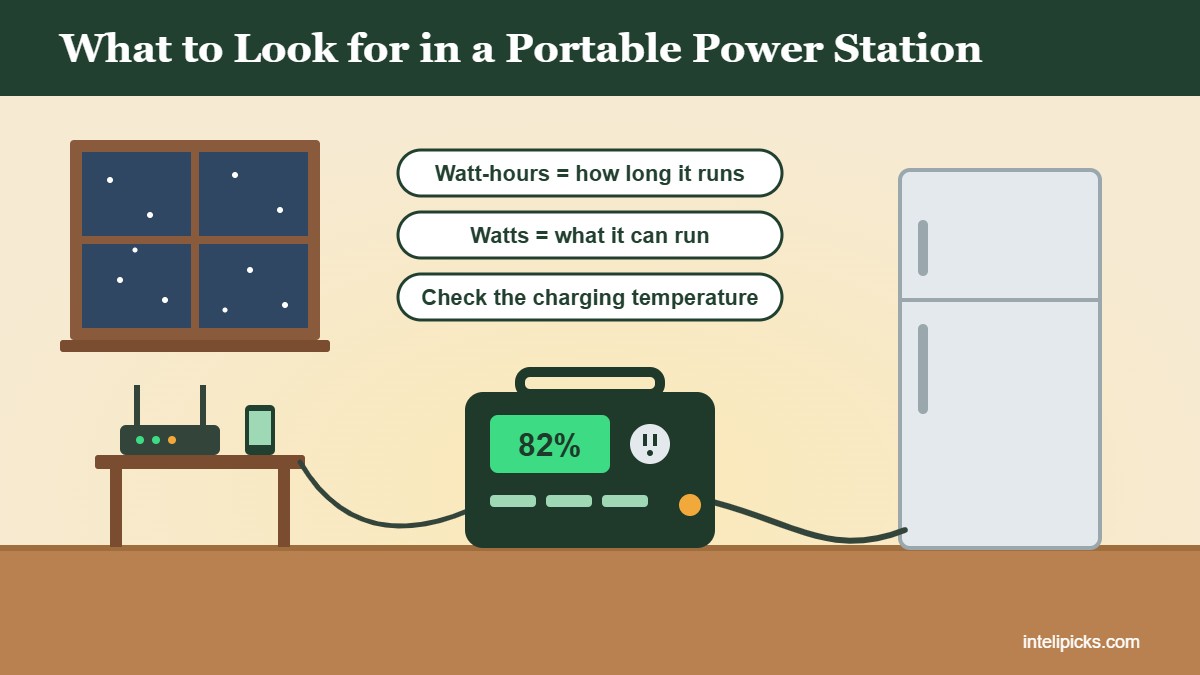
Pick a power station by what you need to run, not by the biggest number on the box. Watt-hours (Wh) tell you how long it can run your devices; watts (W) tell you whether it can run them at all, and motors such as a fridge compressor need extra power for a moment at start-up. Expect to get noticeably less than the rated capacity from the AC outlets. For winter, check the charging temperature in the manual: many units must not be charged below 32 °F (0 °C). Before you buy, look the model up on the CPSC recall list.
Three rules before anything else. Never connect a power station to a wall outlet to feed your house (backfeeding); it can injure utility workers and destroy the unit. Never charge it below the temperature in its manual. And if your model appears in a recall, stop using it and follow the notice.
Start With Your List, Not With the Product Page
Write down what must stay on during an outage and for how many hours: fridge, internet router, phones, a CPAP machine, a couple of lamps. That list decides everything else.
A portable power station runs selected devices. It does not run a house. Anything that makes heat with electricity is the usual surprise: a 1,500 W space heater would empty a 1,000 Wh station in about 40 minutes (1,000 ÷ 1,500), and less once you count losses. If heat is your main worry, read how to heat a room safely without power first.
Watt-Hours and Watts: The Two Numbers That Matter
- Watt-hours (Wh) are the size of the tank. More Wh, more hours.
- Continuous watts (W) are how much the outlets can deliver at the same time. Add up everything you will run together and stay below this number.
- Surge (peak) watts are a short burst for starting motors. Fridges, freezers, sump pumps and furnace blowers draw much more for a moment when they start than when they run. Compare the surge rating with the start-up draw of your largest motor, not with a general safety margin.
A “3,000 W peak” label does not mean 3,000 W of continuous power. Read the continuous figure.
Rated Capacity Is Not What You Get
The battery stores DC power; the inverter turns it into AC for your outlets and uses some energy doing so. The station also powers its own screen, fans and electronics. One hands-on reviewer puts typical real-world efficiency at 65 to 85 percent, depending on the load, the inverter and the room temperature.
- Plan with about 80% of the rated Wh, or less for small loads that run for many hours.
- A bigger inverter is not automatically better. A large inverter left on all day to feed a small load spends more energy on itself. Match the unit to your list.
- Power phones, laptops and other DC devices from the USB-C or 12V ports where you can. It skips the inverter.
How to Size It (10 Minutes With a Pencil)
Use your own numbers. A plug-in watt meter costs little and removes the guesswork. The formula: Wh needed = watts × hours ÷ 0.8.
| Device | How to find its real use |
|---|---|
| Refrigerator | EnergyGuide label: kWh per year ÷ 365 = kWh per day. Or measure 24 hours with a watt meter. |
| Router + modem | Watt meter, or the power adapter label (volts × amps) |
| Phones, laptop | Battery size in Wh × number of charges |
| CPAP | Manual or watt meter; see the note below |
| LED lamps | Label on the bulb × hours |
Add up the watt-hours, divide by 0.8, and you have the capacity to look for. Then check separately that the surge rating covers your fridge starting. Our outage calculator does the arithmetic for you.
Example with made-up round numbers: a fridge that uses 1.2 kWh per day needs 600 Wh for 12 hours; a 15 W router for 12 hours needs 180 Wh; two phone charges, 30 Wh. Total 810 Wh ÷ 0.8 ≈ 1,000 Wh. Your devices will differ, so measure them. For a deeper look at the fridge alone, see how long a 1,000 Wh power station runs a fridge.
CPAP note. ResMed recommends turning the humidifier off when you power its devices from a battery, because the humidifier uses a great deal of power. Check your own machine’s manual and talk to your equipment provider about a backup plan. This is not medical advice.
Hard-wired and 240 V loads. A furnace blower is usually wired into the house, and many well pumps run on 240 V. A standard 120 V station cannot simply be plugged into them. For the furnace, see what size generator you need to run a furnace, and keep stored drinking water if you depend on a well.
Batteries and Cold: Read the Charging Temperature
Most new stations use LiFePO4 (LFP) cells; older and lighter models often use NMC lithium-ion. LFP models advertise far more charge cycles, but those figures are manufacturer claims measured in mild conditions. Goal Zero, for example, states its 4,000-cycle figure for the Yeti 300 as “to 80% of original capacity” at 75 °F with a gentle 0.5C charge and discharge.
For winter, the lines that matter are these, from the same spec sheet:
- Charge: 32 to 125.6 °F (0 to 52 °C)
- Discharge: −4 to 140 °F (−20 to 60 °C)
So that unit can power things in a cold garage, but it must not be charged below freezing. Other models have different limits, and a few have built-in battery heating, so check the manual of the exact model. In practice:
- Keep the station indoors, in the heated part of the house, not in the garage or the car.
- If it has been in the cold, let it warm up inside before you plug it in to charge.
- Expect less runtime when the battery itself is cold.
Choosing between lithium (LiFePO4) and AGM for a cold space? See AGM vs. LiFePO4 in Freezing Weather for charging limits, capacity loss and where each type can safely live in winter.
Planning to run a sump pump? Check its starting watts, not just running watts. Our flood outage guide has a run-time table for a 2,000 Wh station.
Recharging During a Long Outage
- Wall outlet: the fastest way. Charge to full before a forecast storm. Many units offer a slower charge mode that is gentler on the battery; Goal Zero ships the Yeti 300 in low input mode “to increase battery life and reduce noise”.
- Car 12V port: slow. Fine for topping up, not for refilling a big unit.
- Solar: a panel’s rated watts are a best-case figure. Short winter days, a low sun, clouds and snow on the panel all cut output. Treat winter solar as a supplement, not a plan.
- Generator: running a generator outdoors for an hour or two to refill the station, then using the station indoors, is a common setup for multi-day outages. See how to run a generator safely in snow and cold and gas vs. propane in winter.
Safety: Certifications and Recalls
UL 2743 is the safety standard for portable power packs. According to UL, its scope covers lithium-ion units up to 20 kWh; small phone power banks fall under UL 2056, and equipment meant to supply a home’s wiring falls under UL 9540. Look for certification of the whole unit by a recognized lab, not only “certified cells”.
Power stations do not burn fuel, so they make no carbon monoxide, which is their big advantage over generators indoors. They are still large lithium batteries with high-power electronics, and several have been recalled:
| Product | Date | Units | What CPSC reported |
|---|---|---|---|
| Goal Zero Yeti 3000X | Aug 20, 2026 | about 46,200 | Circuit board can overheat; four reports of units catching fire, overheating and smoking; fix is a firmware update |
| EcoFlow Delta Max 2000 (EFD310) | Oct 9, 2025 | about 25,030 | Can overheat and ignite; six reports of fires, over $850,000 in property damage; fix is a firmware update |
| Harbor Freight Predator 2000 | Jul 3, 2025 | about 6,500 | Outlet wiring reversed in EPS mode; shock hazard; replacement |
| HALO 1000 | Aug 29, 2024 | about 5,740 | Batteries can overheat; one death and four other fire reports; replacement |
| Klein Tools KTB1000 / Blackfire PAC1000 | Dec 21, 2023 | about 3,800 (plus 164 in Canada) | Inverter boards can overheat; four reports; refund |
CPSC also warned consumers in September 2025 to stop using Aeiusny 400W and 500W stations sold on Amazon, after 24 reports of fires and explosions.
Before you buy, and again each winter, search your model at cpsc.gov/Recalls (US) or recalls-rappels.canada.ca (Canada). If your unit is listed, stop using it and follow the notice.
Basic rules for any unit: keep the vents clear (no blankets over it), keep it away from heat sources and anything flammable, use heavy-duty extension cords that are not pinched under doors or rugs, and stop using a unit that swells, smells or gets unusually hot.
Connecting to Your Home
Plugging appliances straight into the station, or through a suitable extension cord, needs no electrician. Powering house circuits is different.
- Never backfeed. Do not connect a power station to a wall outlet with a double-ended cord. It can energize the lines outside your house and injure utility workers, and it can destroy the unit when grid power returns.
- Use a transfer switch or interlock installed by a licensed electrician, and ask about your local code and permit rules before you buy a “home integration” kit. UL notes that UL 2743 is a standard for portable use, and that battery systems wired into a home are covered by a different standard, UL 9540.
What to Read in the Warranty
- Length in years, and whether you must register the product.
- The capacity the battery is promised to keep, after how many cycles, and under what test conditions.
- Exclusions: charging outside the temperature range, long storage at empty, commercial use, purchase from unauthorized sellers.
- Who pays for shipping a 50-pound unit back.
Price: Compare Dollars per Watt-Hour
Divide the price by the rated Wh. It lets you compare a 1,000 Wh unit with a 2,000 Wh one, and a “50% off” banner with last month’s price. List prices in this category are discounted often, so check the price history of the exact model instead of trusting the size of the discount. We could not confirm that Black Friday is reliably the lowest price of the year.
Buying Checklist
- I listed my devices and hours, and added up the Wh ÷ 0.8.
- Continuous watts cover everything I will run at once.
- Surge watts cover my fridge or pump starting.
- No 240 V or hard-wired load on my list, or I have a plan with an electrician.
- I read the charge and discharge temperature range in the manual.
- The whole unit is certified to UL 2743 by a recognized lab.
- I checked the model on CPSC and Recalls Canada.
- I can lift it, or it has wheels.
- It has the ports I need (USB-C, 12V) so small devices can skip the inverter.
- I read the warranty exclusions and worked out the price per Wh.
Want this on paper before the next storm? The Winter Battery & Power Outage Guide covers the first hours of an outage, staying warm safely, food safety and generators, with a printable Outage Card and a 14-day pantry checklist. Or start with the free 2-Minute Winter Battery Check.
Sources: CPSC – Goal Zero Yeti 3000X recall · CPSC – EcoFlow Delta Max 2000 recall · CPSC – Predator 2000 recall · CPSC – HALO 1000 recall · CPSC – Klein Tools / Blackfire recall · CPSC – Aeiusny warning · UL Solutions – Q&A: Portable Power Packs · ANSI/CAN/UL 2743:2025 scope · Goal Zero – Yeti 300 specifications · ResMed – battery and humidifier FAQ · Yahoo Tech – power station fridge test