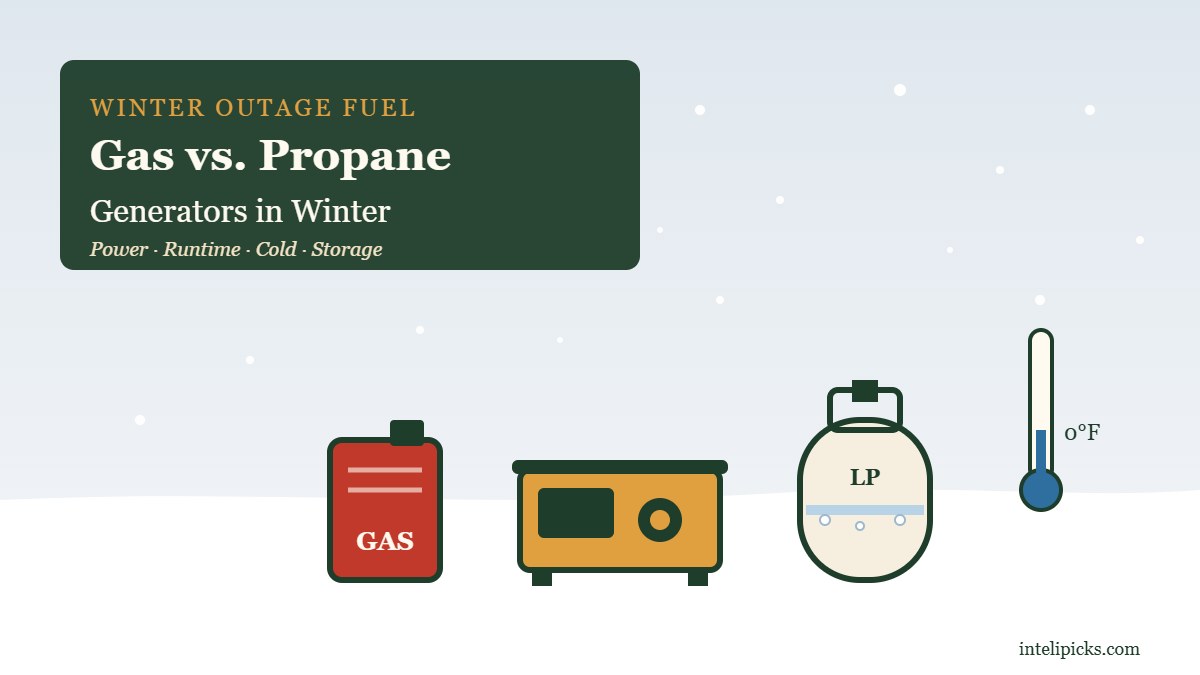
If you own a dual-fuel generator, a winter storm forces a real decision: run it on gasoline or on propane? Most comparison articles answer with a simple pros-and-cons list written for July. In January the answer changes, because cold affects each fuel in a different way — gasoline goes stale and picks up water, while propane can lose pressure in a small tank right when you need it most.
This guide compares the two fuels for a winter power outage specifically: how much power you really get, how long a tank lasts, what happens below freezing, how much fuel you can safely store at home, and how to plan enough fuel to keep the fridge, freezer and furnace going for a multi-day outage.
Short answer
Propane stores for years without going stale and refuels without spills, but it carries about 24% less energy per gallon, most dual-fuel generators make about 10% less power on it, and a small 20 lb tank can lose pressure in the cold under a heavy load. Gasoline gives full power and isn’t bothered by a cold tank, but it goes stale in about 30–90 days without stabilizer and home storage is limited by fire codes. For most homes, a dual-fuel generator with some fresh gasoline plus propane in 40 lb or 100 lb cylinders is the most reliable winter setup.
Gas vs. Propane in Winter at a Glance
| Gasoline | Propane | |
|---|---|---|
| Energy per gallon | About 120,000 Btu | About 91,500 Btu (roughly 24% less) |
| Power output | Full rated watts | Usually about 10% less on dual-fuel models (check your label) |
| Storage life | 30–90 days untreated (Generac); longer with stabilizer | Doesn’t go stale in a sealed cylinder |
| Main cold-weather problem | Stale fuel, water in ethanol blends, gummed carburetor | Pressure drop and frost in small tanks under heavy load |
| Home storage | Many fire codes cap it around 25 gallons total | Cylinders must be stored outdoors |
| Refueling | Engine off and cooled; pour by hand | Engine off; swap cylinders, no spilled fuel |
How Much Power and Runtime You Really Get
Propane carries less energy per gallon
According to the U.S. Energy Information Administration, a gallon of motor gasoline contains about 120,214 Btu, while a gallon of propane contains about 91,452 Btu. That’s roughly 24% less energy in the same volume, and it’s why every dual-fuel generator burns through propane faster and makes a little less power on it.
Expect about 10% fewer watts on propane
Look at the label, not the headline number. Take a popular 7,500-watt dual-fuel model from Champion as an example:
- Gasoline: 9,375 starting watts / 7,500 running watts
- Propane: 8,400 starting watts / 6,750 running watts
That’s a 10% drop. If your furnace blower, fridge and freezer add up to more than the propane rating — especially when the fridge compressor kicks on — the generator can trip its breaker on propane even though it handled the same load on gasoline. Use our Power Outage Calculator and plan with the propane number. For the furnace specifically, see What Size Generator Do I Need to Run My Furnace?
Runtime: one gas tank vs. one 20 lb cylinder
For that same Champion model, the published runtime at 50% load is about 10 hours on its 7.7-gallon gas tank and about 5.5 hours on a 20 lb propane cylinder. A 20 lb cylinder (the standard grill tank) holds about 4.7 gallons of propane. Treat published runtimes as a best case: real loads, cold starts and a struggling tank in the cold usually mean less.
Why Small Propane Tanks Struggle in the Cold
A common myth says propane “freezes” in winter. It doesn’t in any weather you’ll ever see. The real issue is pressure.
Cold means lower pressure
Propane boils at about -44°F. Above that, the liquid in the tank keeps turning into gas, but the colder it gets, the lower the pressure. According to the Propane Education & Research Council’s technical guide, pressure in a tank of propane is roughly:
- 70°F: 127 psig
- 40°F: 72 psig
- 0°F: 28 psig
- -20°F: 13.5 psig
- -40°F: 3.6 psig
The tank chills itself
Turning liquid propane into gas takes heat — about 184 Btu for every pound. That heat has to come from the steel of the tank and the air around it. When a generator pulls gas fast, the liquid inside cools down well below the outdoor temperature. You’ll often see a band of frost on the outside of the tank at the liquid level. As the liquid gets colder, pressure drops further, and eventually the generator surges, loses power or stalls — even when the tank is still half full, and even on a day that’s only around freezing.
A small 20 lb cylinder is hit hardest: it has little steel surface to pull heat from the air, and a mid-size generator under heavy load asks a lot of it. That’s why many owners say propane “quit in the cold” while their gas-fueled neighbor kept running.
How to keep propane flowing
- Use bigger cylinders in deep cold. A 40 lb or 100 lb cylinder has much more surface area and keeps pressure up far better than a grill tank.
- Don’t run tanks nearly empty. Less liquid means less surface in contact with the tank wall, so pressure falls faster.
- Consider connecting two cylinders with a manifold or changeover setup, if your generator manufacturer allows it, using parts rated for propane.
- Never heat a tank or regulator with a flame, a heat gun or the generator’s exhaust. If you want to use a cylinder warmer, use only one made and listed for propane cylinders, and follow its instructions exactly.
- Keep the regulator dry and clear of ice. Freezing rain on the regulator can block its vent.
- Lighten the load. Running fewer appliances at once means a slower draw, which helps a cold tank keep up.
Gasoline’s Winter Problem: Stale Fuel and Water
Gasoline doesn’t have the pressure problem — it starts and runs from a tank regardless of how cold the gas is. Its weakness is time.
- It goes stale. Generac lists a shelf life of 30 to 90 days for gasoline in its portable generators. Stale fuel leaves varnish that clogs the small passages in a carburetor — the classic “it ran fine last winter and now won’t start.”
- Ethanol attracts water. Generac and Honda both say not to use fuel with more than 10% ethanol. Honda notes that ethanol attracts water from the air, which can cause starting and running problems.
- Stabilizer helps, but only on fresh fuel. Add stabilizer when you buy the gas. Stabilizer makers advertise up to 24 months of storage, but Honda is clear that a stabilizer “will not reconstitute stale fuel.”
- Don’t leave fuel in the carburetor. Honda recommends draining the carburetor if the generator will sit for 2 to 12 months. Many owners simply shut off the fuel valve and let the engine run until it stops.
- Rotate your cans. Use stored gas in your car and refill with fresh fuel on a schedule so your outage supply is never old.
Cold Starts: Oil, Choke and Switching Fuels
Oil matters more than fuel for a cold start
Thick oil is one of the biggest reasons a generator won’t crank in deep cold, whichever fuel you use. Generac’s guidance for its portable generators is: SAE 30 above 32°F, 10W-30 from about -10°F to 40°F, and synthetic 5W-30 at any temperature. Other brands publish their own charts, so check your manual — but if a hard freeze is coming and you’re still on straight SAE 30, change it.
Choke and startup procedure differ by fuel
Many dual-fuel generators use a different start procedure on propane than on gasoline — for example, a different choke position. Using the gasoline routine on propane is a common reason a dual-fuel unit won’t start. Your owner’s manual has the exact steps for your model; tape a copy of them to the generator before winter.
Switching from gas to propane
Follow your manual’s switchover procedure. On many models it means turning off the gasoline fuel valve and letting the engine use up the gas in the carburetor before switching to propane — which also leaves the carburetor dry for storage. For more on cold starts, batteries and cords, see How to Run a Portable Generator Safely in Snow and Sub-Zero Cold.
How Much Fuel Can You Safely Store at Home?
This is where the two fuels really differ for a long winter outage.
Gasoline: limited by fire codes
Local rules vary, so check with your fire department. As one example, the Lehi, Utah Fire Department — following the International Fire Code — allows 25 gallons total per residence, with no more than 10 gallons in an attached garage and none in a basement. Store gas only in approved containers, away from the house if you can, and away from anything that sparks or has a pilot light.
Propane: cylinders stay outside
Propane is heavier than air, so a leak sinks and collects in low spots. Under NFPA 58 rules cited by fire departments, you may keep only small 1-lb disposable cylinders (up to two) inside the home or an attached garage. All other propane cylinders — including 20 lb grill tanks — must be stored outdoors, upright, in a shaded, ventilated spot away from doors, windows and vents. Never store them in the house, a garage (attached or detached), a shed or a basement. Never bring a cylinder inside to “warm it up.”
Also check the date stamped on the cylinder collar. Small propane cylinders must be requalified 12 years after they were made; exchange services handle this for you, but a refill station may refuse an out-of-date tank.
Planning Fuel for a 3-Day Outage
Want to run your own numbers? Use our Generator Runtime Calculator — enter your generator’s watts, your load and the runtime from your manual, and it estimates how long your gas or propane will last and how much fuel you need.
Here’s a simple calculation using the Champion example above, running at about half load around the clock:
- Gasoline: 7.7 gallons lasts about 10 hours, so 72 hours needs roughly 55 gallons — more than double the 25-gallon limit in many fire codes.
- Propane: one 20 lb cylinder lasts about 5.5 hours, so 72 hours needs about 13 cylinders (roughly 260 lb of propane). Three 100 lb cylinders would cover it and handle the cold much better.
Those numbers are why a lot of people with dual-fuel generators keep both: gasoline for the first hours, and propane — which doesn’t go stale — as the long-term reserve. They’re also why you probably don’t need to run the generator 24/7.
Run it to protect the food, not around the clock
USDA guidance (via FoodSafety.gov) says a closed refrigerator keeps food safe for about 4 hours, a full freezer about 48 hours and a half-full freezer about 24 hours. Perishable food that has been above 40°F for more than 2 hours should be thrown out.
Some owners run the generator in blocks of a few hours to bring the fridge and freezer back down, then shut it off to save fuel. If you do this, put appliance thermometers in both and let the temperature — not a fixed schedule — decide when to run it again. The fridge is the tighter limit: keep it at 40°F or below. For a full checklist, see Is the Food in My Fridge Still Safe After a Power Outage?
Safety Rules That Apply to Both Fuels
- Outside only, at least 20 feet from the house. CPSC says to run portable generators outdoors only, at least 20 feet from the house, with the exhaust pointed away from doors, windows and vents. Never in a garage, basement, shed or porch — not even with the door open.
- CO alarms inside. CPSC recommends battery-operated CO alarms, or alarms with battery backup, on each level of the home and outside sleeping areas. Test them before winter.
- Refuel only with the engine off and cooled. Gasoline spilled on a hot engine can ignite. Follow your manual for how long to wait.
- Turn off the cylinder valve when you’re done running on propane, and check connections for leaks with soapy water, never a flame.
- If a CO alarm sounds or anyone feels dizzy, nauseous or confused, get everyone outside and call 911.
So Which Fuel Should You Use This Winter?
- Choose propane if you want fuel that keeps for years, cleaner storage and no spills — and you’re willing to use 40 lb or 100 lb cylinders (or connect two) in serious cold.
- Choose gasoline if you only have small tanks, expect deep cold, or need every watt — and you’ll keep fresh, stabilized fuel and rotate it.
- Best for most homes: a dual-fuel generator with both — a modest supply of fresh gasoline plus propane in larger cylinders as the long-term reserve.
Printable Winter Fuel Checklist
- Check the propane running-watt rating on your generator label and plan loads with it.
- Switch to the oil your manual recommends for the coming temperatures.
- Buy fresh gasoline (no more than 10% ethanol) and add stabilizer the same day.
- Store gasoline in approved cans within your local limit, outside the house if possible.
- Store all propane cylinders outdoors, never in an attached garage or basement.
- Use 40 lb or 100 lb cylinders for cold weather; check the date stamp on every tank.
- Tape your model’s start and fuel-switch steps for both fuels to the generator.
- Test-start on both fuels before the storm.
- Put appliance thermometers in the fridge and freezer.
- Pick a spot at least 20 feet from the house and test every CO alarm.
Bottom Line
In winter, neither fuel is perfect. Gasoline gives you full power and doesn’t care how cold the tank is, but it goes stale and fire codes limit how much you can keep. Propane stores for years and refuels cleanly, but it delivers less power and a small grill tank can lose pressure in the cold. Plan with your generator’s propane rating, use larger cylinders, keep some fresh gasoline, and let your fridge and freezer thermometers decide how long you actually need to run.
Want a quick reference for the next outage? Get the free 2-Minute Winter Battery Check, or see the full Winter Battery & Power Outage Guide.
Sources: EIA – British thermal units, PERC Propane Technical Pocket Guide, Champion 7,500W dual-fuel specs (Bob Vila review), Generac – fuel for portable generators, Generac – oil for portable generators, Honda – avoiding fuel-related problems, Lehi Fire Department – home fuel storage limits, 49 CFR 180.209 – cylinder requalification, CPSC – what to know about generators, FoodSafety.gov – food safety during a power outage