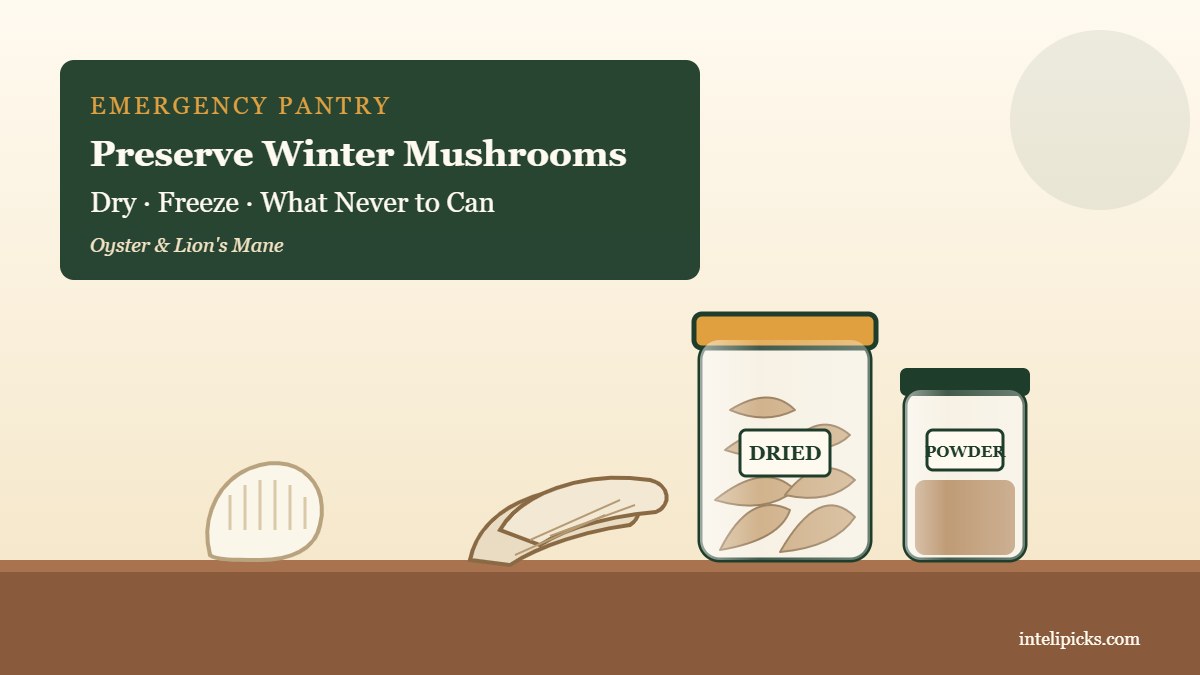
Found a flush of winter oyster mushrooms or a fresh lion’s mane on a dead hardwood? Fresh wild mushrooms only last a few days in the fridge, so the real question is how to keep them — safely — for the weeks and months ahead.
This guide is built around one idea most mushroom articles ignore: a freezer only protects your food while the power is on. When a winter storm knocks out electricity, dried mushrooms in a jar keep going. Below you’ll find what official food-preservation guidance actually says about drying, freezing and canning wild mushrooms, how oyster and lion’s mane behave differently, and four short recipes to use what you’ve saved.
Short answer
Dry them for your emergency pantry — dried oyster and lion’s mane mushrooms keep for months with no electricity. Cook or steam-blanch before freezing (never freeze lion’s mane raw), and remember a freezer only stays safe for about 24–48 hours in an outage. Never home-can or shelf-pickle wild mushrooms: Extension services advise against it because of botulism and toxin risks.
Safety first: only preserve mushrooms you have identified with 100% certainty. Cooking, freezing and drying do not destroy the toxins in poisonous mushrooms. And skip velvet foot (Flammulina velutipes) entirely as a beginner — it grows on the same winter wood as the deadly Galerina marginata. See our winter foraging guide for identification basics.
Drying vs. Freezing vs. Canning: Quick Comparison
| Winter oyster (Pleurotus ostreatus) | Lion’s mane (Hericium erinaceus) | |
|---|---|---|
| Drying | Excellent. Dries fast; tough stems make great mushroom powder. | Good, but tear into thin strips — it holds a lot of water. |
| Freezing | Best after a quick sauté or steam blanch. Experienced foragers report oysters also tolerate freezing raw. | Cook first, squeeze out the water, then freeze. Don’t freeze it raw. |
| Canning / pickling for the shelf | No. Extension services advise against home canning wild mushrooms. | No. Same rule. |
| Works in a power outage? | Dried: yes. Frozen: only while the freezer stays cold. | Dried: yes. Frozen: only while the freezer stays cold. |
Why Dried Mushrooms Beat the Freezer in an Emergency
What happens to frozen mushrooms when the power goes out
According to USDA guidance shared by university Extension services, a full freezer holds a safe temperature for about 48 hours with the door closed, and a half-full freezer for about 24 hours. A closed refrigerator keeps food cold for only about 4 hours.
When the power comes back, frozen food can be refrozen if it still contains ice crystals or reads 40°F or below. If you’re not sure, throw it out. For a full checklist, see Is the Food in My Fridge Still Safe After a Power Outage?
Dried mushrooms don’t need electricity
Properly dried mushrooms sit on a shelf in a jar with no power at all. That makes them one of the few wild foods that belong in an emergency pantry.
How long do they last? Be realistic. The National Center for Home Food Preservation says dried foods generally keep from about 4 months to a year, that cooler storage lasts longer, and that dried vegetables keep about half as long as dried fruit. In practice, plan on several months in a cool, dark cupboard — and store them in the freezer when the power is on if you want them to last longer. Rotate your stock.
Mushroom powder: a low-fuel trick for outages
Dried mushrooms still need to be cooked before you eat them. But grinding them into powder means they cook into a soup, rice or pasta in the same few minutes as everything else in the pot — useful when you’re cooking on a camp stove and saving fuel.
How to Dry Oyster and Lion’s Mane Mushrooms
- Clean gently. Brush off debris and trim the woody base. Don’t soak them.
- Cut thin. Slice oysters about 1/4 inch thick; tear lion’s mane into thin strips. Washington State University Extension recommends a layer no more than 1/2 inch deep on the trays.
- Don’t cook them in oil first. No blanching is needed, and fat can go rancid during storage.
- Dry low and slow. WSU Extension and Oregon State Extension use about 120°F in a dehydrator, for roughly 8–10 hours (thick lion’s mane can take longer). In an oven, use the lowest setting with the door slightly open, and expect it to take longer and need more attention.
- Test for “cracker-dry.” Dried vegetables should be brittle or crisp. If a piece bends instead of snapping, keep drying — leftover moisture invites mold.
- Cool, then pack. Use clean glass jars with tight lids (moisture is easy to spot through glass), in small batches so you don’t reopen the same jar again and again. Store cool, dark and dry. If you see condensation in the jar, dry them again.
Tip: Don’t throw out tough oyster stems. Dry them until brittle and grind them in a coffee grinder for umami-rich mushroom powder.
Using dried mushrooms: rehydrate in hot water or broth, then cook them thoroughly. Strain and use the soaking liquid in soups and sauces.
How to Freeze Them Without Ruining the Texture
University Extension guides recommend heat-treating mushrooms before freezing — either a short steam blanch or a light sauté. Oregon State Extension calls sautéing the preferred method for many varieties.
Method 1: Sauté and freeze (best for flavor)
- Cook the mushrooms in a dry or lightly oiled pan until their liquid evaporates and they’re nearly done.
- For lion’s mane, let it cool and squeeze out the water before freezing.
- Cool quickly, pack in freezer bags with the air pressed out, label and freeze. Freeze bags flat so they thaw fast.
Method 2: Steam blanch (best for plain mushrooms)
- Dip the mushrooms in a solution of 1 teaspoon lemon juice (or 1½ teaspoons citric acid) per pint of water to limit darkening.
- Steam for a few minutes depending on size — Extension charts vary slightly; WSU lists about 3 minutes for slices and 5 for whole mushrooms.
- Cool in ice water, drain well, pack and freeze at 0°F or below.
Why not freeze lion’s mane raw?
Lion’s mane is like a sponge. Experienced forager and chef Alan Bergo (Forager Chef) reports that raw-frozen lion’s mane turns yellow and develops a bitter flavor that cooking doesn’t fix. Oysters are more forgiving, but cooking first still gives you a better texture.
Cook from frozen: add frozen mushrooms straight to a hot pan, soup or sauce. There’s no need to thaw them on the counter.
What Never to Can (and Why)
Home-canned mushrooms are a classic prepper item — but not wild ones.
- UC Master Food Preservers warn that wild mushrooms may contain toxins that canning won’t destroy, and that their density and texture differences could affect the safety of the canned product.
- Oregon State Extension states that only domestically grown button mushrooms may be safely canned, using a pressure canner and a tested recipe. Other types should be frozen or dried.
- Mushrooms are a low-acid food, which is why improper canning carries a botulism risk.
Watch out for blog recipes that water-bath can wild mushrooms in vinegar, or store them in oil on the counter. Neither follows tested, research-based guidance. If you make mushrooms in oil, keep them in the refrigerator and use them quickly — never store them at room temperature.
Short-Term Storage: Paper, Not Plastic
Keep fresh, unwashed wild mushrooms in a paper bag in the refrigerator so moisture can escape. Plastic traps moisture and turns them slimy. Use or preserve them within a few days.
4 Bonus Recipes
1. Pan-browned winter oysters
Tear 8 oz of oyster mushrooms into strips. Cook in a hot, dry pan for a few minutes until their water evaporates, then add 2 tablespoons of butter or oil and cook until golden and fully cooked through. Add one minced garlic clove and a pinch of thyme in the last minute so the garlic doesn’t burn. Salt and pepper to taste.
2. Freezer-friendly lion’s mane “crab” cakes
Shred about 1 lb of lion’s mane into fine strips and dry-sauté until it releases its water. Cool and squeeze it dry. Mix with 1 beaten egg, about 1/2 cup breadcrumbs, 2 tablespoons mayonnaise, a spoonful of mustard or seafood seasoning, and chopped green onion. Form small patties and brown them on both sides until hot all the way through. Cooked cakes freeze well and reheat in a pan or oven.
3. Outage-ready dried mushroom soup
Pour hot water or broth over a handful of dried mushrooms (or a few spoonfuls of mushroom powder), then simmer with onion, garlic, a little fat and thyme until the mushrooms are tender and fully cooked. Add instant rice or small pasta for a filling one-pot meal on a camp stove.
4. Mushroom duxelles cubes
Finely chop fresh mushrooms (or rehydrated dried ones) and cook with a little shallot, butter and salt until all the liquid has evaporated. Cool completely and freeze in an ice-cube tray, then transfer to a freezer bag. Drop a cube into sauces, omelets or soups.
Printable Winter Mushroom Preservation Checklist
- Preserve only mushrooms you’ve identified with 100% certainty. Skip velvet foot.
- Keep fresh mushrooms in a paper bag in the fridge and process within a few days.
- Brush clean, trim woody bases, and save oyster stems for powder.
- Dry thin pieces at low heat until brittle — never stop while they still bend.
- Store dried mushrooms in glass jars, cool and dark; rotate within months.
- Cook or steam-blanch before freezing. Never freeze lion’s mane raw.
- Squeeze cooked lion’s mane dry before freezing.
- Never home-can or shelf-pickle wild mushrooms.
- After an outage, refreeze only if ice crystals remain or it’s 40°F or below.
- Always cook wild mushrooms thoroughly — fresh, frozen or rehydrated.
Bottom Line
For an emergency pantry, drying is the clear winner: dried oyster and lion’s mane mushrooms need no electricity, take little space, and turn into soup or powder in minutes. Freeze what you’ll eat soon, cook before you freeze, and leave the canner out of it.
Want to go deeper into finding and using wild foods year-round? Foraging Secrets is a practical guide worth keeping on the shelf. Check out Foraging Secrets here →
Disclosure: the link above is an affiliate link — if you buy through it, we may earn a small commission at no extra cost to you.
Sources: UC Master Food Preservers – Wild Mushrooms, Oregon State Extension – Preserving Mushrooms, Washington State University Extension – Mushrooms, Colorado State Extension – Freezing Mushrooms, NCHFP – Packaging and Storing Dried Foods, WVU Extension – Food Safety & Power Outages, Missouri Dept. of Conservation – Velvet Foot, Forager Chef – How to Freeze Wild Mushrooms.
This article is general food-safety information. Only eat wild mushrooms you have identified with certainty, and follow your local Extension office’s guidance.