The lights come back on, the fridge starts humming again, and now you’re standing in front of it wondering what to keep. Throw out too little and you risk a bad night. Throw out too much and you’ve binned a few hundred dollars of groceries for nothing. Here’s how to decide, item by item, using the rules the USDA, FDA and CDC actually publish.
Short answer
A closed fridge keeps food safe for about 4 hours. A full freezer holds for about 48 hours, a half-full one for about 24. After 4 hours without power, throw out perishables like meat, milk, eggs, leftovers and cut produce, unless a thermometer shows the fridge stayed at 40°F or below. Freezer food with ice crystals left can be refrozen. Hard cheese, butter, condiments and whole fruit and vegetables are usually fine.
The two numbers that matter: 4 hours and 40°F
Bacteria that make people sick grow fast between 40°F and 140°F. In that range they can double in about 20 minutes. Your fridge’s job is to keep food below 40°F, and a closed fridge can only hold that line for roughly 4 hours once the power is gone.
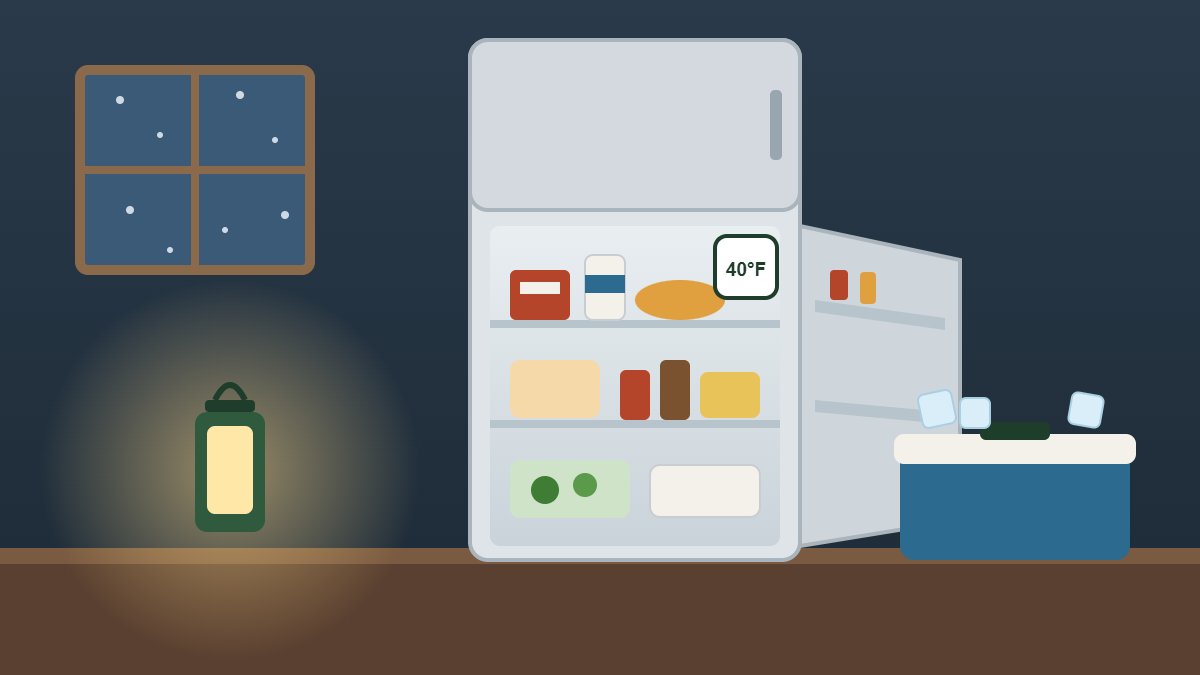
So the official rule is simple: after 4 hours without power, discard refrigerated perishables. The one exception is if you can prove the food stayed cold. An appliance thermometer that still reads 40°F or below means the food is fine, even if the outage ran longer. That’s why a $5 thermometer is the best outage gear you can own.
A lot of people read “4 hours” in one place and “2 hours above 40°F” in another and try to add them up. Don’t. The 2-hour rule is about food that’s already warm. If you don’t have a thermometer, use 4 hours as your line.
How to check the temperature (your hand will lie to you)
- Best: a dial or digital appliance thermometer that lives in the fridge and another in the freezer. Read it the moment the power comes back.
- No appliance thermometer? Use a food thermometer. Slide the tip between two packages, or put it in a glass of water or a carton of milk that’s been in the fridge. Liquid tells you the real food temperature better than the air does.
- Don’t trust touch. Your fingertips are around 90°F, so a package sitting at 50°F still feels cold. Don’t trust the door display either, check an actual thermometer.
- Don’t keep opening the door to check. Every peek lets the cold air spill out and shortens the 4-hour window.
Keep or toss: the fridge, item by item
This follows the FoodSafety.gov chart for food that’s been above 40°F for more than 2 hours. Check each item separately.
| Food | Usually keep | Toss |
|---|---|---|
| Meat, poultry, fish | — | Raw or cooked, thawing meat, deli meats, hot dogs, bacon, sausage, opened canned meat or fish, meat and egg salads |
| Leftovers | — | Casseroles, soups, stews, pizza, cooked pasta, rice and potatoes, gravy, stuffing |
| Dairy and eggs | Butter, margarine | Milk, cream, sour cream, yogurt, eggs and egg dishes, custards, puddings, opened baby formula |
| Cheese | Hard cheese (cheddar, Swiss, Parmesan, provolone), processed cheese, grated Parmesan in a jar | Soft and fresh cheese (brie, cream cheese, mozzarella), shredded cheese, low-fat cheese |
| Fruit | Whole fresh fruit, opened juice, opened canned fruit, dried fruit | Cut fresh fruit |
| Vegetables | Whole raw vegetables, fresh mushrooms, herbs | Cut vegetables, pre-washed greens, cooked vegetables, baked potatoes, garlic in oil, potato salad |
| Sauces | Ketchup, mustard, relish, pickles, olives, peanut butter, jelly, soy, Worcestershire, barbecue and hoisin sauce, opened vinegar dressings | Opened creamy dressings, opened spaghetti sauce, fish and oyster sauce. Opened mayo, tartar sauce and horseradish if above 50°F for over 8 hours |
| Bread and baking | Bread, rolls, muffins, tortillas, bagels, fruit pies | Refrigerator biscuit and cookie dough, cheesecake, cream-filled pastries, pies with egg or milk filling |
Want this on your fridge before the next storm? Download the 1-page printable food card (PDF). No sign-up.
Notice how much stays. Condiments, hard cheese and butter make up a surprising share of the average fridge, and people often toss them in a panic. If you’re short on cooler space, those are the things that can stay behind in the warm fridge.
Two rules on that list look odd at first. Shredded cheese goes while a block of the same cheese stays, because shredding gives it far more surface and a lot more handling. And US store eggs are washed before they’re sold, which removes their natural protective coating, so they need to stay cold.
Why “it smells fine” doesn’t count
The bacteria that make milk sour and meat slimy are mostly harmless spoilers. The ones that make you sick, like Salmonella, Listeria and E. coli, don’t change the smell, taste or look of food. That’s why every agency says the same thing: never taste food to decide if it’s safe.
Cooking it well done doesn’t rescue it either. Some bacteria leave behind toxins while the food sits warm, and those toxins survive cooking. If an item is on the toss list, toss it.
The freezer: what you can refreeze
A closed freezer holds a safe temperature for about 48 hours if it’s full and about 24 hours if it’s half full. When the power comes back:
- Food that still has ice crystals or is at 40°F or below can be refrozen or cooked. Meat that’s soft on the outside but hard in the middle counts.
- Refrozen food is safe, but the texture may suffer, especially fruit, vegetables and ready meals.
- Ice cream and frozen yogurt are the exception: if they thawed, throw them out.
- Anything that thawed and sat above 40°F for more than 2 hours goes in the trash.
You were away and don’t know how long it was out
This is the tricky one. The power may have been off for a day and come back hours before you got home, so everything in the freezer is frozen solid again. Look for clues:
- Ice cubes in the ice maker bin have melted into one solid block.
- Frozen drips of meat juice on the freezer floor or at the bottom of packages.
- Bags of peas or berries frozen into one brick instead of loose pieces.
Any of those means the freezer thawed for a long time. A simple trick for next time: freeze a cup of water, put a coin on top and leave it in the freezer. If you come home and the coin has sunk to the bottom, the freezer thawed and refroze. It’s not an official test, just a cheap warning sign. When you can’t tell, the official advice is short: when in doubt, throw it out.
The power kept flickering on and off
Time above 40°F adds up. Fifteen minutes of power doesn’t reset the clock if the food was already warm. If the outage came and went all night, trust the thermometer, not the count of hours. If the lights are flickering every few minutes, it’s kinder to the compressor to unplug the fridge and plug it back in once the power is steady.
Insulin and other medicines in the fridge
Most food articles skip this, but for many homes it’s the most expensive thing in the fridge. FDA guidance says insulin can generally be kept at room temperature, between 59°F and 86°F, for up to 28 days. Other medicines, like injector pens, eye drops and liquid antibiotics, have their own limits, and they’re printed on the label or package insert. When in doubt, call your pharmacist before you throw anything out or use it. Never use medicine that froze or got very hot.
Winter outages: don’t put food in the snow
It’s tempting to set the groceries on the porch when it’s 20°F outside. The USDA advises against it. Outdoor temperatures swing, the sun warms containers even on cold days, and animals get into things. A better use of the cold: fill jugs or buckets with water, let them freeze outside, then put them in the fridge or a cooler.
If floodwater reached the kitchen, the rules are stricter: food that touched floodwater goes, even in screw-cap or snap-lid containers. See what to do in a power outage during a flood.
Before the next outage
- Put an appliance thermometer in the fridge and one in the freezer.
- Keep a few frozen water jugs in the freezer. They fill empty space, and you can move them to the fridge when the power goes out.
- Keep a cooler and know where to buy ice. Food in a cooler stays safe as long as the ice keeps it at 40°F or below.
- Group freezer food together. Packed items stay cold longer than scattered ones.
- For long outages, the USDA says about 50 pounds of dry or block ice keeps a full 18-cubic-foot freezer cold for about two days. Handle dry ice with gloves, never touch it bare-handed, and keep the room and the car ventilated.
Keeping the fridge running instead
The other way out of this whole problem is to keep the fridge powered. A typical modern fridge draws about 150 watts while the compressor runs and uses roughly 1,200 Wh a day. When the compressor starts, it pulls several times that for a second, so a small power station can shut off even though its rating looks big enough. You don’t need to run it nonstop either: plug it in long enough to pull the temperature back down, then check the thermometer. For the numbers on a typical setup, see how long a 1000Wh power station runs a fridge.
How much backup power would your fridge need?
Tick the fridge, freezer and anything else you’d want running, pick the outage length, and the free calculator shows the battery size, the watts and the startup surge you’d need. It takes about 30 seconds.
Generator safety: run a generator outdoors only, at least 20 feet from the house, with the exhaust pointed away from doors and windows. Never run it in a garage, basement or shed, even with the door open. Keep a working carbon monoxide alarm inside. Plug the fridge into the generator with a heavy-duty outdoor extension cord, and never plug a generator into a wall outlet.
Will insurance pay for the food?
Sometimes. Many homeowners and renters policies cover spoiled food after a utility outage up to a set limit, often a few hundred dollars, and the rules for what caused the outage vary by policy. Before you throw anything out, take photos of the food in the fridge and in the trash bags, write a quick list with rough prices, and save the outage alert from your utility. Then ask your agent whether a small claim is worth filing. Claims usually stay on your insurance history (the CLUE report) for years, and depending on your insurer, a small one can affect renewal discounts.
The 30-second version
Keep the doors closed. Fridge: 4 hours, then toss the perishables unless the thermometer says 40°F or below. Freezer: refreeze anything with ice crystals, toss thawed ice cream. Keep the hard cheese, butter and condiments. Never taste to test. And put a thermometer in both compartments this week, so next time you don’t have to guess.
Sources: FoodSafety.gov, USDA FSIS, CDC, FDA.
This article is general information, not medical or professional safety advice. Follow the guidance of your local health and emergency authorities, and ask your pharmacist about medicines.