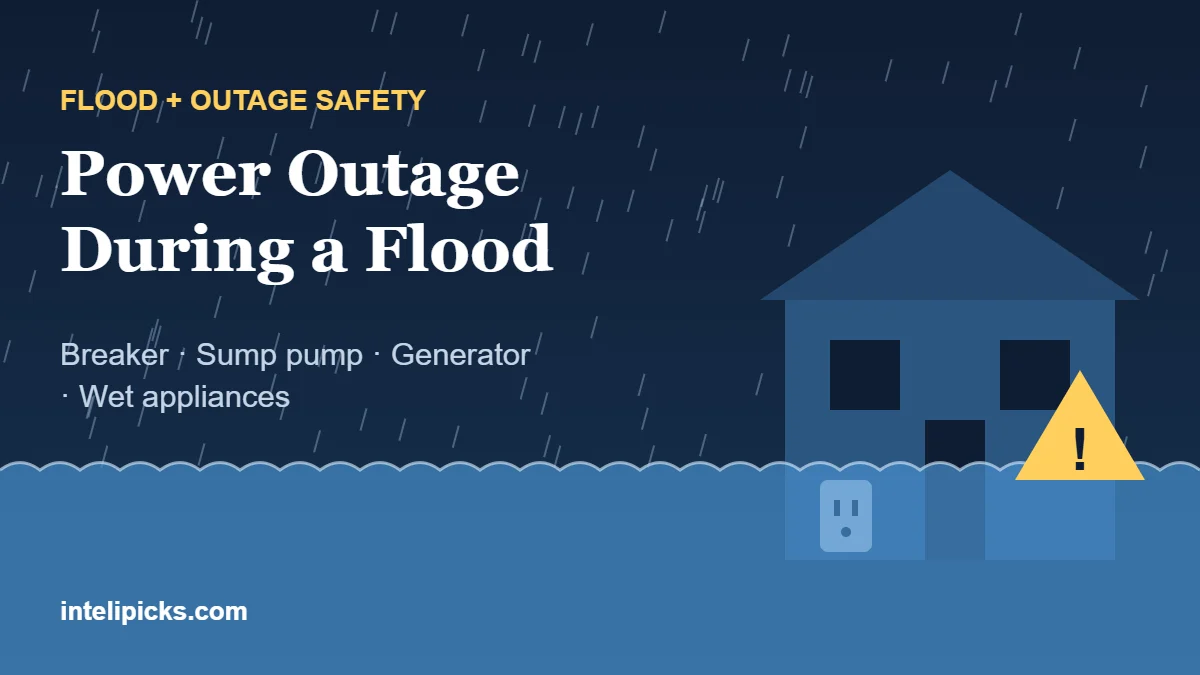
When the power goes out during a normal storm, you find a flashlight and wait. When it goes out while water is coming into the house, the rules change. Water and electricity together can kill, and the dark makes it harder to see where the water is. This guide covers what to do before the water comes in, while it is rising, and after it goes down, for homes in the US and Canada.
Short answer
Turn off the main breaker only while the floor and the area around the panel are completely dry. If there is any water near the panel, outlets or cords, stay out of that area and call your electric utility. Run a generator only outside, at least 20 feet from doors, windows and vents, and never in a flooded basement or garage. After the flood, keep the power off until a licensed electrician has checked the wiring, and don’t use any furnace, water heater or appliance that sat in water until a professional says it is safe.
Why a flood outage is different
A dark house is not a safe house. Power can still reach a flooded basement through your panel, a generator connected the wrong way, or a downed line outside. Submerged outlets and extension cords can energize standing water. Ready.gov’s flood guidance puts it plainly: don’t touch electrical equipment if it is wet or if you are standing in water, and turn off the electricity only if it is safe to do so.
Floods and outages often arrive together. In early November 2026, a series of storms in British Columbia caused outages for nearly 415,000 BC Hydro customers, while heavy rain flooded parts of the coast. In September 2026, Tropical Storm Edouard flooded Southeast Texas and left about 80,000 Entergy Texas customers without power at its peak. And as this is written, California is in the middle of back-to-back atmospheric rivers.
Before the water comes in: the dry-floor rule
If water is forecast or starting to rise outside, and your panel is in a dry spot, turning the power off early is the safest move. Public Safety Canada says to shut off electricity only if flooding has not started yet and the area around the panel is completely dry. The Electrical Safety Foundation International (ESFI) gives the order: switch off each individual breaker first, then the main breaker.
- Check the floor. Dry floor, dry hands, dry shoes. If any of those is wet, stop here.
- Bring a flashlight, not a candle.
- Flip the individual breakers off one by one, then the main breaker.
- Move what you can upstairs: small appliances, extension cords, power strips, chargers and anything with a lithium-ion battery.
- Leave the panel alone after that. Don’t go back to it once water is in the room.
One trade-off to know about: turning off the main breaker also turns off an electric sump pump. If your sump pump is the only thing keeping water out, read the sump pump section below before you decide, and have a backup plan ready.
If there is water near the panel, don’t touch it. The CDC says that if you would have to step into standing water to reach the main switch, call an electrician instead. Canada’s guidance is stricter: don’t attempt to shut off electricity if any water is present. Leave the area and call your electric utility, which can cut power at the meter or the street. Call 911 if you see sparks, smell burning, or someone has been shocked.
While the water is rising
- Stay out of flooded rooms, especially basements, if outlets, cords, a furnace or the panel are under or near the water.
- Treat every downed line as live. BC Hydro tells people to stay at least 10 metres (about 33 feet) away from downed or damaged power lines, and to assume they are live.
- Don’t walk or drive through moving water. Ready.gov notes that six inches of moving water can knock you down and one foot can sweep a vehicle away.
- Use flashlights and headlamps, not candles or lanterns with flames.
- Follow evacuation orders. Before you leave, and only if it is safe, turn off gas and electricity as local officials instruct.
Sump pumps when the power is out
Many basements stay dry only because a sump pump keeps running. When the power fails in a storm, that is exactly when it stops. There are three common backups, and each has limits:
| Backup | How it works | Main limit |
|---|---|---|
| Battery backup pump | A second 12V pump with its own battery and float switch takes over when the power fails | Runs for hours of continuous pumping, not days. A pump that never stops can drain the battery in an afternoon. |
| Water-powered backup pump | Uses city water pressure to pull water out of the pit, no electricity needed | Needs municipal water (not a well) and proper backflow protection. Some places restrict or discourage them; Calgary, for example, advises against potable-water powered backups. Check your local plumbing rules. |
| Generator or power station | Runs your regular AC pump through a cord plugged straight into the generator or station | The pump needs extra power to start, the generator must stay outside and dry, and the cord must never sit in water. |
How much power does a sump pump need?
Check the label on your own pump first: watts = volts × amps. As a rough guide, utility and generator sizing charts list a 1/3 HP sump pump at about 800 running watts and 1,300 starting watts, and a 1/2 HP pump at about 1,050 running watts and 2,200 starting watts. Real pumps vary by model, so the label wins over any chart.
The starting number matters. A generator or portable power station has to handle the surge when the motor kicks on, even if it can carry the running load easily.
How long will a power station keep it running?
It depends far more on how often the pump runs than on the battery size. Here is our own worked example for a 2,000 Wh power station and a pump drawing about 800 watts while running. We assume about 85% of the battery is usable after conversion losses, which gives roughly 1,700 Wh, or a little over 2 hours of actual motor run time.
| How hard it’s raining | Pump runs about | Roughly how long the station lasts |
|---|---|---|
| Light, steady rain | 5 minutes every hour | About 25 hours |
| Heavy rain | 10 minutes every hour | About 12 hours |
| Severe inflow | 20 minutes every hour | About 6 hours |
| Pump never stops | 60 minutes every hour | About 2 hours |
These are estimates, not promises. Lift height, an old battery, and cold temperatures all shorten run time. The useful habit is to time your pump during the next heavy rain: how many minutes per hour does it actually run? Our power station run time guide walks through the same math for a fridge.
Signs the pump is losing the fight
- The water level in the pit keeps rising while the pump runs.
- The motor hums but no water comes out of the discharge pipe.
- It runs nonstop, or turns on and off every few seconds.
- The breaker or GFCI outlet trips when it starts.
- A backup alarm is sounding.
If you see these, don’t reach into a wet pit or handle cords in standing water. Move people and valuables upstairs and treat it like the “water near the panel” situation above.
Using a generator during a flood
Generators save sump pumps and freezers in a flood outage, but they also cause deaths every year. CPSC says to use portable generators outside only, at least 20 feet from doors, windows and vents, and to install battery-operated CO alarms.
- Never run it in a basement, garage or shed, even with the door open, and never in a flooded area.
- Keep it dry. Put it on a dry, level surface under an open canopy that doesn’t trap exhaust. If you can’t keep it out of the rain or water, don’t run it.
- Plug appliances straight into the generator with outdoor-rated, three-prong cords, and keep the cords out of puddles.
- Never plug the generator into a wall outlet. The CDC notes that connecting a generator to home circuits without an approved transfer device is against electrical codes. It can also energize utility lines and injure line crews.
- Have working CO alarms on every level. Our guide to carbon monoxide alarms in an outage explains placement, and this one covers running a generator in winter weather.
After the water goes down
1. Keep the power off until an electrician checks it
Even if your street has power again, a flooded panel, outlets or wiring can short or start a fire when re-energized. The CDC says to have an electrician check the house’s electrical system before turning the power on again, and ESFI says to keep the power off until it has been inspected. In some places, the utility or a local inspector must approve the reconnection.
2. Don’t relight or restart flooded appliances
Floodwater leaves silt inside gas valves and controls, and they can fail later even if they seem to work now. CPSC’s flood guidance says to replace gas control valves, circuit breakers and fuses that have been under water. The heating industry association AHRI says valves and controls touched by floodwater must be replaced, and that the decision to repair or replace the rest of the unit should be made by a qualified professional. Until then:
- Don’t relight the pilot on a flooded water heater, furnace or boiler.
- Don’t plug in a flooded fridge, washer, dryer or space heater.
- If you smell gas, leave, keep lights and switches off, and call the gas company from outside.
3. Get batteries out of the house
Laptops, power tools, e-bikes and power stations with lithium-ion batteries can catch fire after being submerged, sometimes days later. NFPA’s advice is to disconnect them from their chargers, place them in a non-combustible container, store them outside the building, and ask the fire department or manufacturer what to do next.
4. Pump out a flooded basement slowly
It sounds backwards, but draining a flooded basement too fast can damage it. Public Safety Canada advises removing water in stages, about one third of the volume per day, because if the ground outside is still saturated, the walls or floor can buckle.
5. Food and water
- Throw out any food that touched floodwater. The CDC includes containers with screw caps, snap lids, crimped caps, twist caps and flip tops, home-canned food, and cans that are bulging or damaged. Wooden cutting boards, baby bottle nipples and pacifiers that touched floodwater go too.
- Fridge and freezer: with the doors closed, a fridge keeps food cold for about 4 hours, a full freezer about 48 hours and a half-full one about 24 hours. Our guide to food safety after an outage has the full list.
- Private well: if floodwater may have reached your well, drink bottled water. The CDC advises boiling or using another water source until the well has been tested, and waiting at least 7 to 10 days after disinfection before testing. Don’t switch on a flooded well pump yourself. It needs a well or pump contractor.
- City water: follow any boil-water notice. It helps to have stored drinking water on hand before flood season.
6. Dry out within 24 to 48 hours
The CDC says that if your home could not be dried within 24 to 48 hours, you should assume there is mold. Throw away anything that was wet with floodwater and can’t be cleaned and fully dried in that time. Run fans and dehumidifiers only after an electrician has said the circuits are safe, or from a generator placed safely outside.
Insurance: what to check now, not later
- US: standard homeowners and renters policies usually don’t cover flood damage. Flood coverage is a separate policy, and an NFIP policy generally takes effect 30 days after purchase, so buying one when the storm is forecast is too late.
- Canada: overland flood coverage is not automatically included in home insurance. Ask your insurer whether you have it, along with sewer backup coverage.
- After a flood: take photos and video from a safe spot before you throw anything away, keep receipts, and call your insurer early.
A 15-minute prep list for flood season
- Find your main breaker and practice the dry-floor rule with everyone in the house. Add it to your family outage plan.
- Save your electric utility’s outage and emergency numbers in your phone and on paper.
- Test the sump pump by pouring a bucket of water into the pit, and check the backup battery’s age.
- Time how many minutes per hour the pump runs in heavy rain.
- Put fresh batteries in CO alarms and flashlights.
- Store electronics, chargers and lithium-ion batteries off the basement floor.
- Check your flood or overland flood coverage.
- Keep some cash for the days when card readers are down. Here’s how much to keep.
For everything else that keeps a home going through a long outage, from water to light to heat, see our Winter Outage Kit.
Common questions
Can I turn off my breaker if there’s water in the basement?
Only if the panel and the path to it are completely dry. If you would have to step into water, or the floor around the panel is wet, don’t. Call your electric utility or an electrician instead.
The power is out and my basement is flooding. Can I plug in the sump pump?
Only if you can reach the pump’s plug and cord without standing in water, and you power it straight from a generator outside or a power station on a dry surface. If water is already near outlets or cords, leave the basement and get help.
Can I run my generator in the garage with the door open?
No. Carbon monoxide builds up even with the door open. Portable generators belong outside, at least 20 feet from doors, windows and vents.
When can I turn the power back on after a flood?
After a licensed electrician has inspected the wiring and equipment that got wet, and after any inspection or approval your utility or local authority requires.
Do I have to replace a furnace or water heater that got wet?
Not always the whole unit, but any gas valves and controls that were under water should be replaced, and a qualified technician should decide about the rest. Don’t relight or restart it yourself.
Is my well water safe after a flood?
Assume it isn’t until it has been tested. Use bottled water, contact your local health department or a well contractor, and test 7 to 10 days after the well is disinfected.
Sources
- Ready.gov: Floods
- CDC: Reentering Your Flooded Home
- CDC: Keep Food Safe After a Disaster or Emergency
- CDC: How to Disinfect Wells After an Emergency
- CDC: Homeowner’s and Renter’s Guide to Mold Cleanup After Disasters
- CPSC: Portable Generator Safety Alert
- ESFI: Flood Electrical Safety
- Public Safety Canada: Floods – Get Prepared
- Public Safety Canada: After a flood
- AHRI: HVACR Replacement Guidance
- EWEB: Generator Sizing Considerations
- City of Calgary: Climate-ready drainage and water management
- BC Hydro: Downed power line safety
- FEMA: Flood Insurance (NFIP)
- Ontario: Floods
- BC Hydro: Power restored to 99% impacted by weekend storms (Nov. 2026)
- Entergy Texas: Tropical Storm Edouard updates (Sept. 2026)