Two nights, two earthquakes, both in the small hours. At 3:25 a.m. on November 20, a magnitude 4.2 earthquake hit near Commerce, about 7 miles from downtown Los Angeles. People felt it as far away as Lancaster, about 80 miles north, and there were no immediate reports of damage (CBS Los Angeles). The ShakeAlert early warning system was activated (NBC).
Two nights earlier, a magnitude 5.7 earthquake had hit Romania at 2:48 a.m. local time on November 18. It started more than 100 km underground, in a region called Vrancea, and it was felt in six countries: Romania, Bulgaria, Moldova, Ukraine, Serbia and Turkey (The Romania Journal).
Nothing collapsed. Authorities found no material damage. But two people were hurt, and one of them was a woman whose furniture fell on her in her own home (Romania Insider). Android phones across Romania showed an earthquake alert as the shaking arrived (The Romania Journal).
That detail stayed with me. Most earthquake injuries aren’t dramatic. They happen in the dark, at home, from things we could have dealt with on a quiet Saturday afternoon.
So I went looking at how Japan handles this. Few countries live with earthquakes the way Japan does, and its official guidance has been tested by Kobe in 1995, the great Tohoku quake in 2011, Noto in 2024 and Kumamoto this summer. Some of what Japan teaches families is barely mentioned in American and Canadian guides. Below is what I’d borrow, and the few places where you should do the opposite because our homes work differently.
Short answer
During the shaking, Drop, Cover, and Hold On, even in the kitchen. Afterward, shut off the gas only if you smell or hear a leak. If you leave home after strong shaking, switch off the main breaker so a fire can’t start when power returns. Don’t flush until the drains are checked, and keep 3 to 7 days of food, water and toilet bags on hand.
A quick note: this is general guidance, not a substitute for your local utility or emergency officials. If they tell you something different, follow them.
During the shaking: protect yourself first, even in the kitchen
On this point Japan, the US and Canada all agree: Drop, Cover, and Hold On. Get under a sturdy table, protect your head and neck, and don’t run outside. Glass, bricks and roof pieces fall next to buildings first.
Japan adds one thing I hadn’t thought about. If you’re cooking when it starts, don’t reach for the stove. Japan’s Fire and Disaster Management Agency says to move away from the stove and wait until the shaking stops before turning off the flame, because pots and pans can fall and scald you (FDMA). Turn the burner off after the shaking stops. Not during.
The gas meter: here we do the opposite of Japan
This is the one place where copying Japan would cause trouble.
In Japan, the gas meter shuts the gas off by itself when it senses strong shaking, around intensity 5 on the Japanese scale. Once the shaking stops, people press a reset button on the meter and wait about three minutes while it checks for leaks (UR Japan). They can turn their own gas back on.
Most homes in the US and Canada don’t have that kind of meter. And once your gas is shut off at the meter, you can’t turn it back on yourself. A utility worker or certified technician has to do it, and after a big quake there can be a long line.
We have numbers on this. After the 1994 Northridge earthquake in Los Angeles, the gas company had 151,000 requests to restore service, and 88% of those customers had shut off their own gas when nothing was damaged (SoCalGas, via PEER). That was in January. Plenty of families went days without heat or hot water for no reason.
So the North American rule is simple:
- Shut off the gas at the meter only if you smell gas (rotten eggs), hear a hissing sound, see a broken gas line, or suspect a leak (PG&E).
- If you smell gas, get out first. Don’t touch light switches or the breaker panel on the way. Call the gas company or 911 from outside.
- Don’t shut off the gas just because you’re evacuating. FortisBC in British Columbia says this plainly; it will shut gas off itself if officials ask (FortisBC).
- Know where your meter is, and keep a 12-inch or larger adjustable wrench nearby, so you’re ready if you ever do smell gas.
The fire that starts when the power comes back
This is the lesson from Japan I’d most like you to remember, and it’s almost never explained here.
Japan has a name for it: tsuden kasai, a fire that starts when electricity is restored. During the quake the power goes out. A space heater tips over onto a blanket, a lamp falls, a cord gets pinched under a bookcase, or a fish tank splashes onto a power strip. Hours or days later, crews restore power, often while the family is staying somewhere else, and the house catches fire with nobody home.
After Kobe in 1995, investigators found that 85 of the 139 earthquake fires with a known cause were electrical, about 6 in 10. After the 2011 quake, 58 of 108 were electrical (FDMA).
Here’s what Japan recommends, adapted for our homes:
- If the power goes out after a quake, unplug space heaters, irons, hair dryers, toaster ovens and anything that fell over. Leave one light switched on so you know when power returns. Keep the fridge and freezer closed, too; here’s how long food stays safe after an outage.
- If you leave home after strong shaking, switch off the main breaker before you go, as Tokyo’s fire department advises (Tokyo Fire Department). Only do this if you don’t smell gas, and the panel is dry and easy to reach. If the panel is wet, sparking or blocked, stay away from it.
- When you come back, walk through every room first: fallen items, wet floors, crushed cords. Then turn the breakers back on and stay home for a while, watching for smoke or a burning smell.
Japan also sells “seismic breakers” that cut the power automatically during strong shaking, and the government there actively promotes them. I couldn’t find a requirement for them in US or Canadian electrical codes, so for most of us, these manual steps are the protection.
Don’t flush yet
This one surprised me most. Tokyo tells apartment and condo residents not to flush the toilet after a big earthquake until someone confirms the drain pipes are intact. If a pipe inside the building has cracked, what you flush on the 8th floor can come back up in someone’s bathroom on the 2nd (Meguro City, Tokyo). The same can happen underground in a single-family home.
The Japanese answer is a stock of emergency toilet bags. You line the toilet bowl with a bag, use it, add the absorbent powder, tie it off. Tokyo’s numbers are easy to plan with: about 5 uses per person per day, for at least 3 days and ideally 7 (Bunkyo City, Tokyo). For one person that’s 15 bags minimum and 35 for a week. For a family of four, 60 to 140.
Wait to flush until your building manager or your city says the sewer is fine.
Stock what you already eat, and check it once a year
Japan’s guidance is a minimum of 3 days of supplies, ideally a week, with about 3 liters of drinking water per person per day (Bunkyo City). US guidance says one gallon per person per day, which also covers basic washing, so the two aren’t far apart.
The part I like is how they do it. It’s called “rolling stock”: you buy a little more of the food you already eat, use the oldest first, and replace it on your next shopping trip. Nothing sits in a closet for years and expires.
Tokyo even sets aside one day a year for it. November 19 is its official Stockpile Day, a reminder for families to check what they have (Tokyo Metropolitan Government). If you’re reading this in November, that’s a good excuse to do it this week. If you want a starting list, our 2-week no-cook emergency pantry lays it out for 1, 2 or 4 people.
Shoes by the bed, and nothing tall over it
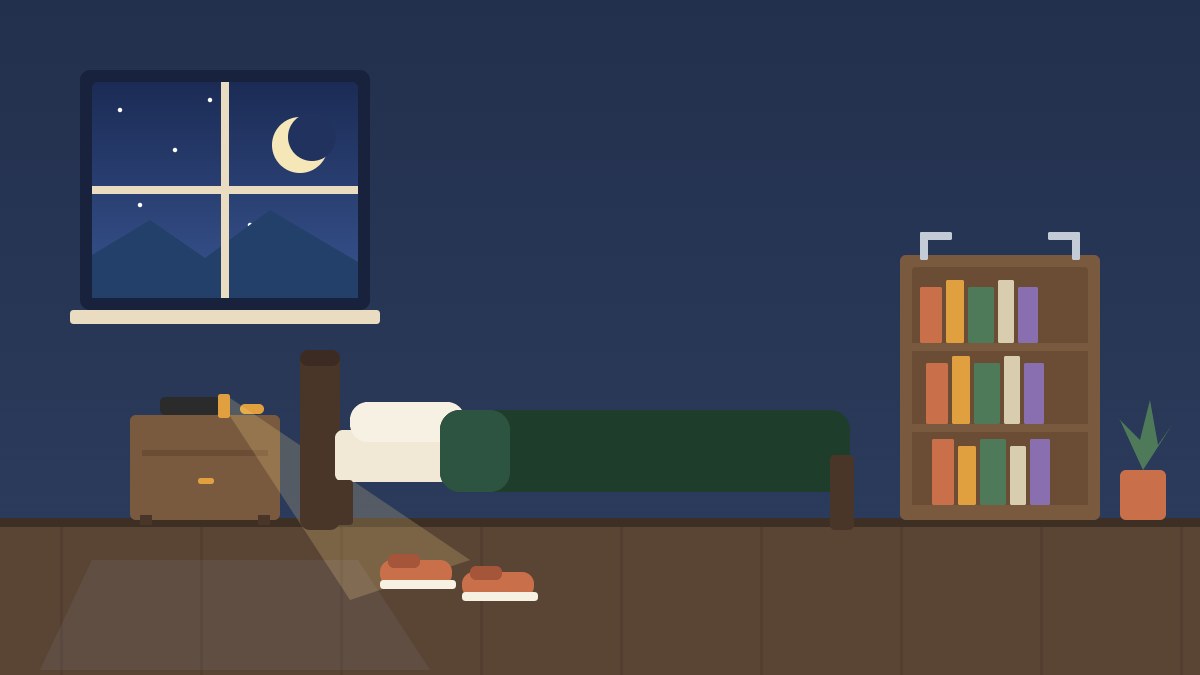
Both of this week’s earthquakes hit in the middle of the night, and an earthquake can come at any hour. When the lights go out, the floor is covered in broken glass and you can’t see it. Tokyo recommends keeping shoes or slippers and a flashlight within reach of the bed.
Look at what’s around your bed tonight. A tall bookcase, a dresser, a heavy mirror or a framed picture above the headboard can all fall on you. Move the bed, or move the furniture. Anchor tall pieces into a wall stud with an L-bracket or a furniture strap. Strap the water heater too. It’s an afternoon of work, and it’s exactly the kind of injury that woman in Romania had.
Cooking without power: one more place we don’t copy Japan
Japanese families stock a small butane cassette stove and spare canisters to cook indoors during outages. In Canada, Health Canada says portable butane stoves should never be used indoors or in confined spaces, because of carbon monoxide (Health Canada). US safety agencies say the same about camp stoves.
My suggestion: cook outside with a camp stove, well away from doors and windows, and keep a battery CO alarm on every floor. If you run a generator, the same rule applies: outside only, well away from the house (here’s how to do that safely in winter). For indoor cooking, a portable power station running an electric kettle or a small induction plate is the safer option. Our outage calculator shows how much battery that takes.
A short list for this weekend
- Find your gas meter and your breaker panel. Put a wrench near the meter, and agree on a family plan for who meets where.
- Shoes and a flashlight by every bed.
- Move or anchor anything tall that could fall on a bed.
- Move fish tanks and vases away from outlets.
- Emergency toilet bags: 5 per person per day, 3 days minimum.
- Water and food for at least 3 days, ideally a week or two, rotated as you use them.
- A battery CO alarm that keeps working in an outage on every floor.
- If you live on the West Coast, turn on earthquake alerts on your phone. In Canada, alerts now cover British Columbia, Quebec and eastern Ontario (Natural Resources Canada).
None of this takes much money. Most of it is moving things around and knowing where things are before you need them. The woman in Romania who was hurt by falling furniture in the middle of the night didn’t get a warning a week ahead. None of us will either. But we do get quiet weekends, and that’s when this work gets done.
Stay safe, and give your bedroom one good look tonight.