In February 2021, during Winter Storm Uri, almost half of Texans lost running water at some point, and the ones who lost it went without for 52 hours on average (University of Houston Hobby School). Lights and heat get most of the attention in a long outage. The bathroom is the problem nobody plans for, and by the second day it’s the one everyone is thinking about.
The good news is that most homes can still flush with a bucket of water. The part most guides skip is that some homes shouldn’t, and a few of the most common tips online are wrong for anyone on a well or a sewage pump. Here’s how to tell which home you have, and what to do in each case.
Short answer
If you’re on city sewer or a gravity septic system, pour 1 to 2 gallons of water into the bowl, slowly at first and then quickly, and the toilet will flush. If you’re on a private well, don’t run the taps or flush from the tank during the outage; use stored water instead. If your waste goes through a pump (grinder pump, basement ejector, pumped septic or an upflush toilet), keep water use to a minimum and use a bag-lined toilet, because the pump can’t move anything until the power returns.
A quick note: this is general guidance. If your water utility, health department or septic installer tells you something different, follow them.
Three questions before you pour a bucket
Whether a toilet works in an outage depends on two things: how water gets into your house and how waste gets out. Answer these three questions now, while the lights are on.
- Where does your water come from? City water usually keeps flowing for a while in a power outage, because the utility has storage and backup power. A private well stops when the pump loses power. Upper floors of tall buildings can lose water quickly too, because they depend on electric booster pumps.
- Where does your waste go? A city sewer or a conventional septic tank works by gravity and doesn’t need electricity. A grinder pump, a basement sewage ejector, a septic system with a pump or an aerobic treatment unit all stop working without power (LSU AgCenter).
- What kind of toilet do you have? A standard tank toilet flushes by gravity. A macerating or “upflush” toilet, the kind often found in basement bathrooms, needs electricity, and the maker of the best-known brand says not to use it or anything connected to it until the power is back (Saniflo).
If you’re not sure about the second question, look for a small control panel with an alarm light near your house or in the yard, or a sealed pit with a lid in the basement floor. Either usually means there’s a pump.
On city sewer or gravity septic: flush with a bucket
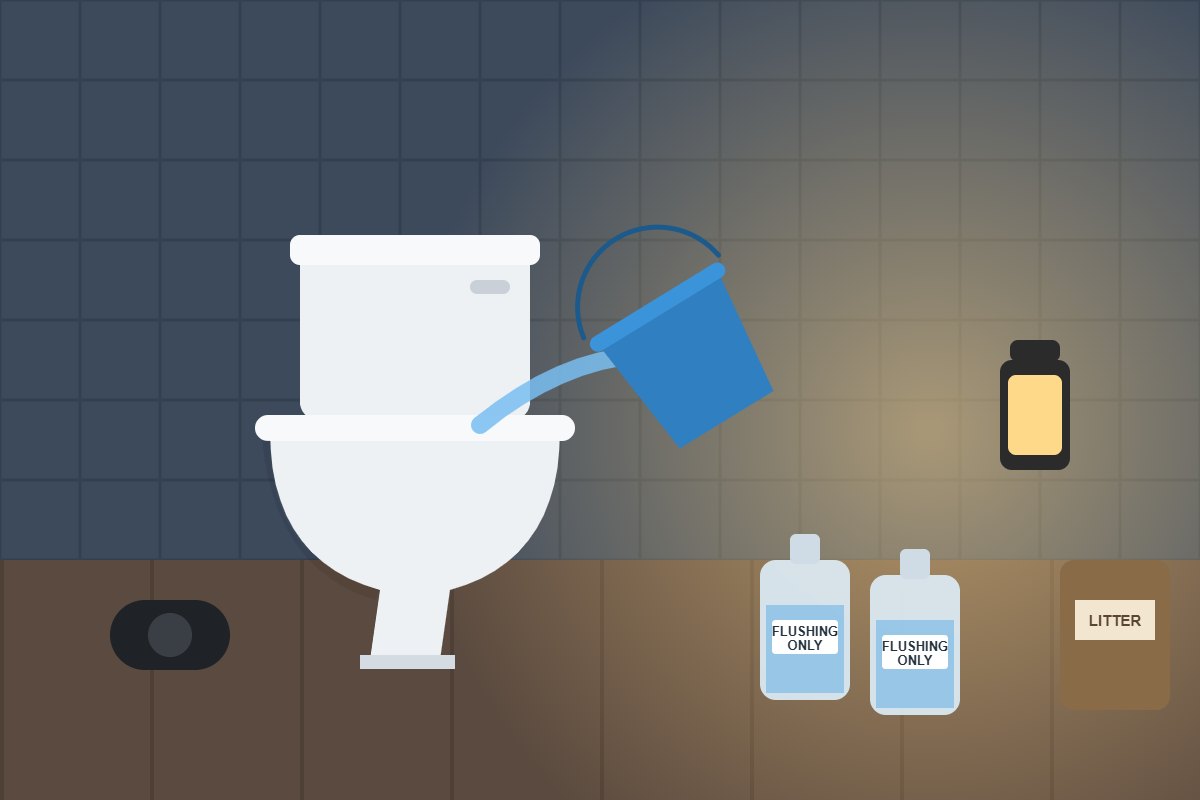
This is the easy case. A gravity toilet doesn’t need electricity, only water. As long as the tap water is running, flush normally. If the water stops, you can do the tank’s job yourself.
The National Park Service describes two ways in its bucket-flush guide (NPS):
- Pour into the bowl (simplest). Use a gallon or two; the amount varies by toilet. Pour steadily at first, then faster, and the bowl will empty itself. If the water rises without draining, stop. Afterward, add a little water slowly so the bowl keeps its normal water level, which blocks sewer smells.
- Fill the tank (clean water only). Close the supply valve behind the toilet, flush once to empty the tank, pour clean water up to the line below the overflow tube, and use the handle as usual. Remember to reopen the valve when the water comes back.
One rule matters here: water you’ve already used, like bath or dishwater, goes only into the bowl, never the tank. Soap and debris can foul the tank’s valves (New Mexico State University Extension). And skip greasy dishwater altogether; fat hardens in pipes.
On a private well: don’t run the taps
This is where a lot of online advice goes wrong. You’ll often read that a well’s pressure tank still holds enough water for a few days of flushing. Health Canada says the opposite. Normally the pump keeps your pipes under pressure, and that pressure stops contaminants from getting in. During a power outage, Health Canada says not to open faucets, take showers or flush toilets, because using the stored water depressurizes the system and raises the chance of contamination (Health Canada). Michigan gives the same advice for extended outages (Michigan DEQ).
There’s also less water in that tank than most people think. Only part of a pressure tank holds usable water; the rest is air. Penn State Extension’s examples put it at about 8 gallons in a 42-gallon tank and about 16 gallons in an 82-gallon tank (Penn State Extension). That’s a handful of flushes, not days.
So on a well, plan to flush with stored water poured into the bowl, the same way as above. If your system did lose all its pressure, or no water came out of the taps, have the water tested before you drink it again. Our guide to well pumps and power outages covers how much water a pressure tank really holds, what size generator your pump needs and how to restart safely.
A generator can run a well pump, but many well pumps run on 240 volts, so have an electrician set up the connection instead of improvising one. Our guide to running a generator safely in snow and cold covers placement and carbon monoxide.
If your waste goes through a pump: use as little water as you can
Grinder pumps, basement ejector pumps and pumped septic systems all collect waste in a small tank and push it out with an electric pump. With no power, that tank just fills. Utilities and pump makers all say the same thing: during an outage, keep water use to an absolute minimum, or sewage can back up into the lowest drain in your house (Liberty Pumps).
How much room is in that tank varies a lot. Some towns say a grinder pump holds enough for about half a dozen flushes; others say most of a day of light use. Since you can’t see inside it, assume it’s small. Pouring buckets into the toilet won’t help here; it fills the tank faster.
For pumped septic systems, King County, Washington, suggests not flushing every time for liquid waste, skipping laundry and keeping showers short. It also says to turn the septic pump’s breaker off while the power is out, so the pump doesn’t push a flood of wastewater into the drainfield the moment power returns (King County). If you have a grinder pump on a city system, check with your utility first; some ask you to leave its power and alarm alone.
In these homes, a bag-lined toilet (below) is usually the better plan from the start.
How much water you’ll need for flushing
More than most emergency kits hold. The usual advice of a gallon of water per person per day is meant for drinking and basic hygiene, not toilets. The EPA assumes about 5 flushes per person per day (EPA WaterSense), and how much each flush takes depends on the age of your toilet: 1.6 gallons for most toilets made since 1994, 1.28 or less for WaterSense models, and about 3.5 for many older ones (EPA).
| Toilet | 1 person, 1 day | 1 person, 3 days | Family of 4, 3 days | Family of 4, 7 days |
|---|---|---|---|---|
| WaterSense (1.28 gal) | about 6.5 gal | about 19 gal | about 78 gal | about 181 gal |
| Standard since 1994 (1.6 gal) | about 8 gal | about 24 gal | about 97 gal | about 226 gal |
| Older (3.5 gal) | about 18 gal | about 53 gal | about 212 gal | about 495 gal |
Those numbers assume normal flushing. In a real outage you’ll use far less if you don’t flush every time for urine, which is what most outage guides suggest anyway. Treat the table as an upper limit, not a shopping list. For drinking water, see how to store drinking water for a winter power outage.
Where to get flushing water
- The bathtub. If an outage is coming, Ontario suggests filling the tub so you can use the water to flush (Ontario), and New York’s health department says the same (NY State Department of Health). A standard tub holds a lot of flushes. If you have small children, think twice: a toddler can drown in very little water, so keep the bathroom door closed and locked, or fill lidded buckets instead.
- Buckets and jugs filled ahead of time. Label them “flushing only” so nobody drinks from them.
- Rain or snow. Melted snow works for the bowl. Melt it on a working stove or in a warm room, never with a camp stove or grill indoors; those make carbon monoxide. Here’s how to make sure your CO alarm works in an outage.
When you shouldn’t flush at all
- The sewer may be broken. After an earthquake, a flood or a sewer main break, flushing can push sewage back into your home or the street. Utah’s Ivins city guide is blunt: if the sewer main isn’t working, don’t flush (City of Ivins). Wait for word from your city or utility.
- Drains are slow or gurgling, or water comes up in the shower or basement drain. Stop using water right away; the system is full.
- Your pipes froze or burst. Shut off the main valve and deal with that first. See how to keep pipes from freezing when the power goes out.
- A “Do Not Use” water notice. This is rare and different from a boil-water notice. Under a boil-water notice you can flush as usual; there’s no need to disinfect water used for flushing (NY State Department of Health). Under “Do Not Use,” don’t use tap water at all.
If you’re on septic and the drainfield is under floodwater, don’t use the system; our guide to power outages during a flood covers the rest of the house.
If you can’t flush: a bag-lined toilet
When flushing isn’t safe, your own toilet still makes the most comfortable emergency toilet. Several local health departments describe the same method (Ivins, Seattle Public Utilities, Loma Linda University):
- Scoop as much water out of the bowl as you can. Don’t flush it if the sewer might be damaged.
- Line the bowl with a heavy-duty garbage bag, doubled, tucked under the seat. A 5-gallon bucket with a seat works the same way.
- After each use, add a little kitty litter or sawdust, or a splash of liquid bleach mixed 1 part to 10 parts water. Never use dry bleach, and never mix bleach with ammonia or other cleaners.
- Tie the bag off when it’s about half full and store it in a lidded trash can outside, away from food, water, kids and pets. Rules for throwing these bags away differ from town to town, so check before you put them out with the trash.
Wash your hands every time, or use hand sanitizer if water is short. Japan plans for this more seriously than most places; we covered how much they stock in what Japan teaches about the first hours after an earthquake.
When the power comes back
- Well: let the water run for a few minutes to clear stagnant water from the lines. If the system lost all its pressure, test the water before drinking it (Health Canada).
- Septic pump: don’t just flip the breaker on and walk away. King County suggests running the pump for 2 minutes, then leaving it off for 4 to 6 hours, and repeating until it shuts off on its own, while you keep conserving water (King County). Other counties use slightly different timings, so follow your installer’s instructions if you have them. Never go into the pump chamber; the gases inside can kill.
- Grinder or ejector pump: an alarm may sound briefly while the tank empties. If it’s still on after an hour or so, call your utility or a plumber.
A 10-minute check to do before winter
- Find out whether your home has a well, a pump on its sewer line, or a pumped septic system.
- Find the shut-off valve behind each toilet and the main water valve, and make sure they turn.
- Set aside two buckets, a box of heavy-duty bags and a bag of kitty litter.
- Write the steps for your type of home into your family power outage plan, so whoever is home knows what to do.
Most outages end before any of this matters. But if one lasts a few days, knowing which kind of home you have is what keeps a hard week from becoming a mess. If you want to know how long your backup power would last, our outage calculator will give you a number in a minute.