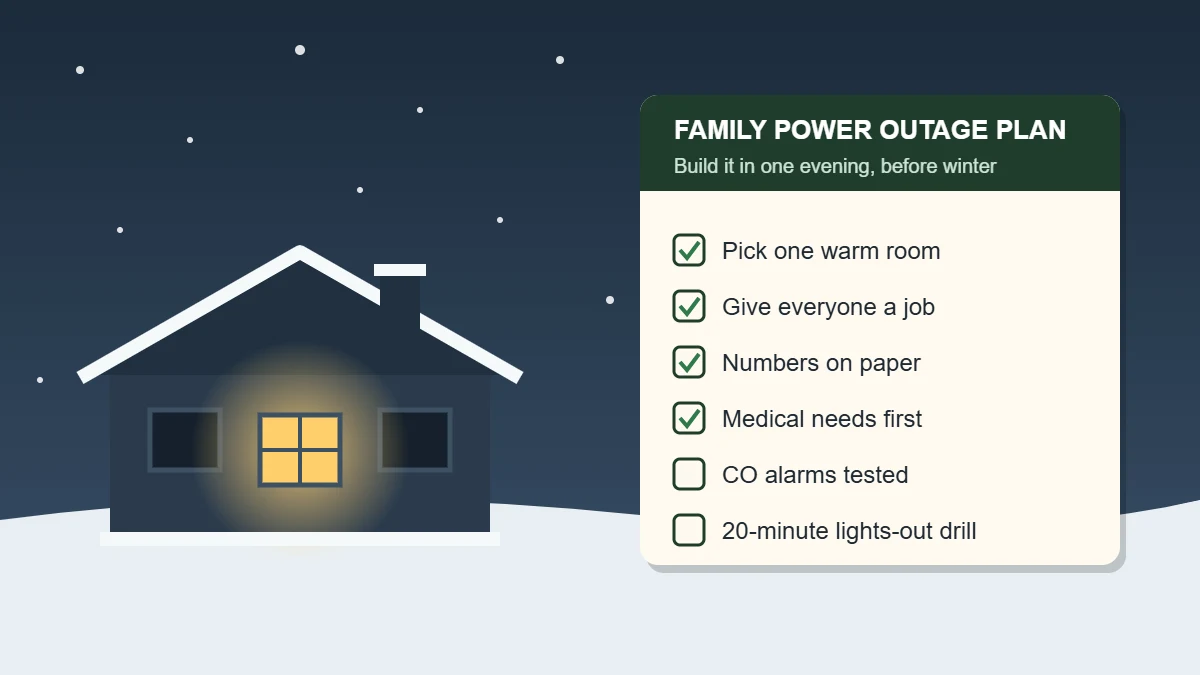
Short answer. Sit down as a family for 30 minutes and decide five things: which one room you will keep warm, the rule for when you leave (for example, indoors below 50°F / 10°C or a medical device with no power), where you go, an out-of-area contact, and who needs extra help. Give each person a job, keep phone numbers on paper, and plan for at least 72 hours at home. Never heat the house with a grill, camp stove or oven; generators go outside, at least 20 feet (6 m) from doors and windows. Then test it with a 20-minute lights-out drill.
Most outage plans are built for a two-hour blackout: find the flashlight, wait it out. That works most of the time. In ordinary years, the average US customer loses power for about two hours in total, according to the U.S. Energy Information Administration. But winter storms don’t follow the average. In 2024, major events pushed that figure to about 11 hours per customer, nearly double the decade before. And an ice storm can keep whole neighborhoods dark for days.
This guide helps you build a family power outage plan in one evening. It covers what to decide, who does what, and what to check before the first storm of the season. It is written for families in the US and Canada who face cold-weather outages.
Why a “two-hour” plan fails in winter
A short summer outage is an inconvenience. A long winter outage is a different problem:
- The house gets cold. Without the furnace (most gas furnaces also need electricity for the blower and controls), indoor temperatures drop hour by hour.
- Pipes can freeze. A burst pipe can do more damage than the outage itself.
- Roads may be closed. You may not be able to drive to a store, a relative or a warming center.
- Phones die. Cell towers can lose backup power during long outages, and your phone battery won’t last days on its own.
- The dangerous mistakes happen. People bring grills, camp stoves and generators indoors to stay warm. That’s how carbon monoxide poisonings happen.
So plan for at least 72 hours at home, the minimum recommended by Public Safety Canada and the American Red Cross. Extend to two weeks of supplies if you live in a rural area or at the end of a long power line.
Step 1: Hold a 30-minute family meeting
Get everyone who lives in the house together, including older kids. Answer these questions and write the answers down:
- Where will we stay warm? Pick one room to heat and live in. A small interior room with few windows works best.
- When do we leave? Agree on a trigger in advance. For example: indoor temperature below 50°F (10°C), a medical device that can’t be powered, or no safe heat source.
- Where do we go? A relative, friend, hotel or local warming center. Name a first choice and a backup.
- How do we reach each other? Choose an out-of-area contact. Local lines and networks get overloaded; a short text to someone outside the storm area often gets through when calls don’t.
- Who needs extra help? Babies, older parents, anyone with a medical device or refrigerated medicine, and pets.
Step 2: Give everyone a job
When the lights go out, confusion wastes time. Assign roles now:
| Role | What they do |
|---|---|
| Power & reporting lead | Checks whether it’s just your house (breakers) or the whole street, reports the outage to the utility and checks the restoration estimate. |
| Warmth lead | Sets up the warm room, closes off unused rooms, manages blankets and safe heat sources. |
| Food & water lead | Keeps the fridge and freezer closed, tracks how long the power has been out, handles meals and water. |
| Care lead | Looks after kids, older relatives, medications and pets. |
| Communications lead | Charges phones and power banks, texts the out-of-area contact, follows local alerts. |
In a small household, one person can hold two or three roles. The point is that nobody has to guess.
Step 3: Write down the information you’ll need in the dark
Your phone may be dead or the network down. Keep a paper copy of:
- Your utility’s outage number and your account number.
- Phone numbers for family, neighbors, your doctor and pharmacy.
- Your local emergency management office and warming-center information.
- A medication list with doses, and which medicines need refrigeration.
- Where the main water shut-off valve and the electrical panel are.
If you’d rather not build this from scratch, our Winter Outage Kit includes a fill-in Home Outage Binder with these pages ready to print.
Step 4: Plan for medical needs first
This is the part most plans skip, and it matters most. More than 3 million Medicare beneficiaries rely on electricity-dependent medical equipment at home, according to the HHS emPOWER program.
- Medical devices: Know how long each device’s battery lasts. Ask the supplier about backup batteries. Plan where you’d go if the battery runs out.
- Utility medical registries: Many utilities let you register a household member who depends on medical equipment. Do it, but don’t treat it as a guarantee. Utilities generally say registration does not mean your power will be restored first. You still need a backup plan.
- Insulin and refrigerated medicine: The FDA says insulin can be kept unrefrigerated between 59°F and 86°F (15–30°C) for up to 28 days. Check the label for your specific product, and never let it freeze. For other refrigerated medicines, ask your pharmacist now, not during the outage.
- Prescriptions: Before winter, try to keep at least a week’s extra supply on hand, if your plan and doctor allow it.
Step 5: Keep warm safely
Heating is where good intentions turn dangerous. Heating equipment is involved in tens of thousands of US home fires every year, according to the National Fire Protection Association (NFPA).
- Never use a gas stove, oven, charcoal grill or camp stove to heat your home.
- Generators go outside only, at least 20 feet (6 m) from doors, windows and vents. Never in a garage, basement or shed, even with the door open. More on this in our guide to running a generator in snow and cold.
- Install battery-powered or battery-backup carbon monoxide alarms on every level and near sleeping areas. The CDC says more than 400 Americans die each year from unintentional carbon monoxide poisoning not linked to fires.
- Use flashlights and LED lanterns instead of candles. NFPA data shows candle fires peak in December and January.
- Layer up: hats, wool socks, sleeping bags, and everyone in the same room.
For details, read how to heat a room safely without power. If you’re thinking about backup power for the furnace, see what size generator you need to run a furnace.
Step 6: Protect your pipes
For the full temperature-by-temperature plan, see how to keep pipes from freezing when the power goes out. The short version:
- Know where your main water shut-off is and make sure it turns.
- If the house is getting cold, open cabinet doors under sinks on outside walls and let faucets drip slightly.
- If you leave during a long outage in freezing weather, consider shutting off the water and draining the lines. If you’re not sure how, ask a plumber before winter.
Step 7: Food and water
- Water: Store at least 4 liters (about 1 gallon) per person per day. Canadian and US guidance both use roughly this figure. See how to store drinking water.
- Fridge and freezer: Keep the doors closed. The CDC says a closed fridge keeps food safe for about 4 hours; a full freezer for about 48 hours (24 if half full). Read our guide to food safety during a power outage.
- Pantry: Stock food that needs no cooking or very little. Our 2-week emergency pantry list covers this.
Step 8: Kids, older parents and pets
- Kids: Explain the plan in simple words. Give them a small job (holding the flashlight, checking on the dog). Pack a “dark box” with cards, books and a headlamp.
- Older parents: If they live alone, decide who checks on them and when. Agree on a time to move them somewhere warmer if the outage drags on.
- Pets: Keep a few days of food, water and any medicine. Check in advance whether the warming center or hotel you’d use accepts pets.
Step 9: Run a 20-minute lights-out drill
A plan you’ve never tested is just a list. One evening this month:
- Turn off the lights (not the breakers) and set a timer for 20 minutes.
- Can everyone find a flashlight without help?
- Does every flashlight and radio work? Are the batteries fresh?
- Are power banks charged?
- Can you find the binder or paper copy with your numbers?
- Does everyone know which room is the warm room and what the “time to leave” rule is?
Write down what went wrong and fix it this week.
If your home is in a flood-prone area, add one more item to the plan: when it is safe to switch off the main breaker, and when it isn’t. Our flood outage guide explains the dry-floor rule.
Common mistakes to avoid
- Planning only for a few hours.
- Keeping the only copy of important numbers on a phone.
- Assuming the utility’s medical registry guarantees priority restoration.
- Running a generator in the garage “with the door open.”
- Opening the fridge every hour to check on the food.
- Waiting until the storm warning to buy batteries.
Frequently asked questions
How long should a family power outage plan cover?
Plan for at least 72 hours at home. In rural areas or places with frequent ice storms, aim for supplies that last up to two weeks.
What is the most important part of a winter outage plan?
Staying warm safely and protecting anyone with medical needs. Most serious harm during winter outages comes from cold, carbon monoxide and fires, not from the outage itself.
Should I register with my utility’s medical program?
Yes, if someone in your home depends on powered medical equipment. But keep a backup plan, because registration usually doesn’t guarantee faster restoration.
How far from the house should a generator be?
At least 20 feet (about 6 meters) from doors, windows and vents, and never in a garage or basement.
How often should we review the plan?
Once a year before winter, and whenever something changes: a new baby, a new medical device, a move, or a new pet.
Your next step
Hold the family meeting this week and write the answers down. If you want everything in one place, the Winter Outage Kit gives you the battery guide, a printable Home Outage Binder and a Pantry Kit, ready to use. Either way, the plan is what counts. Do it before the first storm, not during it.
Sources
U.S. EIA, Hurricanes in 2024 led to the most hours without power in 10 years · CDC, Carbon Monoxide Poisoning · CPSC, Portable Generator Safety · FDA, Insulin Storage in an Emergency · HHS emPOWER Program FAQs · NFPA, Candle Safety · CDC, Keep Food Safe After a Disaster or Emergency · Public Safety Canada, Basic Emergency Kit · Ready.gov, Make a Plan
This article contains no affiliate links.
This article is general preparedness information, not medical advice. For questions about specific medicines or medical devices, talk to your doctor, pharmacist or equipment supplier.