Most “emergency pantry” lists quietly assume the power is on. They tell you to stock dry beans, rice and frozen vegetables, then send you to the stove or the Instant Pot. In a winter storm that takes out the grid for a week or more, half of that list is useless, and some of the advice for cooking without power is dangerous.
This guide is built for the real situation: no electricity, a cold house, maybe no running water, and two weeks to get through. You’ll find how much water and food the official guidance calls for, the order to eat things in so nothing goes to waste, a printable shopping list for 1, 2 or 4 people, and the safe way to warm food indoors.
Short answer
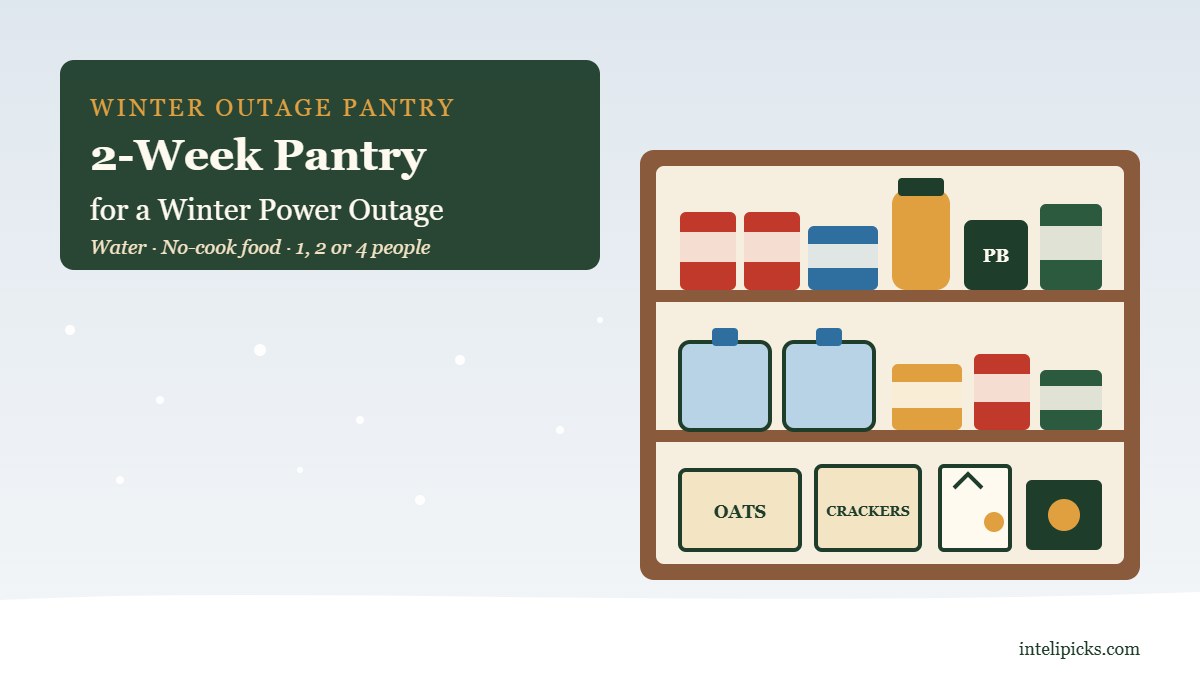
Plan on 1 gallon (about 4 liters) of water per person per day, so 14 gallons per person for two weeks, plus food that needs no cooking: canned meat and fish, canned beans, nut butter, crackers, cereal and shelf-stable milk. During the outage, eat refrigerator food within the first 4 hours and freezer food within 1–2 days before you open the pantry. Keep camp stoves, grills and MRE heaters outdoors; indoors, eat canned food cold or warm it on canned heat with ventilation and a CO alarm.
Safety first. Never use a camp stove, grill, propane or charcoal heater, or a flameless MRE heater inside your home, garage or enclosed porch, even with a window open. They make carbon monoxide, which you can’t see or smell. Keep a battery-powered CO alarm on every sleeping floor. If anyone gets a headache, dizziness or nausea, get everyone outside and call 911.
How Much Water and Food Do You Need for Two Weeks?
The American Red Cross asks for two different supplies: a 3-day kit for evacuation, and a 2-week supply for staying at home. Both are based on one gallon of water per person per day, plus non-perishable, easy-to-prepare food.
| Household | Water for 14 days | Same in liters |
|---|---|---|
| 1 person | 14 gallons | about 53 L |
| 2 people | 28 gallons | about 106 L |
| 4 people | 56 gallons | about 212 L |
In Canada, Get Prepared asks for 2 liters of drinking water per person per day, plus 2 more liters for cooking and cleaning. That’s 4 liters a day, close to the U.S. gallon. Add water for pets.
Two rules from the FEMA and Red Cross guide Food and Water in an Emergency matter most when supplies run low:
- Never ration water. Drink what you need today and look for more tomorrow. Food, unlike water, can be rationed, but not for children or pregnant women.
- Go easy on salty food when water is limited, because it makes you thirsty. Pick low-sodium soups and unsalted crackers and nuts.
The gallon a day covers drinking, mixing food and basic washing. It doesn’t cover flushing. If you have time before a storm, fill the bathtub and use that water only for flushing the toilet (keep small children away from a full tub). Paper plates and baby wipes save a surprising amount of water. For containers and rotation, see How to Store Drinking Water for Emergencies.
Why winter needs more calories, not fewer
Two weeks in a cold house is not the time to cut portions. Your body spends extra energy just staying warm, and storm chores like shoveling, hauling water and carrying wood add more. Cold-weather nutrition research (done with soldiers, who burn far more than someone sitting at home) points to energy-dense, higher-fat foods as the efficient way to cover the gap. In a pantry, that means nut butter, nuts, trail mix, olive oil and fish packed in oil.
Plan on at least the calories you normally eat, around 2,000 a day for many adults, and stock a little more than that. The shopping list below is deliberately generous; anything you don’t eat rotates into everyday meals.
Why a sack of dry beans and rice is the wrong backup
Dry beans need soaking and a long simmer, and rice needs a pot of boiling water. Both burn through drinking water and stove fuel you may not have. Canned beans are already cooked, can be eaten cold straight from the can, and their liquid counts toward your water. For grains, pick instant oats, ready-to-eat rice pouches, crackers, cereal and tortillas.
Eat in This Order: Fridge First, Freezer Second, Pantry Last
The FEMA and Red Cross guide says to use perishable food first, then freezer food, and only then start on non-perishables. USDA timings tell you how long each stage lasts.
Hours 0–4: the refrigerator
A closed refrigerator keeps food cold for about 4 hours. Eat the milk, yogurt, deli meat and leftovers first, and open the door as little as you can. After 4 hours without power, USDA says to discard perishable food like meat, poultry, fish, soft cheese, milk, eggs and leftovers. Never taste food to decide whether it’s safe.
Some fridge items are fine after the 4 hours and are worth saving, because they make canned food taste better in week two. USDA lists these as safe:
- Hard cheeses such as cheddar, Swiss and Parmesan
- Butter and margarine
- Peanut butter
- Jelly, mustard, ketchup and most other condiments
- Bread and rolls
Opened mayonnaise and hard-cooked eggs are not on the safe list. Throw them out. Our full guide is Is the Food in My Fridge Still Safe After a Power Outage?
Hours 4–48: the freezer
A full freezer holds its temperature for about 48 hours with the door closed, and a half-full one for about 24 hours. Keep it shut and plan meals around what’s inside. When the power returns, food that still has ice crystals or reads 40°F or below can be refrozen.
Don’t stash food outside in the snow. Sun can warm it above 40°F even on a cold day, and animals get into it. A cooler with ice and a thermometer is safer. If you run a generator or power station for the freezer, our Power Outage Calculator shows what size you need.
Days 3–14: the pantry
Once the fridge and freezer are done, you live on shelf-stable food. Without a refrigerator, an opened can of meat, fish, beans or soup is perishable again, so buy small cans, single-serve pouches and 8-ounce milk boxes that you finish in one sitting. A big family-size can makes sense for four people. For one person, it’s a waste.
Printable 14-Day Winter Pantry Shopping List
Quantities are for a full 14 days with no cooking required. Choose foods your household already eats, and check every can and pouch for a “Keep Refrigerated” label before it goes on the shelf.
| Category | What to buy | 1 person | 2 people | 4 people |
|---|---|---|---|---|
| Water | Bottled water, plus small juice boxes or electrolyte packets | 14 gal + 7 boxes | 28 gal + 14 boxes | 56 gal + 28 boxes |
| Ready-to-eat protein | Small cans or pouches of chicken, tuna, salmon, sardines in oil; jerky or shelf-stable summer sausage | 18 cans/pouches + 8 oz jerky | 36 + 16 oz | 72 + 32 oz |
| Beans and soups | Canned black beans, chickpeas, kidney beans, lentils; low-sodium ready-to-eat soup or chili | 8 beans + 10 soups | 16 + 20 | 32 + 40 |
| Fats and nuts | Peanut or almond butter (16 oz jars), unsalted nuts, trail mix, olive oil | 2 jars + 1.5 lb nuts + small oil | 3–4 jars + 3 lb + 16 oz oil | 6–7 jars + 6 lb + 2 bottles |
| Grains | Tortillas, whole-grain crackers, dry cereal, instant oat packets, ready-to-eat rice pouches | 3 tortilla packs, 3 crackers, 2 cereal, 14 oats, 6 rice | Double | 4× |
| Fruit and vegetables | Canned fruit in juice, applesauce cups, dried fruit (prunes, raisins), canned carrots, corn, green beans, diced tomatoes | 8 fruit, 6 applesauce, 12 oz dried, 8 veg | Double | 4× |
| Shelf-stable dairy | 8 oz shelf-stable milk boxes, powdered or small cans of evaporated milk, shelf-stable cheese | 14 boxes + 8 oz cheese | 28 + 16 oz | 56 + 32 oz |
| Comfort and flavor | Instant coffee, tea, hot cocoa, granola or protein bars, dark chocolate, honey, single-serve mayo, mustard and hot sauce packets | 14 bars + packets | 28 bars | 56 bars |
| Special needs | Ready-to-feed infant formula, glucose tablets, 14 days of prescriptions, pet food and pet water | Per person and per pet, for 14 days | ||
| No-power kit | 2 manual can openers, canned heat (chafing fuel) with a metal stand, matches or lighter, vacuum thermos, fridge and freezer thermometers, battery CO alarm, paper plates, wipes, hand sanitizer, trash bags | 4–6 fuel cans | 6–8 | 10–12 |
No-cook meals that don’t get boring
By day eight, plain tuna and crackers gets old fast, and people who are sick of their food stop eating enough. A few combinations that work cold:
- Bean wraps: black beans or chickpeas, canned corn, a drizzle of olive oil and hot sauce in a tortilla.
- Chicken salad pouch: canned chicken mixed with single-serve mayo and mustard packets, on crackers.
- Overnight oats: instant oats soaked in shelf-stable milk with raisins and peanut butter.
- Snack plate: hard cheddar from the fridge (safe per USDA), summer sausage, crackers and dried fruit.
Dried fruit, canned beans and applesauce add fiber, which helps with the constipation a can-and-cracker diet causes. A hot drink once or twice a day does more for morale than almost anything else on the list. Dried mushrooms are another shelf-stable winner. See How to Cook and Preserve Winter Mushrooms.
How to Warm Food Safely Without Electricity
Outdoors only: camp stoves, grills and butane burners
The FEMA and Red Cross guide says a charcoal grill or camp stove “can be used outdoors,” and CDC warns never to use grills or other propane-, gasoline- or charcoal-burning devices inside your home, and never to heat your home with a gas oven. Sterno’s own safety sheet says its butane stoves must never be used in a home, tent or car, because they can produce carbon monoxide. The same goes for flameless MRE heaters: use them outside.
Indoors: canned heat for already-cooked food
Remember that commercially canned food is already cooked. You can eat it cold. If you want it warm, the Red Cross guide says you can keep cooked food hot with candle warmers, chafing dishes and fondue pots. Use them carefully:
- Set chafing fuel in a sturdy metal stand, away from curtains, paper and pets, in a ventilated room. Sterno says to use chafing fuel in well-ventilated areas.
- Keep the CO alarm in the same room.
- If you heat food in the can, open the can and remove the label first. A sealed can can burst.
- Only warm food that is already cooked. A small warming flame can’t safely cook raw meat, poultry or eggs.
- Put the snuffer cap on to put it out. Never blow it out or carry a lit can. Canned heat is for warming food, never for heating the room.
- Heat water once, pour it into a vacuum thermos, and use it for coffee, tea and oats all day. That saves fuel.
Shelf Life, Dented Cans and Frozen Cans
According to USDA, low-acid canned foods (meat, poultry, fish, soups, most vegetables) keep for 2 to 5 years, and high-acid canned foods (fruit, juice, tomatoes, pickles, sauerkraut) for 12 to 18 months. Write the purchase date on top and rotate: eat the oldest cans in everyday meals and replace them.
Dented cans: a small dent on a can that’s otherwise in good shape is fine. Throw out any can with a deep dent (one you can lay your finger into), any dent on a seam, heavy rust, swelling or leaks.
Frozen cans: in an unheated house, canned food can freeze. Food safety experts say to throw out any can that’s swollen or bulging. Thaw the others slowly in a cool spot, and discard the food if it looks or smells off after opening. To prevent it, keep your pantry in the warmest lived-in room during an outage, not the garage.
Babies, Diabetes, Seniors and Pets
- Infants: CDC says ready-to-feed liquid formula is the safest choice in an emergency, because powdered formula is not sterile. If you must use powder, mix it with bottled water. You don’t need to warm formula. Use it within 1 hour of starting a feeding and within 2 hours of mixing, and throw out leftovers. If you can’t clean bottles properly, feed from a disposable cup.
- Diabetes: keep fast sugar on hand (glucose tablets, small juice boxes, honey), plus protein and lower-sugar snacks. Ask your pharmacist how to store insulin without a working fridge, and don’t let it freeze.
- Seniors: add soft foods like applesauce, canned fruit, instant oats and low-sodium soup, not just hard nuts and jerky.
- Pets: two weeks of food and their own water. Canned pet food needs no preparation and adds moisture.
Printable 14-Day Pantry Checklist
- Store 1 gallon (4 L) of water per person per day for 14 days, plus pet water.
- Fill the bathtub for flushing before the storm.
- Buy food that needs no cooking: canned meat and fish, canned beans, nut butter, crackers, cereal, canned fruit.
- Choose small cans and single-serve packs you can finish in one sitting.
- Pick low-sodium soups and unsalted snacks.
- Check every can and pouch for “Keep Refrigerated.”
- Pack two manual can openers.
- Put thermometers in the fridge and freezer.
- During the outage: fridge food first, freezer second, pantry last.
- Keep the pantry in the warmest room so cans don’t freeze.
- Warm only cooked food indoors, on canned heat, with ventilation and a CO alarm.
- Keep stoves, grills and MRE heaters outdoors. Rotate cans and write dates on top.
Bottom Line
A good winter outage pantry is mostly cans, pouches and jars you’d eat anyway, plus a gallon of water per person per day. Eat the fridge first and the freezer second, choose food you don’t have to cook, and keep anything that burns fuel outside. Do that, and two weeks without power becomes a lot more manageable.
Want a quick reference for the next storm? Get the free 2-Minute Winter Battery Check, or see the full Winter Battery & Power Outage Guide, which covers staying warm safely, food safety and generators when the power goes out.
Sources: American Red Cross – Survival kit supplies, FEMA and American Red Cross – Food and Water in an Emergency, Get Prepared (Public Safety Canada) – Basic emergency kit, USDA FSIS – Keeping food safe during severe storms, USDA FSIS – Shelf-stable food safety, University of Nebraska–Lincoln Extension – Is this food still safe to eat?, NDSU Extension – Is frozen canned food safe to eat?, CDC – Avoiding carbon monoxide poisoning, Sterno – Product safety information, CDC – Prepare and store powdered infant formula in an emergency, Performance nutrition for cold-weather military operations (2023).