When the power goes out in January, most people try to keep the whole house warm. That’s the plan that fails first. A house loses heat through every window, wall and door gap, and no emergency heater you can safely run indoors will keep up with all of it.
The plan that works is smaller: pick one room, trap the heat you already have, and warm people before you try to warm air. This guide walks through that plan step by step, shows the battery and generator math, and is blunt about the heat sources that kill people every winter.
Short answer
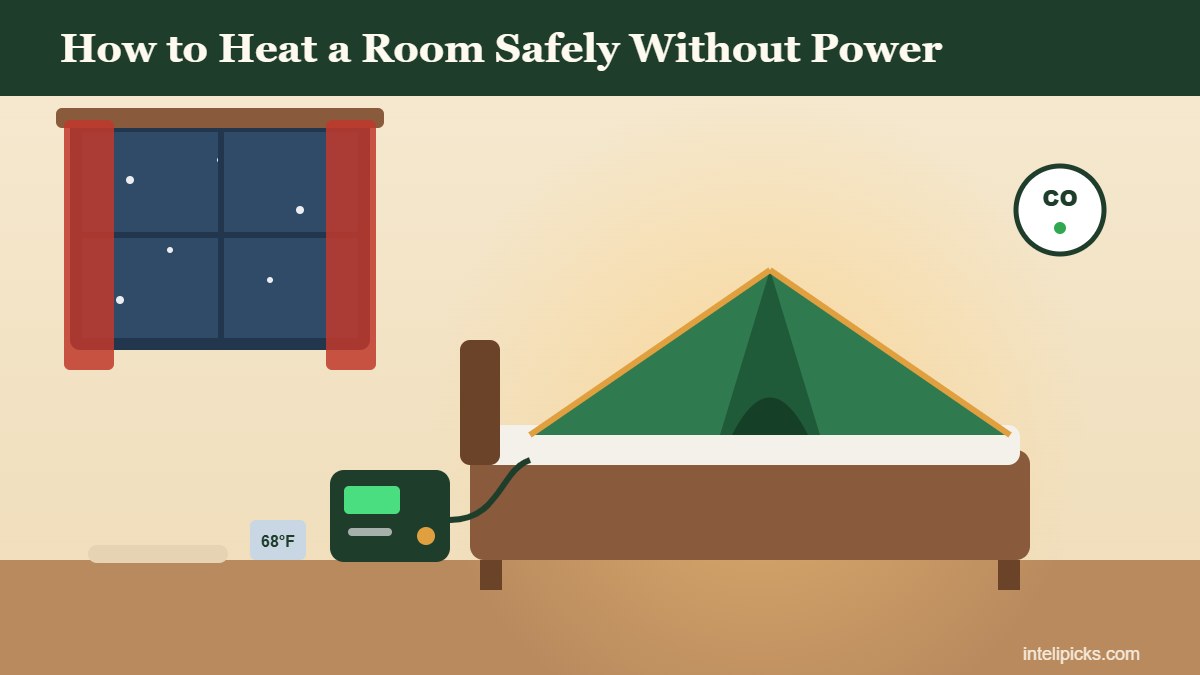
Don’t try to heat the whole house. Move everyone into one small room, close it off, cover the windows at night and build a tent or blanket fort on the bed to trap body heat. If you have a power station, run an electric blanket under the covers (about 100 W) instead of a space heater (1,500 W). If you have a generator, use it to run your gas furnace through a proper transfer switch. Never use an oven, stove, grill, camp stove or generator indoors for heat.
Carbon monoxide kills quietly. In CPSC’s latest estimates, generators and heating appliances caused most non-fire CO deaths, and 64% happened between November and February. Keep a battery CO alarm in the room you sleep in, run generators only outdoors at least 20 feet from the house, and never sleep with any fuel-burning heater running. If the alarm sounds or anyone feels dizzy, sick or confused, get everyone outside and call 911.
Step 1: Shrink the Space to One Warm Room
The cheapest move comes first: close off the rooms you aren’t using. The less air you have to keep warm, the longer your body heat, sunshine and any backup heat will last.
Which room to pick
- Small beats big. A bedroom or den is easier to keep warm than an open living room with a high ceiling.
- Fewer windows and outside walls. An inside room loses heat more slowly. If you have a sunny, south-facing room, it can pick up free heat during the day.
- Not the basement if anything burns fuel. A basement often stays cooler and steadier than upstairs, but it’s the worst place for any propane appliance: propane is heavier than air and collects low.
- Near a bathroom, so nobody has to leave the warm room for long.
Seal it up
- Close every door to the rest of the house and roll a towel or blanket along the bottom of the door.
- Open curtains on sunny windows during the day. Close them, or cover the glass with blankets, bubble wrap or plastic sheeting, before sunset.
- Keep the vents and any required fresh-air gap open if you use a fuel-burning heater (more on that below).
Trap body heat: tents, beds and layers
Each person gives off roughly as much heat as a 100-watt light bulb. In a big room that heat disappears. In a small space it adds up, which is why preppers pitch a small camping tent or build a blanket fort on top of the bed, not on the floor. A cold floor pulls heat out of your body all night.
- Sleep together in the warm room, with sleeping bags or extra blankets, and wear a hat.
- Dress in loose layers of wool or synthetic fabric. Cotton holds sweat and makes you colder.
- Eat regular meals and drink warm, non-alcoholic drinks. Alcohol makes you feel warmer while your body actually loses heat faster. For a no-cook food plan, see our 2-week emergency pantry for winter outages.
- Hot water bottles are an old trick that still works. Many tank-style gas water heaters with a standing pilot light keep heating water without electricity (power-vent and most tankless models don’t). If yours does, warm tap water in a rubber hot water bottle, wrapped in a sock or towel, makes a bed noticeably warmer. Use warm, not boiling, water and never give one to a baby.
Step 2: Heat the Person, Not the Air (Battery Math)
If you own a portable power station, this is where most people make an expensive mistake. Almost every plug-in space heater in the US and Canada draws up to 1,500 watts on high, whether it’s ceramic, oil-filled or “infrared.” Electric heat is electric heat: watts in, the same heat out.
An electric blanket or heated mattress pad puts a much smaller amount of heat exactly where you are. Here’s what that means on a typical 1,000 Wh power station, assuming about 85% of the battery is usable after inverter losses (roughly 850 Wh):
| What you plug in | Typical draw | About how long 850 Wh lasts |
|---|---|---|
| Space heater on high | 1,500 W | about 35 minutes |
| Space heater on low | 750 W | a little over 1 hour |
| Electric blanket or heated pad | about 100 W | about 8 hours |
| Low-power or 12 V blanket | about 50 W | about 17 hours |
Check the label on your own blanket: wattage varies a lot by size and model. A few tips make a big difference:
- Put the blanket under a comforter or inside a sleeping bag. Left uncovered in a cold room, its thermostat runs it at full power.
- Warm the bed for half an hour on a higher setting, then turn it down.
- A 12-volt blanket plugged into the station’s car outlet skips the inverter, so more of the battery goes into heat.
- Follow the blanket’s manual: don’t fold or bunch it while it’s on, and check who it says shouldn’t use it.
Want numbers for your own setup? Our free Power Outage Calculator adds up a blanket, fridge, phones and lights and tells you what battery size to look for. If you’re curious how a power station handles a fridge too, see how long a 1000Wh power station runs a fridge.
Running the heater, fan or lights from a battery? Cold changes how much of its capacity you actually get, and some types must not be charged when frozen. See AGM vs. LiFePO4 in Freezing Weather before you decide where the battery sits.
Step 3: Have a Generator? Run the Furnace, Not a Space Heater
If your home has a gas or propane furnace, the furnace only needs electricity for its blower and controls. A typical gas furnace draws about 300 to 800 watts while running, with a short startup surge. That small amount of electricity unlocks heat for the whole house, while a 1,500 W space heater warms one corner and burns through generator fuel. Details and real numbers are in What Size Generator Do I Need to Run My Furnace?
- A furnace is hard-wired, so connecting it to a generator safely needs a transfer switch or interlock installed by a licensed electrician. Never backfeed your house through an outlet.
- Run the generator outdoors only, at least 20 feet from the house, with the exhaust pointed away from doors, windows and vents. Our guide to running a portable generator safely in snow and cold covers placement, fuel and cold starts.
- Plan your fuel with the Generator Runtime Calculator, and read gas vs. propane in winter before you stock up.
- If you do run a space heater, keep it at least 3 feet from beds, curtains and clothes, and never plug it into a power strip (CPSC). The U.S. Fire Administration found portable heaters were involved in only 3% of home heating fires but 41% of the fatal ones. From a generator, use a heavy outdoor cord sized for the load; our cord size calculator checks it.
Gas Fireplaces: Will Yours Work Without Power?
Many vented gas fireplaces can still give heat during an outage, but it depends on how they light:
- Standing pilot (a small flame that stays lit): these generally don’t need house power to run. Only the optional blower fan stops.
- Electronic ignition: some models have a battery backup pack, often hidden behind the lower panel. If yours does, put fresh batteries in before the storm and practice lighting it once while the power is on. If it doesn’t, it may not light at all.
Your fireplace manual is the final word. Keep the glass front closed, keep children and pets back, and have the CO alarm working in that room. If you heat with a wood fireplace or stove, don’t close the damper until the fire and embers are completely out.
Indoor Propane Heaters: Read the Fine Print
This is where safety advice and store shelves seem to disagree. Most emergency guidance tells you not to burn fuel indoors at all. At the same time, stores sell small “indoor-safe” radiant propane heaters such as the Mr. Heater Buddy series, which have a low-oxygen shutoff and a tip-over switch.
Look closely at the manual, though. The Portable Buddy manual describes it as safe for indoor use in small recreational enclosures, like a hunting blind or an ice shack with a vent. It isn’t sold in Massachusetts, and the manual says it isn’t for use in a dwelling home in California. And the numbers are sobering: in the CPSC’s latest report, LP gas heaters were linked to an estimated 43 carbon monoxide deaths in 2022, and about 70% of those involved unvented portable propane heaters.
If you already own one and decide to use it, the manual’s own rules are the minimum:
- Give it the fresh-air opening the manual requires. For the Portable Buddy, that’s at least 9 square inches, for example a window cracked open.
- Keep the clearances: 30 inches above, 24 inches in front, 6 inches on the sides.
- Never run it while you sleep and never leave it unattended. The manual says this in capital letters. Warm the room, then shut it off before bed.
- Only small 1-lb cylinders inside. A 20-lb tank must stay outdoors, connected only with the hose and filter the manual specifies.
- Keep a battery CO alarm in the same room. The low-oxygen sensor is not a carbon monoxide detector.
- Expect moisture: burning propane releases water vapor, so a closed room gets damp quickly. That’s one more reason to keep the vent open.
If you can’t meet every one of these rules, don’t use it. The no-flame options above are safer for a home.
What Never to Use for Heat
- Your gas oven or stovetop. CDC says not to heat your home with a gas oven, and the Red Cross says never to use a cooking range or oven for heat. They aren’t built to run for hours as a heater and can fill the house with carbon monoxide, door open or closed.
- Grills, camp stoves and charcoal. Never indoors, and never in a garage or on an enclosed porch. Charcoal was linked to 18 CO deaths in the CPSC’s 2022 estimates.
- A generator anywhere inside, including the garage with the door open. Generators were the single biggest cause in the CPSC data: 892 deaths from 2012 to 2022.
- Outdoor propane heaters (tank-top and patio heaters) inside the house.
- “Terracotta pot candle heaters.” The viral trick doesn’t create heat, it only moves the little heat a few tealights make, and covering burning candles can overheat the wax and start a fire. Candles in general are a fire risk during outages; CPSC suggests flashlights or battery-operated candles instead.
Seniors, Babies and Pets
Older adults and infants lose heat faster and often don’t notice it. The National Institute on Aging recommends keeping homes at at least 68 to 70°F for older people and warns that even 60 to 65°F can trigger hypothermia in older adults. A cheap indoor thermometer in the warm room tells you where you stand.
Signs of hypothermia, according to CDC:
- Adults: shivering, exhaustion, confusion, fumbling hands, memory loss, slurred speech, drowsiness.
- Infants: bright red, cold skin and very low energy.
If a person’s temperature is below 95°F (35°C), get medical help right away (call 911). While you wait, CDC advises moving them somewhere warm, removing wet clothing and warming the center of the body first (chest, neck, head and groin), using an electric blanket if you have one, or skin-to-skin contact under dry layers. Offer warm drinks only if they’re alert, and never alcohol.
Bring pets into the warm room too, with their water bowls where they won’t freeze.
Protect the plumbing as well. A cold house puts your pipes at risk before it becomes dangerous for people. Our guide to keeping pipes from freezing when the power goes out shows when to drip faucets and when to drain the system, which matters most if you have to leave.
When to Leave
If you can’t keep the warm room safe and reasonably warm, especially with an older adult, a baby or someone with a medical condition at home, don’t wait it out. Local governments open warming centers during long outages. Check your city or county website, local radio, or call 211 (in the US and most of Canada) to find one, and go while the roads are still passable.
Printable “Warm Room” Checklist
- Pick one small room and close off the rest of the house.
- Roll towels along door gaps; cover windows at night.
- Put a battery CO alarm and a thermometer in the warm room, and keep CO alarms outside every sleeping area and on every level.
- Set up a tent or blanket fort on the bed, not on the floor.
- Wear dry wool or synthetic layers and a hat; skip alcohol.
- Use the power station for an electric blanket under the covers, not a space heater.
- With a generator: power the furnace through a proper transfer switch, 20+ feet outside.
- Check your gas fireplace’s backup batteries before the storm.
- Never use the oven, stove, grill, camp stove or candles for heat.
- Watch seniors and babies; know the hypothermia signs and where the nearest warming center is.
Bottom Line
You don’t need to heat a house to get through a winter outage. Shrink the space to one room, keep the cold out, warm the people with blankets and an electric blanket on battery, and use a generator to run the furnace rather than a space heater. Keep every flame and engine where carbon monoxide can’t reach you, and leave early if someone vulnerable is getting cold.
Want this on paper before the next storm? The Winter Battery & Power Outage Guide covers the first hours of an outage, staying warm safely, food safety and generators, with a printable Outage Card and a 14-day pantry checklist. Or start with the free 2-Minute Winter Battery Check.
Sources: CPSC – Non-Fire CO Deaths, 2022 Annual Estimates · CPSC – Winter CO and fire safety tips (Jan. 2025) · CDC – Don’t heat your home with a gas oven · CDC – Carbon monoxide poisoning basics · NIH/NIA – Hypothermia, a cold weather hazard for seniors · American Red Cross – Winter storm safety tips · U.S. Fire Administration – Portable heater fires in residential buildings · Mr. Heater Portable Buddy (MH9BX) operating instructions · 211 Canada. Checked November 2026. Always follow your appliance manuals and local officials.