Most people with gas heat find out the hard way: when the power goes out, the furnace goes out too. The gas is still there, but the blower, the igniter, the draft motor and the control board all need electricity. The good news is that a furnace needs far less power than most people expect, so you don’t need a giant generator to keep the house warm.
Short answer
A typical gas furnace draws about 300–800 watts while running, with a short startup surge of up to about 2,000 watts on older blower motors. A 2,000–3,000 watt inverter generator runs most gas furnaces comfortably. For a power station, look for at least about 1,500 W output with a higher surge rating, and roughly 2,000 Wh of battery to get through a full night. The exact number is on your furnace’s rating plate.
Where the watts go
A gas furnace has four electrical parts, and they don’t all run at once.
- Blower motor: the big one. It pushes warm air through the ducts and makes up most of the load.
- Draft inducer: a small fan that clears the exhaust before the burners light.
- Igniter: a glowing element that lights the gas. It pulls a few hundred watts, but only for under a minute, and usually shuts off before the blower starts.
- Control board and gas valve: a few dozen watts.
The type of blower motor matters most. Older furnaces use a PSC motor, which typically draws around 400–800 watts and gives a hard kick at startup. Since July 2019, US efficiency rules have pushed new furnaces to more efficient ECM (variable-speed or constant-torque) motors, which often draw well under 450 watts in heating and start gently. A quick way to tell: an older motor usually has a metal capacitor strapped to it; an ECM motor has a small electronics module and a multi-pin plug.
Typical numbers by heating type
These are typical ranges, not guarantees. The overnight column assumes the system runs about 40% of the time on a cold night.
| Heating type | Running watts | Startup surge | 8-hour night (Wh) |
|---|---|---|---|
| Hot-water boiler (gas) | 100–250 W | 300–600 W | about 320–800 |
| Gas furnace, newer ECM blower | 250–450 W | 500–900 W | about 800–1,450 |
| Gas furnace, older PSC blower | 500–800 W | 1,200–2,400 W | about 1,600–2,550 |
| Oil furnace | 650–1,100 W | 1,600–3,200 W | about 2,100–3,500 |
| Heat pump or electric furnace | 2,500–20,000 W at 240 V | much higher | beyond small generators and batteries |
Find your furnace’s real number in 2 minutes
- Turn the furnace switch off and take off the front panel.
- Find the rating plate sticker inside. Look for total unit amps or the blower motor’s amps.
- Multiply by 120. For example, 7 amps × 120 = 840 watts. That’s close to the maximum the furnace pulls while running.
- Ignore the breaker size. A 15-amp breaker doesn’t mean the furnace uses 1,800 watts; the breaker is sized with a safety margin.
Generator or power station?
Inverter generators are the usual pick for a furnace. They make clean power that modern control boards like, they’re quiet, and at a furnace’s light load many 2,000–2,500 W models use only around a tenth of a gallon of gas an hour (check your model’s runtime spec). Older open-frame generators can work with simple furnaces, but their rougher power can upset newer variable-speed boards.
Power stations are silent and safe indoors, but capacity is the limit. A 1,000 Wh unit runs a newer furnace for roughly 5–6 hours on a cold night, and an older one for about 3–4. A 2,000 Wh unit usually gets a newer furnace through the night. Whatever you choose, it needs a pure sine wave output and a surge rating above your blower’s startup kick.
Add the furnace to everything else
The furnace is rarely the only thing you want running. Tick the furnace fan, fridge, Wi-Fi and lights in the free calculator and it adds up the watts, the surge and the battery size for your outage length.
The furnace lights, then shuts off after a few seconds
This is the most common surprise, and it’s usually not the generator’s fault. A gas furnace checks that the flame is really burning by sending a tiny current through the flame to the metal burner, which is grounded. That signal needs the power source’s neutral and ground to be tied together at one point.
In your house panel, they are. But most inverter generators and nearly all power stations have a “floating” neutral, where the two are kept separate. Plug the furnace straight into one of those and the furnace lights, can’t detect the flame, and shuts the gas off a few seconds later.
- Connected through a transfer switch or interlock: the furnace still uses your panel’s neutral-ground connection, so a floating-neutral source normally works as is.
- Furnace plugged directly into the generator or power station: a small neutral-ground bonding plug in a spare outlet on the generator usually fixes it. Never use that plug when the generator feeds the house through a transfer switch or inlet, and ask an electrician if you’re not sure which setup you have.
How to connect it safely
A furnace is usually hard-wired, so you can’t just plug it into an extension cord. The common options, all installed by a licensed electrician:
- Single-circuit furnace transfer switch: switches just the furnace between the grid and your generator or power station. The simplest and cheapest legal option for heat only.
- Manual transfer switch: covers several circuits at once, like the furnace, fridge, some lights and Wi-Fi.
- Interlock kit plus an outside power inlet: lets the generator feed your main panel, with a plate that makes it impossible to have both the grid and the generator on at once.
- Replacing the furnace switch with a plug and outlet: allowed in some places only if the furnace manufacturer’s instructions and your local code permit it. Check with your electrician and local inspector first.
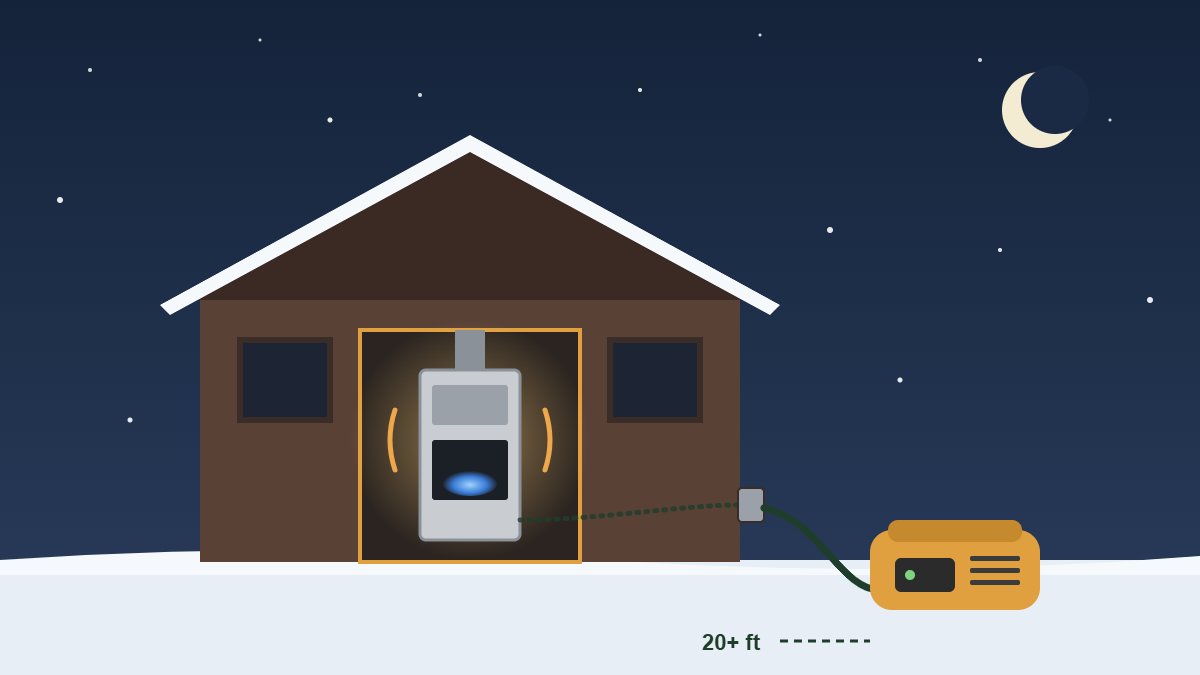
Safety: never plug a generator into a wall outlet or dryer outlet with a double-ended cord. It can send power back into the utility lines and kill a lineworker. Run a generator outdoors only, at least 20 feet from the house, with the exhaust pointed away from doors, windows and the furnace’s outside vent pipes. Never in a garage, basement or shed, even with the door open, and never with the cord running through a cracked-open window. Keep working carbon monoxide alarms on every level of the home.
Two things people forget
- The condensate pump. High-efficiency furnaces (the ones with white plastic vent pipes) often drain into a small pump plugged into a nearby outlet. If that outlet has no power, the pump fills up and many models shut the furnace off. Power it too.
- Space heaters are the expensive way. A 1,500 W space heater empties a 1,500 Wh battery in about an hour and warms one room. The same energy runs a gas furnace’s fan for several hours while the gas heats the whole house.
Make the power last longer
- Turn the thermostat down to the mid to high 50s °F during the outage. Fewer cycles, less power, and pipes stay safe.
- Close doors to rooms you aren’t using.
- Keep the fridge and freezer closed so they don’t compete for the same power. Here’s how long the food stays safe if you need to choose.
Sources: ACHR News on the 2019 DOE furnace fan standard, PNNL Building America Solution Center, OSHA portable generator safety, CDC carbon monoxide.
This article is general information, not electrical advice. Connecting a generator or power station to home wiring should be done by a licensed electrician, following your local code.