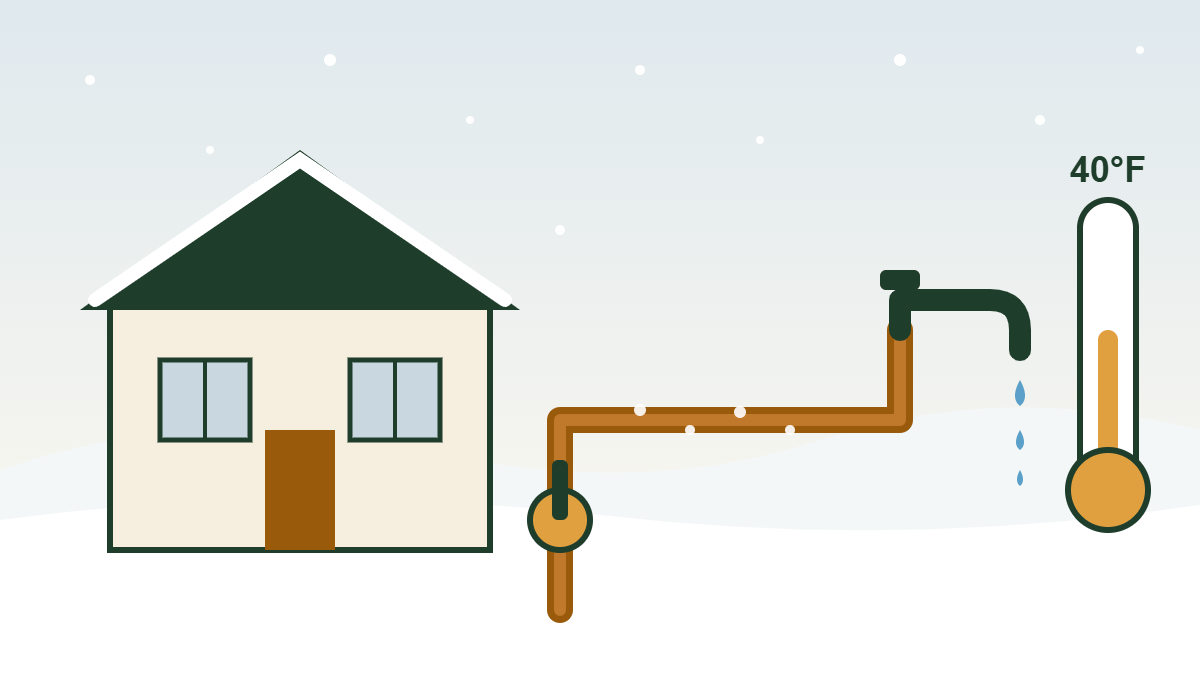
Short answer. When the power and heat go out below freezing, keep the heat in (close doors, open sink cabinets), drip both hot and cold at the faucet farthest from your main valve, and watch the indoor temperature. Pipes in attics, crawl spaces and outside walls are at risk once it is about 20°F (-7°C) or colder outside. If the house falls toward 40°F (4°C) and heat is not coming back, shut off the main water valve and drain the plumbing. On a private well there is no pressure to drip, so drain earlier. Never thaw a pipe with an open flame, and never heat the house with a grill, camp stove or gas oven.
A burst pipe is one of the most expensive things a winter outage can do to a home. State Farm says it received more than 20,000 frozen-pipe and winter water claims from January 2024 through June 2025 and paid more than $628 million, and the five states with the highest totals were Illinois, Oregon, Washington, Texas and Tennessee. That list is the first myth buster: this is not only a northern problem. Below is what actually happens inside a freezing pipe, how many hours your house likely has, and a plan you can follow by temperature, not by guesswork.
Why Pipes Burst (It Is Not Where the Ice Is)
Water expands about 9% when it freezes, but the ice pushing on the pipe wall is usually not what splits it. The classic study on this, by Jeffrey Gordon at the University of Illinois Building Research Council (1996), found that ice first forms a plug that seals the pipe. As more water freezes, the liquid water trapped between that plug and a closed faucet has nowhere to go, and its pressure climbs until the pipe fails. Copper typically bursts somewhere in the thousands of psi.
Two practical lessons follow. First, the break often appears downstream of the ice, sometimes in a spot that never froze at all. Second, a slightly open faucet gives that trapped water an escape route. That is why dripping helps: it relieves pressure. It does not make the water immune to freezing.
The same study is the source of the familiar 20°F rule: in field tests, uninsulated pipes in an unheated attic began freezing when the outside temperature fell to about 20°F. The Insurance Institute for Business & Home Safety notes that homes in the South are often more vulnerable, because pipes are more likely to run through attics, crawl spaces and outside walls.
How Many Hours Do You Have?
There is no honest one-size countdown. Charts that say “pipes freeze in 6 hours” describe exposed pipes in cold spaces. Pipes inside the heated part of the house are protected for as long as the house itself stays warm, and that depends mostly on insulation and air leaks.
The best data we found comes from RMI, which simulated a real week-long Duluth, Minnesota cold snap (outdoor temperatures between 5°F and -25°F) with the power out, and measured how long each type of home took to fall below 40°F inside:
| Type of home | Hours until indoors fell below 40°F |
|---|---|
| Typical 1950s home | 8 hours |
| Typical 1980s home | 23 hours |
| Home built to the 2009 energy code | 45 hours |
| Net-zero energy ready home | 61 hours |
| Passive House | 152 hours |
That was an extreme cold snap, so most outages give you more time. A separate New York City study by Urban Green Council found that in a winter blackout, typical buildings would drift to between 32°F and 43°F indoors over a week, while a high-performing single-family house stayed above 60°F. The takeaway: an older, drafty house can lose its safety margin in one night; a tight, well-insulated one buys you days. Either way, the indoor thermometer is your clock.
The Outage Plan, Step by Indoor Temperature
When the power goes out (house still warm)
- Put a thermometer where pipes are most exposed: a kitchen sink cabinet on an outside wall, the basement or the room above a crawl space.
- Keep the heat in. Close doors to unused rooms, keep the garage door shut if water lines run through it, hang blankets over drafty doors and close curtains at night. Our guide to heating a room safely without power covers the safe ways to add heat.
- Open the cabinet doors under sinks on outside walls so room air reaches the pipes.
- Drip both hot and cold at the faucet farthest from where water enters the house, if you are on city water. A steady drip is enough to relieve pressure. One exception: if your water utility asks people not to drip, follow it. During the February 2021 freeze, Houston asked residents not to run water because citywide dripping was dragging down water pressure.
- Fill containers with drinking water and the bathtub for flushing, in case you need to shut the water off later. See how to store drinking water for an outage.
- Find your main shutoff now, while you have light and time. It is usually where the water line enters the house: basement wall, utility room, garage, near the water heater or in a crawl space. Some homes, especially on slabs, only have a shutoff at the street meter box, which may need a meter key.
If it drops toward 50°F inside
- Check the faucets every few hours. If only a trickle comes out when you open one fully, suspect a partly frozen pipe and start gentle thawing (see below) before it seals completely.
- Look at the forecast and the utility’s restoration estimate. If power is not expected back before the house reaches 40°F, prepare to drain: gather buckets, a flashlight and towels, and read the next section.
- If you have a generator or power station, this is the moment to run whatever keeps your heat going. More on watts below.
At 40°F inside with no heat coming: shut off and drain
Purdue University Extension’s guidance for winter power failures is to begin draining once room temperature drops below about 40°F. At that point pipes in outside walls and cold cavities are close to freezing. Draining takes out the water that would freeze and burst. Here is the order:
- Turn off the water heater first. Switch off the breaker for an electric heater, or set a gas heater to off or pilot. An empty tank with the elements or burner on can be ruined.
- Close the main water valve. On a well, turn off the breaker for the well pump.
- Open every faucet, hot and cold, starting on the top floor to let air in, then open the lowest faucets (basement sink, laundry tub or the lowest tub spout) so the lines drain down.
- Flush every toilet and hold the handle down to empty the tank. Sponge out what remains if you can.
- Protect drain traps. The water sitting in sink, tub and toilet traps can freeze and crack them. Purdue suggests pouring RV or plumbing antifreeze (propylene glycol) into traps and toilet bowls. Never use automotive antifreeze, which is toxic, and never put antifreeze into your water supply lines or appliances.
- Drain outdoor faucets and disconnect hoses, and if you have time, drain the water heater, washing machine hoses and the water softener as the manuals describe.
- Leave the faucets open until heat is back.
Draining is not perfect. Low spots in horizontal runs can hold water, and some single-handle faucets only open fully under pressure. It still removes most of the water and most of the risk. In an apartment, do not shut off the building’s water or touch a fire sprinkler system. Call the landlord or building maintenance instead.
Special Cases Most Guides Skip
Private well
A well pump stops the moment the power goes out. What is left is the water stored in the pressure tank, and less of it is usable than the tank size suggests. A common 20-gallon tank, Amtrol’s Well-X-Trol WX-202, is rated to deliver only about 5.4 to 6.2 gallons between pump cycles at typical pressure settings. Dripping faucets will empty that within hours, and then nothing protects the pipes. If you are on a well and cannot power the pump, Purdue’s advice is to turn off the pump, drain the pressure tank and drain the lines. A generator or large power station that can run the pump is the alternative; see what size generator you need for how to size it.
Tankless water heater
Most tankless water heaters have built-in freeze protection, but it runs on electricity. Navien warns that if you lose power during a freeze, the internal protection stops working and you must drain the unit or provide backup power, and that freeze damage is not covered by its warranty. Rheem gives the same advice. The draining steps differ by model, so keep the manual where you can find it in the dark. In general: power off, gas off, close the cold-water inlet and hot-water outlet valves, open a hot faucet, then open the drain caps under the unit into a bucket. A small power station can often run just the freeze protection, which typically draws little power, but check the rating label on your unit.
Boilers and hot-water baseboard heat
Hot-water heating loops run along outside walls and can freeze before the rest of the house. If you have backup power, Purdue recommends keeping the circulator pump running, because moving water resists freezing. A typical small circulator draws well under 100 watts. Without power, these systems are hard to drain completely, and antifreeze in a heating loop is a job for a heating contractor, not something to improvise in an outage.
Crawl spaces, mobile homes and slab houses
In a manufactured or mobile home, the water lines usually run under the floor inside the belly wrap, often kept warm by heat tape that stops when the power does. Find the shutoff where the supply line comes up under the home before an outage, and drain early. Homes on vented crawl spaces should have the vents closed or covered during a hard freeze. In slab homes, common across Texas and the South, the most exposed pipes are often in the attic and outside walls, not under the floor.
Renters
Ask your landlord now where the shutoff is, keep cabinet doors open, report heating problems in writing, and call emergency maintenance at the first sign of a frozen pipe. Renters insurance generally covers your belongings and extra living costs after a sudden pipe burst, not the building itself.
What to Run on a Generator or Power Station
The cheapest way to save your pipes with backup power is to keep your existing heat running, not to buy a space heater. A gas furnace or boiler needs only its blower, controls or circulator pump: a circulator draws under 100 watts, and a furnace blower anywhere from a few hundred to about 1,000 watts. A 1,500-watt space heater, by comparison, empties most portable power stations in an hour or two. Use our outage calculator to see what your battery or generator can carry, and our power station buyer’s checklist before you buy one.
| Load | Typical draw | Worth powering? |
|---|---|---|
| Boiler circulator pump | About 50 to 90 W (high-efficiency models less) | Yes, keeps heating loops from freezing |
| Tankless heater freeze protection | Low; check the unit’s label | Yes, protects the heater itself |
| Pipe heat cable | Roughly 3 to 10 W per foot, by product | Yes, for short exposed runs |
| Furnace blower and controls | Roughly 300 to 1,000 W, higher at startup | Yes, if your generator can start it |
| Electric space heater | 750 to 1,500 W | Only in one room, and only with care |
Safety, without exception: run a portable generator outdoors only, at least 20 feet from the house, with the exhaust pointed away from doors, windows and vents, as the Consumer Product Safety Commission advises. Never in a garage, basement or porch, even with the door open. The CPSC estimates about 100 people die each year from carbon monoxide linked to portable generators, and the CDC counts more than 400 deaths a year from unintentional carbon monoxide poisoning not linked to fires. Keep battery-powered CO alarms on every level. See how to run a generator safely in snow and cold.
If you use an electric space heater, keep it at least 3 feet from anything that can burn, plug it straight into a wall outlet (no power strips), and turn it off when you leave the room or go to sleep. Never heat the house with a gas oven, grill, camp stove or unvented fuel heater.
Eight Myths About Frozen Pipes
- “A dripping faucet keeps the water from freezing.” Not exactly. Moving water can still freeze. The drip mainly relieves the pressure that bursts pipes. It helps a lot, but it is not a substitute for heat or draining in a long outage.
- “Pipes burst where the ice is.” Usually not. Pressure builds in the water trapped between the ice plug and a closed faucet, and the pipe splits there, sometimes in a spot that never froze.
- “PEX can’t burst.” PEX tolerates freezing much better than copper, but it is not freeze-proof. Its rigid fittings can fail, repeated freeze-thaw cycles can damage it, and a frozen PEX line still delivers no water.
- “Insulated pipes won’t freeze.” Insulation only slows heat loss. With no heat source, an insulated pipe in a cold space will still freeze, just later.
- “Only northern homes need to worry.” The South is often more vulnerable, because pipes run through attics, crawl spaces and outside walls. Texas and Tennessee are in State Farm’s top five for frozen-pipe losses.
- “If water still trickles, the pipe isn’t frozen.” A weak trickle from a fully open faucet is a classic sign of a partial freeze. Act then, not later.
- “A torch thaws a pipe fastest.” Every safety authority says never use an open flame. Torches set wall framing and insulation on fire, melt plastic pipe and can turn trapped water into steam.
- “Any antifreeze will do.” Automotive antifreeze is toxic and does not belong anywhere in household plumbing. Only RV or plumbing antifreeze, and only in drains, traps and toilets.
If a Pipe Is Already Frozen
- Open the faucet the pipe feeds, so melting water and pressure have somewhere to go.
- Find the frozen section. Look for frost, a bulge, or a pipe on an outside wall or in a cold cabinet.
- Apply gentle heat, starting from the faucet end and working back toward the ice: a hair dryer, an electric heating pad, or towels soaked in hot water. If you have no power, warm towels and a closed, warmed room are the safe options.
- Keep electrical tools away from standing water, and use a GFCI-protected outlet.
- Never use a torch, propane or kerosene heater, or charcoal to thaw a pipe.
- If you can’t find or reach the frozen section, or the pipe is inside a wall, shut off the main and call a plumber. If any pipe has split, shut off the main immediately.
A small crack can release up to 250 gallons of water a day, so knowing where your main shutoff is, before the outage, is the single most valuable thing on this page.
When the Power Comes Back
A pipe that split while frozen often does not leak until the ice melts. That is why many floods start after the heat comes back, not during the outage. Restore water in this order:
- Keep the water heater off (breaker or gas).
- Close all faucets except one cold faucet on the lowest floor.
- Open the main valve slowly and listen. Running water inside a wall or ceiling means a break: close the main again.
- Open the other faucets one at a time, cold first, then hot, from the bottom floor up, until they run without sputtering air.
- Turn the water heater back on only when its tank is full, which you can tell by a steady stream from the hot faucets. An electric heater switched on with an air pocket in the tank can burn out its upper element.
- With every faucet closed, check the water meter. If the leak indicator is still moving, water is escaping somewhere.
- Walk the house again over the next several hours, checking ceilings, cabinets, the basement and the crawl space as the walls warm up.
What Insurance Expects From You
A sudden burst pipe is generally covered by a standard homeowners policy, but read the freezing clause. The common HO-3 form excludes freeze damage while a home is vacant or unoccupied unless you used reasonable care to keep the heat on or shut off the water and drain the system. Slow leaks over weeks are usually excluded too. During an outage, take photos of your thermometer, the steps you took and any damage, stop the water, start drying within a day or two, and call your insurer promptly. Policies differ, so check yours before winter.
Quick Answers
At what outdoor temperature should I start worrying? Around 20°F for pipes in attics, crawl spaces and outside walls, based on University of Illinois field tests. Exposed outdoor lines can freeze closer to 32°F.
Should I drip hot or cold? Both, at the faucet farthest from the main. Hot lines freeze too.
How long can my house go without heat? From under a day in an older, drafty house during a deep freeze to several days in a tight, well-insulated one. Watch the indoor temperature and drain at about 40°F.
Is it safe to leave the house with the water drained? Yes, and it is the safer choice if you are evacuating during a long winter outage. Turn off the water heater, leave the faucets open and put a note on the main valve so no one turns it back on before the heat is restored.
Will my water still be safe to drink after the pipes thaw? If no pipes broke and your utility has not issued a boil-water notice, yes. Run the cold water for a few minutes first. After a city-wide freeze, check for notices before drinking tap water.
Next step. Pipes are one part of a winter outage plan. If you want the whole plan in one place, from batteries and heat to water and food, grab the free sample of the Winter Battery & Power Outage Guide, or see the full Winter Battery & Power Outage Guide.
Sources: Gordon, J.R., An Investigation into Freezing and Bursting Water Pipes in Residential Construction, University of Illinois Building Research Council (1996) · IBHS, Freezing and Bursting Pipes · RMI, Hours of Safety in Cold Weather (2020) · Urban Green Council, Baby It’s Cold Inside (2014) · Purdue Extension, Protect Your Plumbing and Appliances during a Winter Power Failure · American Red Cross, Preventing and Thawing Frozen Pipes · Iowa State University Extension, Cold Weather and Frozen Pipes · State Farm, Frozen Pipes? Not So Nice! (January 2026) · Navien, Tankless Water Heater Frozen · Rheem, Can Water Heaters Freeze? · Rinnai, Freeze Protect Your Rinnai Product · Amtrol Well-X-Trol WX-202 drawdown specifications · Viega, Is Your PEX Pipe Freezing? · Plumber Magazine, The Science Behind Frozen Pipes · KHOU, Why Houston asked residents not to drip faucets (2021) · CPSC, Portable Generator Safety · CDC, Carbon Monoxide Poisoning · Sample HO-3 Homeowners Policy Form
This article contains no affiliate links.