When the power goes out in a snowstorm, the generator suddenly matters more than anything else in the house. It also becomes more dangerous. Snow, wind and bitter cold push people to do the one thing that kills: move the generator into the garage, the shed or the porch “just for tonight.”
This guide covers how to run a portable generator outdoors in snow and sub-zero cold — where to put it, how to keep snow off it without trapping exhaust, how to get it started when it’s frozen, and the fuel and cord problems that only show up in winter.
Short answer
Run it outside only, at least 20 feet from the house, with the exhaust pointed away from doors, windows and vents — never in a garage, shed or porch, even with the door open. Keep snow off the outlets only in a way your manual allows (some allow a vented, noncombustible generator tent; some say wait out the storm), use cold-weather oil, keep the starter battery charged, use bigger propane tanks in deep cold, and have battery-powered CO alarms working inside.
Why Winter Is the Most Dangerous Time to Run a Generator
According to the U.S. Consumer Product Safety Commission (CPSC), an average of nearly 100 people die in the U.S. each year from carbon monoxide (CO) poisoning caused by portable generators. CO has no smell and no color, and it can knock you unconscious before you notice any symptoms.
Winter storms make it worse. During the February 2021 Texas winter storm, the Texas Department of State Health Services counted 19 carbon monoxide deaths among 246 storm-related deaths, linked to generators, grills, heaters and vehicles used in enclosed spaces, and to ice blocking vents on gas heating equipment.
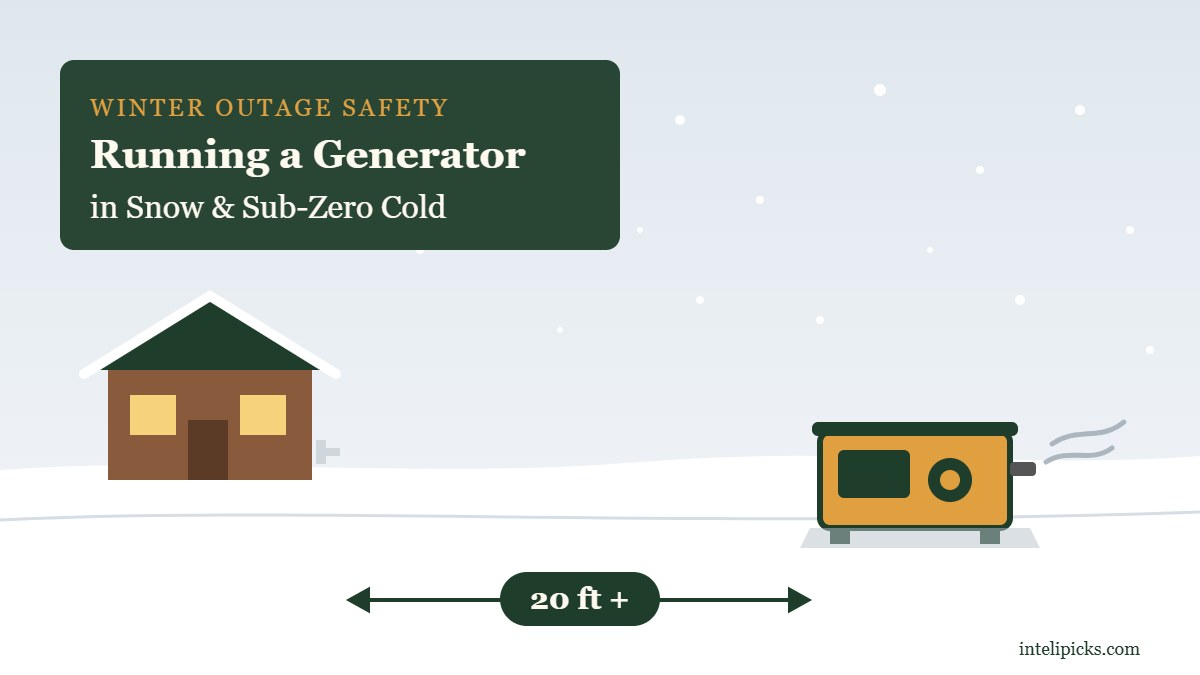
Rule #1: Outside Only, at Least 20 Feet From the House
The CPSC’s guidance is direct: operate portable generators outside only, at least 20 feet away from the house, and never inside a home, garage, basement, crawlspace, shed or other enclosed space.
That includes a garage with the door open. CPSC states that opening doors or windows will not provide enough ventilation to prevent CO from building up to lethal levels.
- Point the exhaust away from the house, and away from doors, windows and vents — yours and your neighbor’s.
- Watch the wind. If it’s blowing exhaust toward the house, move the generator. Your manual may say your specific home or wind conditions require more distance than 20 feet.
- Don’t run it on a porch, under a deck or in a carport.
If the storm brings floodwater instead of snow, the same 20-foot rule applies, with a few more: never run it in a flooded garage or basement, and keep it and its cords out of standing water. Our guide to a power outage during a flood covers the rest.
The Hidden CO Trap: Your Furnace Vents
Many people start the generator precisely to keep a gas furnace running. Here’s the part most generator guides miss: high-efficiency furnaces often vent through pipes on an outside wall, close to the ground. If drifting snow buries those pipes, the furnace’s own exhaust can back up into the house.
CPSC recommends clearing snow away from the outside vents of fuel-burning appliances such as furnaces. Every time you go out to check the generator, check the furnace vents too.
If you’re sizing a generator for your furnace, see our guide: What Size Generator Do I Need to Run My Furnace?
Keeping Snow Off Without Trapping Exhaust
Blowing snow and freezing rain getting into the outlets is a real shock and damage risk. But the common fixes — a tarp, a plywood box, a shed — can trap heat and exhaust or catch fire.
Check your manual first
Manufacturers don’t all agree here. Some generator manuals say flatly never to expose the unit to rain or snow while it’s running. CPSC says to follow the manufacturer’s instructions, which may include using an NFPA-rated noncombustible generator tent, or may tell you to wait until the rain or snow passes. If your manual forbids running in snow, take that seriously — it affects both safety and your warranty.
If you use a generator tent or canopy
Purpose-built canopies are designed to keep precipitation off the outlets while leaving the engine open to air. The installation manual for one popular canopy (GenTent) includes rules worth following with any cover:
- Never obstruct or cover the exhaust muffler. If exhaust blows directly onto the canopy, it’s installed wrong.
- Keep the clear apron over the outlets at least 4 inches from the exhaust.
- During snowstorms, brush away snow that blocks the top vent or piles up around the generator.
- Shut the generator off before refueling or doing any maintenance.
What not to do
- Don’t wrap a running generator in a plastic tarp — it can melt or ignite on the hot muffler and traps exhaust and heat.
- Don’t build a closed box around it. Air-cooled engines need a lot of airflow.
- Don’t let snow drift against the air intake or exhaust. Check it regularly during heavy snow.
Get it off the snow
Set the generator on a firm, level surface above the snow — a cleared patio slab or packed gravel works. Keep it away from wooden decks attached to the house. Clear the spot and lay out your cords before the storm, while you can still see what you’re doing.
Getting a Cold Generator to Start
Use the right oil for the temperature
Thick oil makes a cold engine hard to crank and slow to lubricate. Generac’s guidance for its portable generators is a good example of how manufacturers handle this:
- SAE 30 above 32°F
- 10W-30 between about -10°F and 40°F
- Synthetic 5W-30 usable in all temperatures
Other brands publish their own charts, so check your owner’s manual before you change oil — but if you’re still running straight SAE 30 and a hard freeze is coming, that’s the first thing to fix.
Know your generator’s temperature limits
Generators aren’t rated for unlimited cold. For example, the manual for one Westinghouse dual-fuel model says it’s rated for continuous operation at ambient temperatures up to 104°F, and for short periods between 5°F and 122°F. Look up the range in your own manual. If you live where it regularly drops below that, plan for it.
Keep the starter battery alive
Electric-start generators depend on a small 12V battery, and cold weather is hard on batteries. If you can’t pull a recoil cord — because of your shoulders, back or age — that battery is your whole plan.
- Keep it on a battery maintainer (float charger) through the winter, or charge it fully before a storm.
- Test-start the generator before the storm arrives, not during it.
- A small jump starter, kept charged indoors, is a useful backup if your model allows it. Check the manual for the correct connection.
Start it with no load
Start the generator with nothing plugged in (or the main breaker off on a transfer switch or interlock), let it run a few minutes to warm up, then add loads one at a time, starting with the most important ones like the furnace and fridge.
Old fuel and water in the fuel
Gasoline goes stale, and ethanol-blended fuel can absorb moisture. In deep cold, water in the fuel system can freeze. Use fresh fuel with a stabilizer, and if the generator has been sitting for months with old fuel, deal with it before the storm rather than trying to start it during one.
Some owners in very cold climates also report problems with moisture freezing in the engine’s crankcase breather hose. If you live somewhere that regularly drops well below 0°F, ask your dealer or check your manual for cold-weather advice for your specific model.
Propane in the Cold: Why Small Tanks Quit
Many dual-fuel owners plan to run on propane in winter because it doesn’t go stale. There’s a catch: propane boils at about -44°F, so it still vaporizes well below freezing — but as the generator draws gas, the liquid in the tank cools itself down. A small 20 lb grill tank has limited surface area to pull heat from the cold air, so pressure can drop until the engine starves, especially under a heavy load or as the tank gets low.
- Use larger cylinders (such as 40 lb or 100 lb) for a large generator in cold weather, or connect tanks with a manifold if your setup allows it.
- Don’t let tanks run nearly empty in very cold weather.
- Never heat a propane tank or regulator with a flame, a heat gun or the generator’s exhaust.
Also remember that most dual-fuel generators make less power on propane than on gasoline. Check the propane rating on your generator’s label — not the bigger gasoline number — when you plan what you’ll run.
Extension Cords and Connections in the Cold
- Use heavy-duty outdoor cords sized for the load and length. Undersized cords overheat and drop voltage.
- Choose cords that stay flexible in the cold. Some standard vinyl outdoor cords get stiff and can crack when bent in freezing weather. Look for cords labeled for cold weather; many are rubber or TPE jacketed (for example SJEOW, SJOOW or SOOW). Check the temperature rating printed on the jacket.
- Keep connections out of snow and water. Lift the joint off the ground and protect it so snowmelt can’t get into the plug.
- Lay cords before the storm and route them where they won’t be buried, driven over or shoveled.
Never backfeed through a wall outlet
Plugging a generator into a wall outlet or dryer outlet with a double-male cord (“backfeeding”) can send power back into the utility lines and endanger line workers and neighbors, and it can start a fire in your home. To power household circuits, use a transfer switch or an interlock installed by a licensed electrician — or plug appliances directly into the generator with proper cords.
CO Alarms: Your Last Line of Defense
CPSC recommends battery-operated CO alarms, or alarms with battery backup, on each level of the home and outside separate sleeping areas. Hardwired alarms without battery backup won’t work in a power outage. Test them before winter.
If you’re shopping for a generator, CPSC also recommends looking for models with a CO shut-off safety feature. CPSC has estimated that the voluntary standards behind these features could prevent a large share of generator CO deaths.
If a CO alarm sounds, or anyone feels dizzy, nauseous or confused, get everyone outside to fresh air immediately and call 911.
Pre-Storm Generator Checklist
- Test every CO alarm and replace batteries if needed.
- Check that your oil matches the coming temperatures (see your manual).
- Fully charge the starter battery, or keep it on a maintainer.
- Test-start the generator and run it for a few minutes under a light load.
- Have fresh, stabilized fuel or full propane tanks ready.
- Pick and clear a spot at least 20 feet from the house, with exhaust pointed away from doors, windows and vents.
- Set up your canopy or shelter (if your manual allows it) before the weather turns.
- Lay out cold-rated cords and protect the connections.
- Know how your transfer switch or interlock works — or which appliances you’ll plug in directly.
- Plan your loads with our Power Outage Calculator.
- During the storm: clear snow from the generator, its vents and your furnace vents regularly.
- Always shut it off and let it cool before refueling.
Bottom Line
A generator can keep your family warm through a winter outage, but only if it stays outside, far from the house, with its exhaust pointed away and CO alarms working inside. Most cold-weather problems — hard starts, dead batteries, frozen propane tanks, cracked cords — are easy to prevent if you deal with them before the storm instead of in the middle of it.
Want a printable reference for the next outage? Get the free 2-Minute Winter Battery Check, or see the full Winter Battery & Power Outage Guide.
Sources: CPSC winter storm warning (Feb 2026), CPSC generator CO report (2022), Texas DSHS winter storm mortality report, Generac portable generator oil guidance, Westinghouse WGen12000DFc manual, GenTent canopy manual.
This article is general safety information, not a substitute for your generator’s owner’s manual or a licensed electrician.