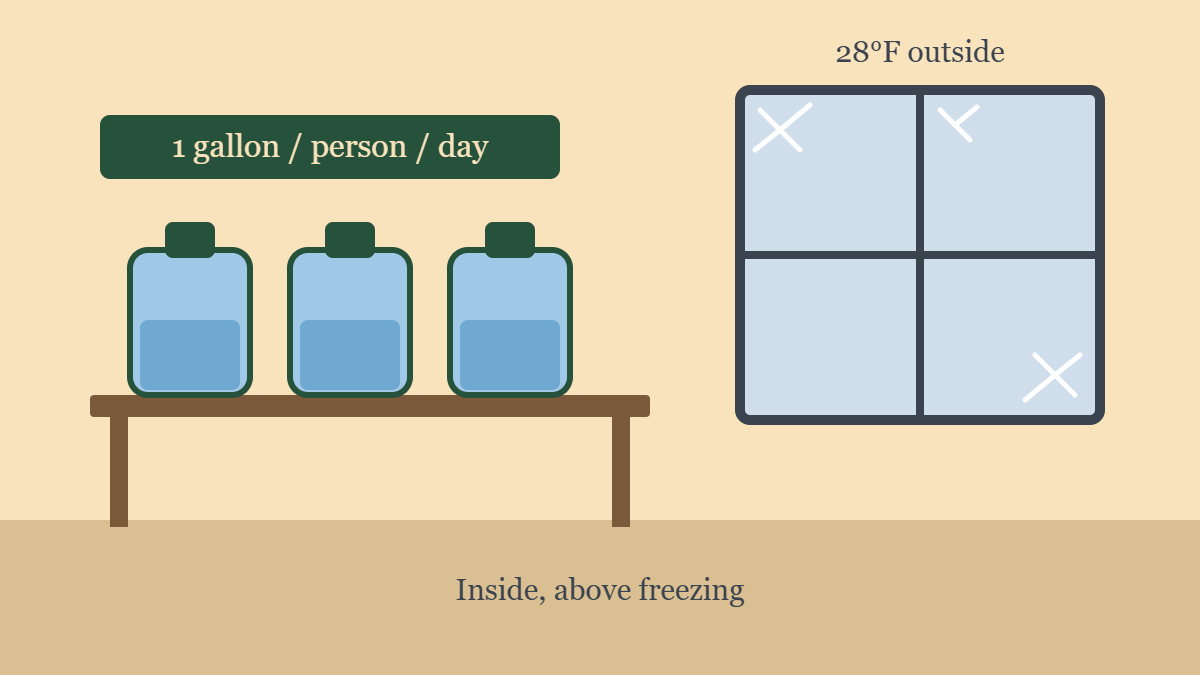
Short answer. Store at least 1 gallon (about 4 liters) per person per day, enough for 3 days as a minimum and 2 weeks if you can manage it. Use unopened store-bought water or clean food-grade containers, keep them in a cool, dark place that stays above freezing, and replace water you filled yourself every 6 months. In winter the usual mistakes are storing jugs in an unheated garage and filling them to the brim, because water expands when it freezes.
Most water storage advice is written for hurricane season, when heat is the enemy. A winter outage is different. Pipes can freeze, a well pump stops without electricity, and the jug you left in the garage can split overnight. This guide keeps the official quantities and adds the cold-weather details that usually get skipped.
How Much Water Do You Actually Need?
The CDC says to store at least 1 gallon of water per person per day for 3 days, for drinking and sanitation, and to try for a 2-week supply if you can. It also says to store more for hot climates, for pregnant women and for people who are sick. Pets need water too; University of Florida extension guidance suggests a quart to a gallon per pet per day, depending on size.
| People in the home | 3 days | 14 days |
|---|---|---|
| 1 | 3 gal (11 L) | 14 gal (53 L) |
| 2 | 6 gal (23 L) | 28 gal (106 L) |
| 4 | 12 gal (45 L) | 56 gal (212 L) |
| 6 | 18 gal (68 L) | 84 gal (318 L) |
These figures are the minimum, at 1 gallon per person per day. Add the pets, add a margin for anyone who is pregnant, sick or very active, and remember that water weighs about 8 pounds per gallon, so 14 gallons is over 100 pounds. If 14 days is out of reach, start with 3 days and add a few gallons each time you shop.
On a private well? No electricity usually means no pump, and no pump means no water from the tap at all. Your stored supply is your only supply, so aim for the 2-week figure.
Which Containers Are Safe
The safest and most reliable choice, according to the CDC, is unopened commercially bottled water. Keep it sealed in its original container and follow the date on the bottle. If you fill your own containers, use food-grade ones.
| Container | Verdict | Why |
|---|---|---|
| Sealed store-bought bottles or jugs | Best | Already treated and sealed; the date on the label tells you when to replace them |
| Food-grade 5-gallon jugs or barrels (HDPE, recycling code 2) | Good | Made for the job; heavy when full, so use handles or a hand truck |
| Clean 2-liter soda bottles | Good | Previously held a beverage, easy to wash, tight cap, cheap |
| Plastic milk and juice jugs | Avoid | Milk protein and fruit sugars are hard to remove and feed bacteria; the plastic also gets brittle |
| Glass bottles | Avoid | Heavy, and they can crack in a freeze or when dropped |
| Bleach or chemical containers | Never | Not food-grade; residue cannot be washed out reliably, and water stored for washing can be mistaken for drinking water |
How to sanitize a container before filling it: wash the inside and outside with dish soap and hot water, then rinse. Then rinse with a solution of 1 teaspoon of unscented household bleach per quart of water, let it stand briefly, and rinse again with clean water. Fill it with safe tap water, close it tightly, and label it “drinking water” with the date.
Where to Keep It in Winter
The general rule is a cool, dark place, because heat and light encourage algae and bacteria and wear out plastic. In winter, add one more rule: above freezing.
- Best: a closet, pantry shelf, the space under a bed or a spot along an interior wall of a heated room. It stays cool and dark and it stays above freezing, even if the heat goes off for a day or two.
- Acceptable with precautions: a basement that stays above freezing. Keep containers off the floor on a shelf or boards, away from paint, gasoline and cleaning chemicals.
- Risky: an unheated garage, shed, porch or car. In a long cold snap the water will freeze, and a full container can split.
If you can only use a cold space, leave air in each container. Water expands when it freezes, and common practice is to fill containers to roughly 80 to 90 percent so the ice has somewhere to go. A 2-liter bottle that is three-quarters full usually survives, while thin 500-ml bottles split easily. Frozen water is not ruined. If the container is intact, thaw it indoors and use it as normal.
Plan for a long outage in the cold, too. If the house is also losing heat, the water in your pipes can freeze, which is another reason the stored supply matters. Our guide to heating one room safely without power covers how to keep the part of the house you are using above freezing.
How Long Stored Water Lasts
- Store-bought water: follow the date on the bottle.
- Water you filled yourself: the CDC says to replace it every 6 months. Label the date on each container when you fill it.
Pick two dates and tie the check to them, such as the two days a year the clocks change. On those days, glance at the labels, replace anything older than 6 months, and look for leaks, cracks, cloudiness or an off smell. If a container looks or smells wrong, do not drink it; treat it and use it for washing, or discard it.
When You Run Short: Making Water Safe
The CDC lists three ways to make questionable water safe: boiling, disinfecting and filtering. Boiling is the most reliable.
- Boil it. If the water is cloudy, let the particles settle or filter it through a clean cloth or coffee filter first. Bring it to a rolling boil for 1 minute (the CDC says longer at high elevation), then let it cool and store it in a clean, covered container.
- Disinfect it with bleach if you cannot boil. Use plain, unscented household bleach. For 1 gallon of clear water, the CDC gives 8 drops (a little under 1/8 teaspoon); for cloudy water, 16 drops (1/4 teaspoon). Mix well and wait at least 30 minutes before drinking. Check the bleach label for its strength and follow the CDC’s current chart for your product.
- Filter it. A filter helps with sediment and some germs, but check what it is rated for. A basic filter does not replace boiling or disinfecting.
Important limits: the CDC warns that water contaminated with fuel, toxic chemicals or radioactive material is not made safe by boiling or disinfecting. And if you boil water on a camp stove or grill during an outage, do it outdoors or in a well-ventilated space. Never run charcoal or a fuel stove inside the house, because the carbon monoxide is deadly.
Extra Water You May Already Have
Before an outage, you can fill spare clean containers, pots and the bathtub (for washing and flushing, not drinking, unless the tub was cleaned first). FEMA also lists water in your pipes and in your water heater tank as emergency sources. Use these only if the water is not contaminated and treat before drinking when in doubt. Shut off the power or gas to the heater before draining it.
Seven Mistakes People Make
- Counting only drinking water. The 1-gallon figure covers drinking and basic sanitation; it does not cover a daily shower.
- Keeping everything in the garage. One hard freeze and the jugs split.
- Filling every container to the brim in a space that can freeze.
- Reusing milk jugs because they are free.
- Forgetting the date. Without a label, nobody knows how old the water is.
- Storing near chemicals. Gasoline, paint thinner and pesticides can affect plastic containers and are a risk in themselves.
- Assuming you will be able to boil it. Plan the fuel and the cookware now. If the power is out and you have no stove, boiling is not an option.
Quick Winter Water Checklist
- Work out your number: people × days × 1 gallon, plus pets.
- Buy sealed bottled water or food-grade jugs; avoid milk jugs and glass.
- Sanitize and label any container you fill yourself, with the date.
- Store it indoors in a cool, dark spot that stays above freezing.
- If any container may get cold, leave 10 to 20 percent air space.
- Keep unscented bleach and a dropper, or know how you will boil water without power.
- Set two reminders a year to rotate and check.
Water is only part of the plan. If you are working on the rest, see the 2-week no-cook pantry list and the notes on food safety when the power goes out, which covers what to keep and what to throw away.
Quick Answers
Is 1 gallon per person per day enough? It is the CDC’s minimum for drinking and basic sanitation. More is better if you have space, especially in heat, during illness or pregnancy, and for pets.
Can I use tap water to fill the containers? Yes, if your tap water is normally safe. Fill containers with it, close them tightly, label them and replace them every 6 months.
Does stored water go bad? Sealed store-bought water is good until its date. Water you fill yourself should be replaced every 6 months, because containers and caps are never perfectly sterile.
Is frozen water safe to drink after it thaws? If the container held and the water was clean to begin with, yes. Treat it if you have any doubt.
Can I store water in a bathtub? For washing and flushing, if you clean it first and cover it. It is not a good place for drinking water you plan to keep.
Keep the pipes from freezing, too. Stored water helps most when your plumbing also survives the outage. See how to keep pipes from freezing when the power goes out, including when to shut off the main and drain the system.
Next step. If you want the whole plan in one place, grab the free sample of the Winter Battery & Power Outage Guide, or see the full Winter Battery & Power Outage Guide.
Sources: CDC, How to Create an Emergency Water Supply · CDC, How to Make Water Safe in an Emergency · Ready.gov, Water · University of Florida IFAS, Emergency Water Supply (SS439) · Mississippi State Extension, Disaster Relief: Drinking Water · Utah Division of Emergency Management, Water Storage Guide · Regional Water Providers Consortium, emergency water containers · Cottage Life, Storing drinking water in winter
This article contains no affiliate links.