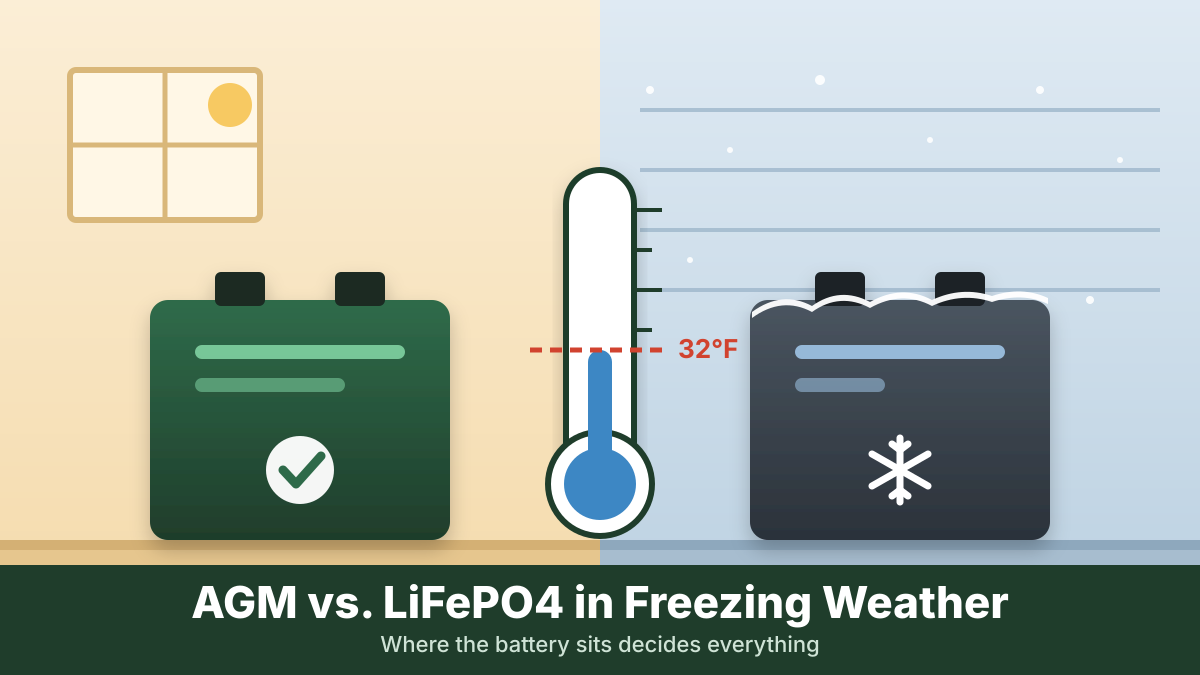
Short answer. Cold hurts the two batteries in different ways. A LiFePO4 battery handles cold discharging better than AGM, but it must not be charged when its cells are below freezing (32°F / 0°C; some makers say 41°F / 5°C). An AGM battery can still accept a charge in the cold, but a half-empty one can freeze and crack. Keep the battery in a heated room or basement and LiFePO4 is the better pick. Put it in an unheated garage or shed and you need either a LiFePO4 model with built-in heating or an AGM battery kept fully charged on a charger with temperature compensation.
Three rules before anything else: never charge a battery that is frozen or swollen, never charge a LiFePO4 battery whose cells are below the maker’s stated limit, and read the limits for your exact model, because they differ from brand to brand.
Charging and Discharging Are Two Different Problems
Most “which battery is better in the cold” articles skip the point that matters most for a winter outage. Taking power out of a cold battery and putting power into a cold battery are different chemical events.
- Discharging in the cold mostly means you get less usable energy. The battery is not damaged, but the runtime you counted on shrinks.
- Charging in the cold is where LiFePO4 can be permanently damaged, because lithium can plate onto the anode instead of going in properly. For AGM, the cold-weather danger is a different one: a discharged battery can freeze.
That is why the answer depends less on the chemistry than on where the battery sits and what state of charge it is in when the cold arrives.
Where the Battery Sits Decides Everything
| Location | Better choice | What to check |
|---|---|---|
| Heated room or basement that stays above about 41°F (5°C) | LiFePO4 | Charging limits in the manual; keep it away from heat sources and out of the way of exits |
| Cool but unfrozen space (40s to low 30s °F / around 0°C) | LiFePO4 for discharge, with a plan for charging; AGM works if kept full | Pack temperature before you start charging, not the weather forecast |
| Unheated garage or shed that drops below freezing | LiFePO4 with built-in heating, or AGM kept fully charged | For AGM: float charger with temperature sensor. For heated LiFePO4: how the heater is powered and when it turns on |
| Outdoors or an unheated vehicle | Neither, unless it is rated and housed for it | Bring it inside before the cold snap |
If you are still choosing a power station or battery size, read what to look for in a portable power station first. This article only deals with what the cold does to the battery you pick.
What LiFePO4 Does in the Cold
Discharge. LiFePO4 keeps working at temperatures where a lot of batteries struggle, but capacity falls. As one clear example, Victron’s lithium battery documentation says rated capacity drops by about 20% at 32°F (0°C) and by about 50% at -4°F (-20°C), measured at a discharge rate of up to 1C. Its 100 Ah model is listed at 80 Ah at 32°F and 50 Ah at -4°F. That is one maker’s data for one product line, not a universal rule, so treat it as a planning example.
Example with made-up round numbers: a 1,280 Wh battery that powers your router, a few lights and a phone charger for a long evening at room temperature might give you roughly half of that, around 640 Wh, if it is genuinely at -4°F. Size for the cold, not the brochure.
Charging. This is the part that catches people. Victron blocks charging when the battery’s cell temperature is below 41°F (5°C), because its testing found that charging lithium iron phosphate below that point damages cells. Other makers publish different numbers. Many allow charging from 32°F (0°C), and some manuals give one limit for the battery pack and a separate one for the cells. When two numbers appear, use the stricter one, and remember that what counts is the temperature of the cells, not the air.
Fire safety groups say the same thing in plainer words: NFPA’s consumer guidance advises against charging lithium-ion batteries below 32°F or above 105°F.
Portable power stations. Most have a battery management system that refuses to charge when the pack is too cold. For example, EcoFlow lists its DELTA 2 as chargeable from 32°F (0°C) and dischargeable from 14°F (-10°C), and notes that what matters is the pack’s real temperature. If you plug in a solar panel or a wall charger and nothing happens in a freezing room, that is the protection working, not a fault. Warm the unit gradually in a heated room first.
Heated LiFePO4 batteries. Some models have an internal heater that turns on before charging, so the battery can be charged in colder air. They cost more and the heater draws power from the charging source, so check how it behaves in your setup and what the manual says about the lowest air temperature it supports.
What AGM Does in the Cold
Charging. AGM and other lead-acid batteries can usually be charged below freezing, as long as the battery is not frozen. A proper charger adjusts voltage with temperature, higher when cold and lower when hot, using a sensor on or near the battery. Without that adjustment, a cold AGM battery tends to end up undercharged. Follow the battery maker’s charge settings, because the exact adjustment differs between makers.
Freezing. The risk with AGM is not the cold on its own. It is a battery left partly discharged. Trojan’s guide says batteries can freeze in cold temperatures if they are not fully charged, advises keeping them fully charged in winter, and says never to charge a frozen battery. Trojan’s deep-cycle storage guide gives these electrolyte freezing points by state of charge:
| State of charge | Electrolyte freezing point |
|---|---|
| 100% | -92°F (-69°C) |
| 62% | -16°F (-27°C) |
| 40% | +5°F (-15°C) |
| 20% | +19°F (-7°C) |
Read the table as a direction, not a guarantee. It comes from a flooded-battery guide, and published numbers differ between sources. The glass mat in an AGM battery holds the electrolyte in place, but it does not make the battery immune to freezing, and Trojan’s guide still tells you to keep the battery fully charged in cold months. A frozen lead-acid battery can crack its case or damage its plates, so do not charge it. Have it tested or replace it.
How to check your AGM battery. Measure resting voltage with a basic multimeter, with the battery rested and no charger or load connected. Trojan’s table for 12 V AGM batteries shows roughly 12.84 V at 100%, 12.54 V at 75%, 12.24 V at 50%, 11.94 V at 25% and 11.64 V at 0%. If yours reads near the bottom half of that table before a freeze, charge it fully and keep it on a maintenance charger.
Capacity. Lead-acid also loses usable capacity in the cold, and the figures vary by model, so check the datasheet for your battery. Do not assume a battery that works for four hours in your garage in July will do the same in January.
Safety: Heat, Gas, and Recalls
- Lead-acid and ventilation. Lead-acid batteries can release hydrogen when charging. Charge them in a ventilated space, away from sparks, and follow the maker’s instructions. LiFePO4 does not release hydrogen in normal use.
- Do not warm batteries with heat sources. Do not put a battery next to a space heater, a fireplace or a stove to thaw it. Move it to a room at normal indoor temperature and let it warm up on its own.
- Check the damage first. If a case is swollen, cracked, leaking or smells odd, stop. Do not charge it. Contact the maker or a battery recycler.
- Check for recalls. Portable power stations have had real recalls, so look up your model before you rely on it in an outage. The table below lists recalls we verified on the regulators’ pages.
| Product | Recall date | Units | Reported hazard |
|---|---|---|---|
| Goal Zero YETI 3000X (CPSC 26-712) | Aug 20, 2026 | About 46,200 | Circuit board can overheat; free firmware update; four reports of fire or overheating, no injuries |
| EcoFlow DELTA Max 2000 (CPSC 26-010) | Oct 9, 2025 | About 25,030 | Units may overheat and ignite; free firmware repair |
| HALO 1000 (CPSC 24-350) | Aug 29, 2024 | About 5,740 | Lithium-ion cells can overheat; one death reported in 2022 |
| Predator 2000-Watt (CPSC 25-366) | Jul 3, 2025 | About 6,500 | Reversed outlet wiring in EPS mode; shock hazard |
Recalls are different from cold-weather problems, but a winter outage is a bad time to learn your power station is on a recall list. Search your model on cpsc.gov/Recalls (or Health Canada’s recall site if you are in Canada) and stop using any recalled unit until the remedy is done.
Seven Winter Mistakes to Avoid
- Charging LiFePO4 in a freezing garage. The air feels like “just above freezing,” but the cells may be colder. Warm the unit first.
- Trusting the weather forecast instead of the battery. A battery in a sealed box can lag behind the air for hours, in both directions.
- Leaving AGM at 30–50% all winter. Partly discharged is the most dangerous state for freezing.
- Charging a frozen battery. Thaw it somewhere above freezing and have it tested, or replace it.
- Using the sticker capacity for cold-weather planning. Size your runtime for the coldest day you expect.
- Warming a battery with a heater. Use room temperature, not a heat source.
- Storing a lithium battery at 0% or 100% for months without a plan. Health Canada’s guidance for long storage is roughly half charge. Some makers recommend something different, so follow your manual and check it every few months.
Cold-Weather Battery Myths
“AGM batteries can’t freeze because the acid is in glass.” They can. Trojan’s guide says batteries can freeze if they are not fully charged, and tells you never to charge a frozen one.
“LiFePO4 doesn’t care about cold.” It handles cold discharge better than lead-acid, but cold charging is the real limit.
“A battery on a concrete floor will drain.” This one is old. McGill University’s Office for Science and Society says the myth persists, but high temperatures are the thing to worry about. ODYSSEY says placing a battery on concrete does not cause self-discharge. In a freezing garage the concern is the cold, not the floor, and a piece of wood or foam under a battery will not save it from a hard freeze.
“Warm it up fast with a heater and charge.” No. Let it warm gradually in a heated room before charging.
Before the Cold Snap: A Battery Checklist
- Find the charging and discharging temperature limits for your exact model in the manual.
- Decide where the battery will sit during an outage, and move it there before the cold arrives.
- Charge AGM batteries to full and put them on a maintenance charger with a temperature sensor.
- For LiFePO4, check the manual for the cell-temperature limit and plan where you will charge it.
- Bring portable power stations into the warmest room you can safely use. Keep them away from heaters and exits.
- Check your model for recalls and finish any remedy.
- Test the battery under a real load: lights, router, phone charger, whatever you plan to run.
- Write your expected cold-weather runtime on a label stuck to the battery or station.
- Keep a plan for heating that does not rely on the battery. See how to heat one room safely without power.
- If you also own a generator, read gas vs. propane generators in freezing weather before you need it.
Quick Answers
Can I charge a LiFePO4 battery in my garage in winter? Only if the cells are above the maker’s lower limit (32°F / 0°C for many, 41°F / 5°C for some), or if the model has a built-in heater designed for that.
Can I use AGM in an unheated shed? Yes, if you keep it fully charged and on a maintenance charger. A half-empty AGM battery is the one that can freeze.
Which lasts longer overall? LiFePO4 typically lasts for more charge cycles than AGM, but the cold-charging limit decides how well that lifespan holds in a winter location. Compare the cycle ratings in the datasheets for the models you are considering.
Which is safer? Neither is risk-free. AGM can release hydrogen when charged and is heavy; lithium batteries can overheat if they are damaged or recalled. Buy from makers with clear manuals and recall support, and follow the instructions.
Which One Should You Pick?
If the battery lives in a heated space, choose LiFePO4 and read the charging limits. If it must live in a cold space, choose the heated version of LiFePO4 or a well-maintained AGM on a charger with temperature compensation, and keep it full. Either way, the winter plan is the same: know where the battery will be, know its temperature limits, and know how long it will really run in the cold.
Related reading: keep the food side covered with our two-week no-cook emergency pantry list and holiday food safety during a power outage.
Want this on paper before the next storm? Grab the free sample and get 1–2 emails a week, or see the full Winter Battery & Power Outage Guide.
Sources: Victron Lithium Smart, Operation · Victron Lithium Smart, Technical data · Victron blog on the 5°C charge limit · NFPA lithium-ion battery safety tip sheet · Health Canada, lithium-ion battery safety · CPSC, EcoFlow Delta Max 2000 · Trojan Battery FAQs and user’s guide · Trojan deep-cycle storage guide · McGill OSS, batteries on concrete · ODYSSEY, batteries on concrete · CPSC, Goal Zero YETI 3000X · CPSC, HALO 1000 · CPSC, Predator 2000
This article contains no affiliate links.