The power goes out, the house gets cold, and somebody wheels the generator out or lights the camp heater. That’s exactly the night a carbon monoxide alarm has to work. Many homes have one, but not every alarm keeps working when the electricity is gone. Here’s how to tell what you have, what a good one looks like, where it goes, and what to do the moment it sounds.
Short answer
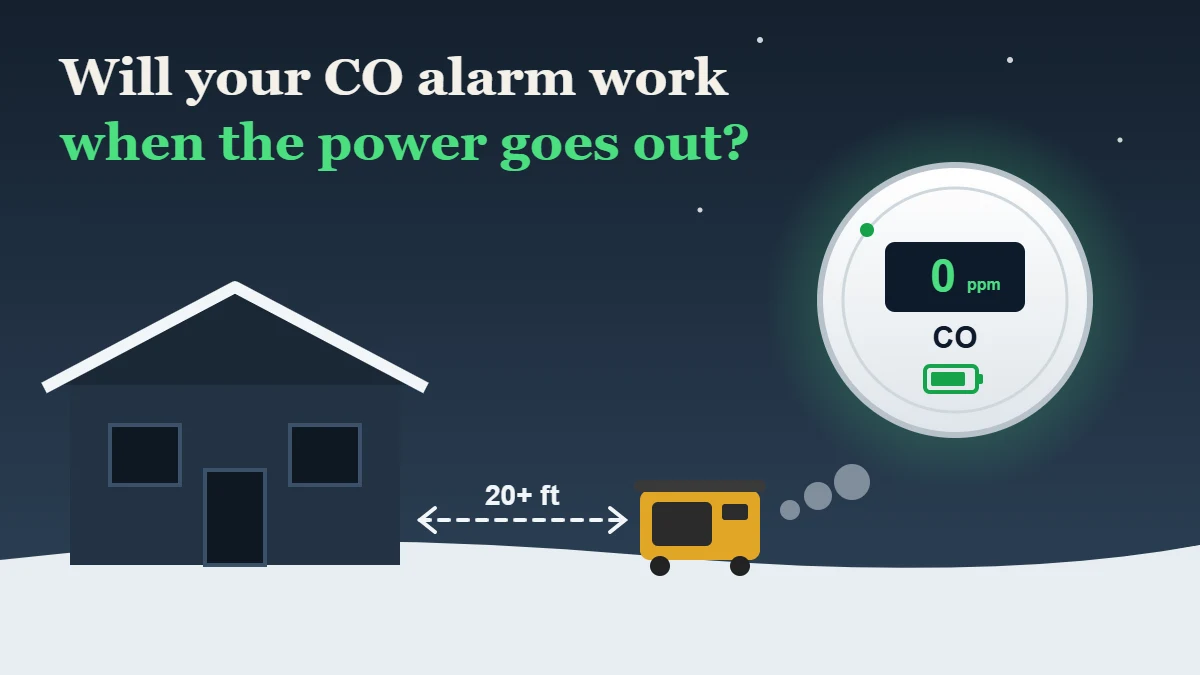
Only if it runs on batteries or has a battery backup. A battery-only alarm keeps working. A hardwired or plug-in alarm keeps working only if it has a backup battery that isn’t dead. A plug-in alarm with no battery goes silent the moment the power goes out. CPSC says alarms that are not battery-operated should have a battery backup, and that you should have one on every level of the home and outside the sleeping areas. Check yours tonight: if you unplug a plug-in alarm and its light goes dark, it won’t protect you in an outage.
If a CO alarm sounds, don’t troubleshoot it. Get everyone, pets included, outside into fresh air right away, then call 911 from outside. Don’t go back in until responders say it’s safe, even if the alarm stops. If anyone has a headache, dizziness, nausea or confusion, tell the dispatcher and get medical care.
Why winter outages are the riskiest time for carbon monoxide
Carbon monoxide has no color and no smell. You can’t notice it until you feel sick, and people who are asleep can be overcome before they feel anything. According to the CDC, more than 400 Americans die from unintentional CO poisoning not linked to fires each year, more than 100,000 visit an emergency department, and more than 14,000 are hospitalized.
Winter is the peak. CPSC reports that more than half of non-fire CO deaths happen in the four cold months of November through February. Outages make it worse because people run portable generators, propane heaters and grills to stay warm or keep the fridge going. CPSC estimates that from 2012 to 2022 about 750 people died from CO poisoning linked to generators alone, and one gasoline generator can put out as much CO as hundreds of cars.
An alarm is your last line of defense, not your first. The first is never running fuel-burning equipment indoors. But when something goes wrong, the alarm is what wakes you up.
Which CO alarm do you have? (and will it work without power)
| Type | How to recognize it | Works in an outage? |
|---|---|---|
| Battery-only | Mounted on a wall or ceiling, no wire and no plug. Battery door or “10-year sealed battery” on the label. | Yes, as long as the battery is good. Test it monthly. |
| Plug-in with battery backup | Plugs into an outlet and has a battery compartment. Often says “battery backup” on the front or label. | Yes, on the backup battery. Replace the backup battery when the alarm chirps. |
| Plug-in with no backup | Plugs into an outlet and has no battery compartment at all. | No. It shuts off with the power. Replace it or add a battery alarm. |
| Hardwired with battery backup | Wired into the ceiling, usually a combination smoke/CO alarm, with a battery door. | Yes, on the backup battery. Many are interconnected, so one alarm sets off all of them. |
| Smart / Wi-Fi alarm | Connects to an app on your phone. | The siren works if it has a battery. Phone alerts stop when your router loses power. |
A 30-second test for plug-in alarms: unplug it. If the power light stays on or switches to a battery indicator, and the alarm still sounds when you press the test button, it has a working backup. If it goes dark, it won’t help you during an outage. Plug it back in when you’re done.
While you’re there, check the date on the back. CO sensors wear out. Replace the alarm when the manufacturer says to, or as soon as it gives its end-of-life signal (usually a chirp pattern described in the manual). The replace-by date or manufacture date is usually printed on the back. If you can’t find one, or the alarm is older than you remember buying it, replace it.
What a good CO alarm for power outages has
- Battery power or battery backup. This is the one feature that matters most for outages. A sealed 10-year battery means no battery swaps.
- A UL 2034 listing. This is the US and Canadian performance standard for CO alarms, and CPSC recommends residential alarms meet it. Look for the UL or ETL mark with “UL 2034” on the package.
- An electrochemical sensor. It’s the common type in quality home alarms and is usually listed on the box.
- A digital display (nice to have). It shows the current or peak CO level, so you can see a problem building even before the alarm goes off.
- Interconnection (nice to have). CPSC says interconnected alarms are best, because when one sounds, they all sound. That matters if the generator problem is on the other side of the house from the bedrooms.
Common examples on store shelves include battery and plug-in models from Kidde and First Alert, some with a digital display and battery backup. We don’t sell alarms and don’t earn anything on these. Compare the features above, not the brand.
“Low-level” CO: what a standard alarm won’t tell you
Home alarms listed to UL 2034 are designed to sound before CO becomes immediately dangerous, not at the first trace. Under the standard, an alarm must go off within 60 to 240 minutes at 70 parts per million (ppm), within 10 to 50 minutes at 150 ppm, and within 4 to 15 minutes at 400 ppm. Most alarms are not designed to alarm at levels below about 30 ppm.
That’s on purpose: it cuts false alarms. But it means a standard alarm can stay quiet while low levels build slowly, for example from a heater that isn’t burning cleanly. Some alarm manuals suggest that people with medical conditions consider devices that warn below 30 ppm. If your household includes infants, pregnant women, older adults, or anyone with heart or lung disease, a model with a digital display or a low-level monitor is worth the extra cost. Either way, flu-like symptoms that ease when you leave the house are a warning sign on their own.
Where to put CO alarms (and how many you need)
- Outside each sleeping area, in the hallway near the bedrooms. This is the most important spot, because CO is most dangerous when you’re asleep.
- On every level of the home, including the basement.
- Inside any bedroom with a fuel-burning appliance, such as a gas fireplace or heater. Many local codes require this.
- Follow the manual for height and distance. Keep alarms out of places where furniture or curtains can block them, and away from the spots the manufacturer lists, such as right next to a furnace or in very humid bathrooms.
For a typical two-story house with bedrooms upstairs and a basement, that means at least three alarms: one in the bedroom hallway, one on the main floor and one in the basement. Local codes can require more, so check yours.
Symptoms of carbon monoxide poisoning
The CDC lists the most common symptoms as headache, dizziness, weakness, upset stomach, vomiting, chest pain and confusion. They’re often described as “flu-like.” Clues that point to CO rather than the flu:
- Several people in the house, or the pets, feel sick at the same time.
- Symptoms started after a generator, heater or other fuel-burning device was turned on.
- Symptoms get better when you go outside and come back when you return.
Don’t wait for the alarm if these fit. Get outside and call 911.
If your CO alarm goes off during an outage
- Get everyone outside into fresh air right away. Don’t stop to open windows or look for the source.
- Call 911 from outside, or from a neighbor’s home.
- Count heads, including pets.
- Stay out until responders say the home is safe, even if the alarm stops.
- Don’t restart the source (generator, heater, furnace) until it has been checked and the cause fixed.
The generator rules that keep the alarm quiet
- Run portable generators outside only, at least 20 feet from the house, with the exhaust pointed away from doors, windows and vents (CDC and CPSC).
- Never in a garage, basement, crawlspace, shed or on a covered porch, even with the doors open. Opening doors or windows doesn’t provide enough ventilation.
- If you’re buying a generator, CPSC suggests looking for a CO shut-off feature that turns it off automatically when CO builds up around it.
- Never use a gas stove, oven or grill to heat the house, and never run a car in an attached garage.
More detail in our guides to running a portable generator safely in snow and cold, heating a room safely without power and gas vs. propane generators in winter.
Running a generator to keep a sump pump going during a flood? Our flood outage guide explains where to place it and how to power the pump without a wall outlet.
Your 10-minute CO check before the next storm
- Count your CO alarms: one outside each sleeping area and one on every level?
- Unplug any plug-in alarm. Does it stay on? If not, replace it or add a battery alarm.
- Press the test button on every alarm.
- Check the replace-by date on the back of each one.
- Keep spare batteries with your outage supplies.
- Decide now where the generator will sit, at least 20 feet from the house, and have a cord long enough to reach.
Want this written into a plan your whole family can follow? Our Winter Outage Kit includes a fillable house map, a backup power plan with generator placement, and a safety page on carbon monoxide, generators and space heaters. You can also start free with our family power outage plan guide.
Sources: CDC – Carbon Monoxide Poisoning Basics, CDC – Use a Generator Safely, CPSC – Carbon Monoxide Information Center, CPSC – Keep Warm and Safe This Winter (2026), CPSC – Report on CO Fatalities and Generator Safety, CPSC – Portable Generator Safety, First Alert – Smoke and CO Alarm Certifications (UL 2034), First Alert – Where to Install CO Detectors.