If your feed is full of videos warning that the power will go out across the country on Tuesday, November 17, take a breath. Here is what is actually scheduled for that day, where the rumor came from, and what is worth doing this week anyway, because winter outages are real even when this one is not.
Short answer
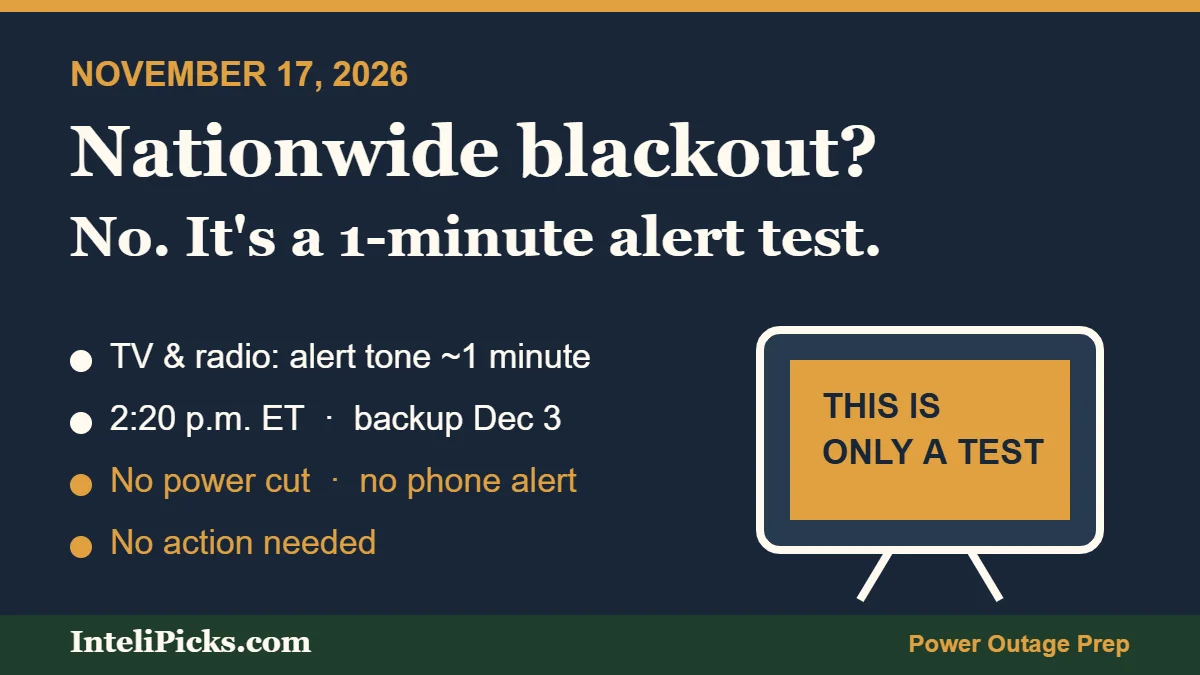
No nationwide blackout is scheduled for November 17, 2026. What is scheduled is a one-minute nationwide test of the Emergency Alert System (EAS) on TV and radio at 2:20 p.m. Eastern Time. It is a test of the warning system, not of the power grid. Your phone is not part of this test, and you don’t need to do anything. Normal local outages from storms, wind or equipment can still happen on any day, which is the only real reason to check your basics.
Update, Nov. 16: what about the bank outage?
On Monday, November 16, customers of several big US banks, including Chase, Bank of America, Wells Fargo and U.S. Bank, reported trouble logging in and making payments, and Zelle users reported problems too. A Chase spokesperson said it was a technical bug, not a cyber issue, and JPMorgan said customers still had access to their accounts and funds. It had nothing to do with the power grid or with the November 17 alert test. It is, though, a good reminder to keep a little cash at home: when banking apps, card readers or ATMs go down, in a bank glitch or a real power outage, cash still works. Here is how much cash to keep for a power outage, and which bills to get.
What is actually happening on November 17
On September 16, 2026, the FCC announced that FEMA, working with the FCC, will run a nationwide test of the Emergency Alert System on November 17, 2026, at 2:20 p.m. ET. If something forces a delay, such as severe weather or a real emergency, the backup date is December 3, 2026. The message reads:
“This is a nationwide test of the Emergency Alert System, issued by the Federal Emergency Management Agency, covering the United States from 2:20 to 2:50 hours ET. This is only a test. No action is required by the public.”
| What you’ll notice | What will NOT happen |
|---|---|
| TV and radio programs interrupted by the alert tone and test message for about a minute | No power cut, no grid shutdown |
| The message in English and Spanish, depending on the station | No test alert on your phone (FEMA says this year’s test is radio and TV only) |
| Programs going back to normal right after | No action needed: you don’t have to unplug, evacuate or change settings |
Local time of the test: 2:20 p.m. Eastern, 1:20 p.m. Central, 12:20 p.m. Mountain (including Arizona), 11:20 a.m. Pacific, 10:20 a.m. Alaska and 9:20 a.m. Hawaii. The “2:20 to 2:50” in the message is the window stations have to relay it. The interruption itself is short.
Why now? Federal law requires FEMA to test the national alert system at least once every three years. The last nationwide test was in October 2023. That one also sent a test alert to cell phones, which is why many people remember their phones going off. This year’s test is EAS only.
In Canada? The US test runs on US broadcasters and providers. It is not a Canadian Alert Ready test.
Where the blackout rumor came from
The rumor stitches together a few real things and a lot of invention.
1. A Simpsons episode from 2023
The clip being shared comes from “It’s a Blunderful Life” (season 35, episode 7), which aired on November 19, 2023. In it, an older Lisa looks back on a fictional blackout in Springfield days before Thanksgiving, and her diary shows November 17. The episode never says 2026, and it is about one cartoon town, not the world. The story also doesn’t line up with this year’s calendar: in the episode the blackout starts six days before Thanksgiving, but in 2026 Thanksgiving falls on November 26, nine days after November 17.
2. The real alert test on the same date
Posts paired the cartoon date with FEMA’s test announcement and presented the test as a “cover” for a shutdown. The official notice describes a one-minute alert broadcast and nothing else. We found no notice from FEMA, the FCC, any grid operator or any utility announcing a planned blackout for November 17.
3. A Pentagon plan about military bases
On September 30, the Defense Department announced a program called FORTRESS America. Part of it is making major military bases able to generate their own power, independent of the civilian grid, so they keep running if the grid is attacked. News reports later tied this to a goal of keeping bases running for 90 days. That figure did not appear in the publicly available part of the memo, and the plan is about bases, over years, not about cutting power to homes. It is not a warning that civilians will lose power for 90 days.
4. Viral videos
Short videos on TikTok, Facebook, Instagram, YouTube and X have claimed everything from a 72-hour outage to a 90-day one, with internet, banks and flights going down too. Some use AI-generated voices or footage. If a video claims a president or an agency “announced” a blackout, check FEMA.gov, your state emergency agency or your utility. A real announcement would be there, not only in a reel.
Don’t buy in a panic. Fear is great for selling “blackout kits.” You don’t need anything special for November 17. If you want to be better prepared for winter, do it calmly, with the list below, and buy only what you’d actually use.
The useful part: a calm 24-hour check for a real winter outage
The US grid is made of regional systems, and real outages are local: an ice storm, high wind, a car hitting a pole. Mid-November is when winter outages start. Spend an evening on this and you’ll be ready for the real thing.
Light, phones and information
- Put flashlights or battery lanterns where you can find them in the dark. Skip candles, they are a fire risk.
- Charge phones and power banks. Save your utility’s outage number and outage map in your phone.
- Have a battery or hand-crank radio for local updates if phones and internet are down.
Carbon monoxide and heat
- Check that you have a working CO alarm with a battery or battery backup on every level and outside sleeping areas. A plug-in alarm without a backup battery goes silent in an outage. Here’s the 30-second test.
- Never heat your home with a gas oven or stove, a grill or a camp stove. How to heat one room safely without power.
- If you have a generator: outdoors only, at least 20 feet from the house, exhaust pointed away from doors and windows. Never in a garage, basement or porch, and never plugged into a wall outlet. Running a generator safely in snow and cold.
Food and water
- Keep the fridge and freezer doors closed. According to the CDC, a closed fridge keeps food safe for up to 4 hours. A full freezer keeps food safe for about 48 hours, a half-full one for about 24.
- After 4 hours without power, throw out perishable fridge food such as meat, fish, eggs, milk and leftovers, unless you kept it at 40°F or below with ice or a cooler. When in doubt, throw it out. More on keeping holiday food safe in an outage.
- Put an appliance thermometer in the fridge and freezer: 40°F or below in the fridge, 0°F or below in the freezer.
- Keep water and a few days of food you can eat without cooking. Here’s a simple 2-week winter pantry.
- In a long cold-weather outage, pipes can freeze. How to keep pipes from freezing when the power is out.
People who need extra planning
- If someone uses powered medical equipment or medicine that must stay cold, ask their care team what to do in an outage and plan where you’d go.
- Agree on a family plan: who checks on whom, and where you meet. A simple family power outage plan.
- If your home gets too cold to stay safe, go to a warm place: family, friends or a local warming center.
Want the whole winter plan on paper? Our Winter Outage Kit puts the checklists, the fridge rules and a 2-week pantry plan in printable form. It’s useful for any outage, not because of this rumor.
Quick answers
Will the power go out on November 17?
No nationwide outage is scheduled. The only national event that day is a one-minute TV and radio alert test. Local outages can happen any day, as usual.
Will my phone get an alert during the test?
No. FEMA says this year’s test goes to radio and TV only. Real emergency alerts to phones keep working as normal.
Do I need to unplug anything or turn off my TV?
No. The test message itself says no action is required by the public.
What if the test is postponed?
The backup date is Thursday, December 3, 2026, at the same time.
Did The Simpsons predict a blackout?
No. A 2023 episode shows a fictional six-day blackout in Springfield, and November 17 appears in Lisa’s diary. It doesn’t mention 2026, and its Thanksgiving timeline doesn’t match this year’s calendar.
Is the military preparing for a 90-day blackout?
The Pentagon is working to make military bases able to run on their own power if the grid is attacked. That is a long-term plan for bases, not an announced blackout for homes.
Was the November 16 bank outage part of the blackout?
No. Chase said the November 16 problems were a technical bug, not a cyber issue, and the power grid was not involved. Keeping some cash at home still helps when card payments go down. See how much cash to keep and how to store it.
Has the US ever had a nationwide blackout?
The US grid is split into separate regional systems, so outages, even big ones, have been regional rather than nationwide.
Sources
- FCC Public Notice DA 26-989: Nationwide EAS test on November 17, 2026 (Sept. 16, 2026)
- FEMA: IPAWS National Test
- CDC: Keep Food Safe After a Disaster or Emergency
- CPSC: Portable Generator Safety
- WBAL/Hearst: Customers at major US banks report difficulty with some online services (Nov. 16, 2026)
- Ready.gov: Power Outages