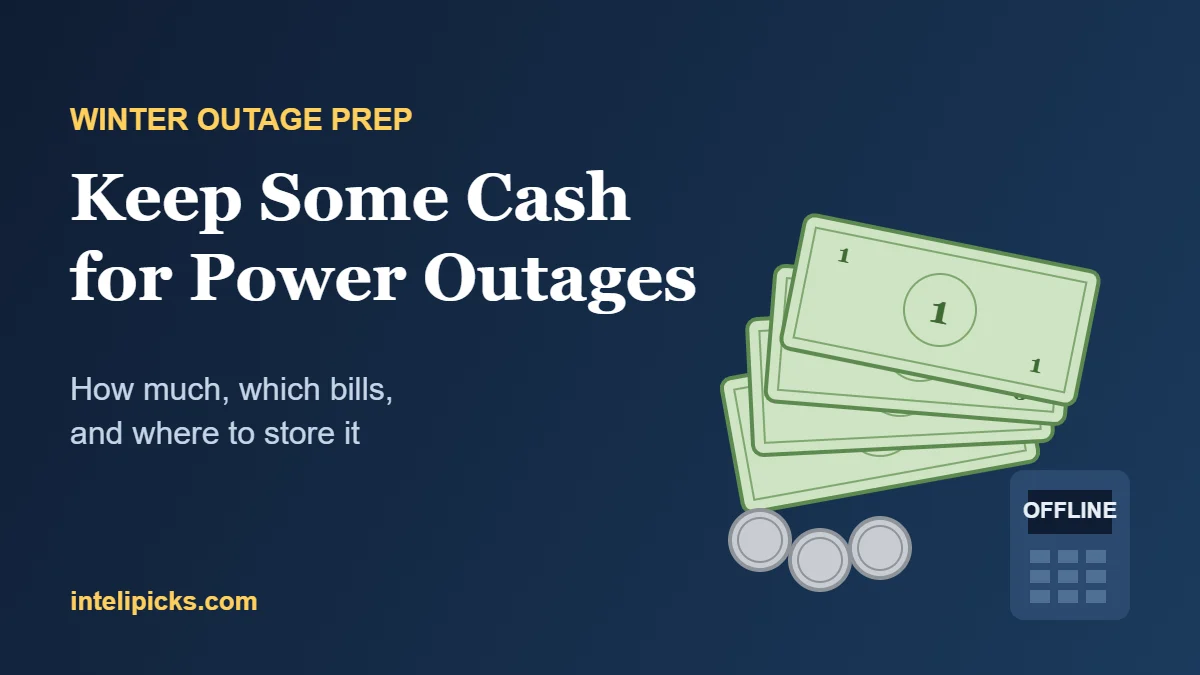
When the power goes out, the card in your wallet can become a piece of plastic. Store card readers, ATMs and gas pumps all need electricity and a working network, and in a long outage they often have neither. A small stash of cash at home fixes that problem for a few days. Here is why it matters, how much to keep, which bills to get, and how to store it without creating a new risk.
Short answer
Keep enough cash to cover about three days of basics (food, water, medicine, gas) for everyone in your home. For most households that works out to roughly $150 to $500, mostly in $1, $5, $10 and $20 bills plus some coins. Store it in a waterproof bag inside a fire-resistant box, and keep the rest of your emergency savings in an insured bank account. No US or Canadian agency sets an official dollar amount, so the range above is our estimate based on official guidance. Adjust it to your own prices.
Why cards stop working when the power goes out
Paying by card or phone depends on a chain of equipment: the store’s terminal, its router, the phone or internet line, and the bank’s systems on the other end. In a blackout, the weakest link is usually the local one. Ready.gov puts it simply: it is important to have small bills on hand because ATMs and credit cards may not work during a disaster, right when you need supplies, fuel or food.
- Card terminals go dark with the power. A store running on a generator still can’t approve cards if its internet or phone line is down.
- ATMs need both power and a network connection. The few that keep working tend to draw long lines and can run out of cash. After Hurricane Helene in 2024, card problems pushed more people than usual to ATMs, and some machines ran empty.
- Gas pumps need grid power to pump and to read cards. Stations with backup power may switch to cash only.
- Phone payments and banking apps need cell data. In a long outage, cell towers run on backup batteries that don’t last forever.
It isn’t only storms. On November 16, 2026, several large US banks and Zelle had an online outage that locked many people out of their apps for part of the day. The money was safe, but for a few hours it was hard to reach. (We covered that in our update on the November 17 blackout rumor.) A little cash at home covers both kinds of trouble: a dead grid and a bank that is down.
Not just storms: when the bank itself goes down
On Monday, November 16, 2026, there was no storm. A software bug in Chase’s own on-premise hardware slowed transactions, and the delays spilled over to customers at several other big US banks and to Zelle payments (Al Jazeera). Some Chase customers opened the app to a message that read “Some services aren’t available. We’re working on them. Please try back later.” (AP). AP also photographed a Chase ATM in Irving, Texas, showing a “not working” screen (KUOW/AP). Chase said it wasn’t a cyberattack and that customers still had access to their accounts and funds (AP via OPB).
Nobody lost money. But for a few hours, “my money is in the bank” and “I can pay for this right now” weren’t the same sentence. That’s the gap a small stash of cash covers, whether the cause is an ice storm or a line of bad code.
Then come the fake “verify your account” messages
Three days later, on November 19, Chase said attackers who targeted some of its outside vendors may have reached marketing data with customer names and email addresses. The leaked records were mostly email addresses, with phone numbers in some cases, and Chase said they didn’t include card numbers or especially sensitive personal information (AP via U.S. News). Visa and Mastercard reported incidents at service providers the same week (ABC News).
A leaked email list plus a fresh outage is exactly the story a scammer wants: “We had a problem. Please confirm your details.” The rules don’t change, whichever bank you use:
- Don’t use links or phone numbers from the message. Open your bank’s app, or type its web address yourself.
- Never share a password, PIN or one-time code with anyone who contacted you first, by email, text or phone.
- Treat urgency as the warning sign. “Act now or your account will be locked” is pressure, not information.
- Get outage news from the source: the bank’s own website or official social accounts.
The FTC has a short guide to spotting these messages: How to recognize and avoid phishing scams.
What the official guidance actually says
Every major agency agrees you should keep some cash, and none of them in the US or Canada gives a dollar figure:
- FEMA advises keeping a small amount of cash in a safe place at home, because ATMs and credit cards may not work after a disaster.
- Ready.gov lists cash and small bills in its emergency kit guidance.
- The FDIC suggests a small amount of cash to buy food or supplies in case ATMs and cards aren’t working. It also says large amounts belong in an insured bank account, not at home.
- Public Safety Canada recommends cash in smaller bills and coins. It also warns it may be hard to get cash from banks, and suggests having enough to cover basic needs for a few weeks if you can.
The only central bank we found that publishes a number is the Netherlands’ central bank (DNB). In 2025 it advised households to keep €70 per adult and €30 per child for the first 72 hours of a payment outage, based on calculations by the Dutch national family-finance institute. North American costs and distances are different, but it is a useful sanity check: the goal is a few days of basics, not a hoard.
How much cash to keep: a simple worksheet
Instead of guessing, add up what you would actually need to pay for in cash over three days if the cards stopped working:
- Food and water: what your household spends on groceries in three days, minus what is already in your pantry.
- One tank of gas: the cost of filling up from about a quarter tank. In winter you may need to drive to a warm place or to family.
- Medicine: pharmacy co-pays and over-the-counter basics.
- Winter extras: ice, batteries, propane, or one night in a motel if your home gets too cold to stay in.
For most homes, that lands in these ranges (our estimate; your local prices decide the real number):
| Household | Staying home, stocked pantry | Might need to leave or drive a lot |
|---|---|---|
| 1 adult | $100–$150 | $200–$300 |
| 2 adults | $150–$250 | $300–$400 |
| Family of 4 | $250–$350 | $400–$500+ |
Rural homes, long commutes, prescription needs and places with frequent multi-day outages should sit at the high end. If your area regularly loses power for a week, Canada’s “few weeks of basics” advice is worth taking seriously, built up over time rather than all at once.
Which bills to get (and why not $100s)
In an outage, stores that stay open often can’t make change for long. A $100 bill for a $9 bag of ice is a problem for both of you. Small bills let you pay close to the exact amount. Here is one way to split a $200 starter stash in the US:
| Denomination | How many | Total |
|---|---|---|
| $1 bills | 20 | $20 |
| $5 bills | 10 | $50 |
| $10 bills | 6 | $60 |
| $20 bills | 3 | $60 |
| Quarters (one roll) | 40 | $10 |
| Total | $200 |
In Canada, there are no $1 or $2 bills, so use $5, $10 and $20 bills plus loonies and toonies. Public Safety Canada specifically suggests smaller bills such as $10s, and change.
Tip: you don’t have to build it in one trip. Ask for small bills when you get cash back, or set aside a few $5s and $1s each week until you hit your number.
Where to keep it
- Waterproof and fire-resistant. The FDIC suggests a waterproof bag inside a fire-resistant box or safe. A sealed freezer bag inside a small fire-resistant document box is a cheap version.
- Easy to grab. Keep it with your winter outage kit or documents, so you can take it if you have to leave quickly.
- Split it up. A little in your wallet, a little in the car, most of it at home. One fire or theft doesn’t take all of it.
- Skip the obvious spots. The freezer, under the mattress and the sock drawer are the first places a burglar checks. And don’t advertise that you keep cash at home.
- Tell one trusted person where it is, so it isn’t lost if you aren’t the one at home. Add it to your family outage plan.
Why “some” cash, not a lot
Cash at home has real downsides, which is why every official source says “small amount”:
- Home insurance pays little for cash. Policies usually have a special limit on money. New York’s insurance regulator gives $200 as a typical example, and some policies allow more. Check your declarations page.
- Deposit insurance doesn’t cover it. FDIC (and CDIC in Canada) insurance protects money in an insured bank account, not bills in your closet.
- It earns nothing. Money in a savings account at least earns some interest.
- It can be lost or stolen. The more you keep, the more you can lose at once.
So the cash stash is a short bridge for a few days, and your real emergency fund stays in the bank. A bank outage like the one on November 16 makes money hard to reach for a while; it doesn’t make it disappear.
Cash attracts scammers after outages and storms. The FTC warns that people who show up offering cleanup or repairs and want cash up front are a red flag: get a written contract, license and proof of insurance first. FEMA employees never ask for money for inspections, disaster aid or help with applications. Utility workers won’t demand on-the-spot payment either. If in doubt, call the company or agency at a number you look up yourself, and report scams at ReportFraud.ftc.gov.
A 10-minute checklist
- Work out your number with the worksheet above.
- Get it in small bills plus a roll of quarters (or loonies and toonies in Canada).
- Seal it in a waterproof bag and put it in a fire-resistant box with your documents.
- Keep $20 to $40 in the car and in your wallet.
- Tell one trusted person where it is.
- Don’t spend it on everyday things. If you dip into it, refill it.
- Keep the rest of your emergency savings in an insured account.
Cash is one piece of being ready. The others matter more for safety: a way to heat a room safely, a working carbon monoxide alarm if you run a generator or heater, and food you can eat without power.
Common questions
Is there an official amount of cash to keep for emergencies?
Not in the US or Canada. FEMA, Ready.gov, the FDIC and Public Safety Canada all say to keep some cash, ideally in small bills, but leave the amount to you. The Dutch central bank’s €70 per adult and €30 per child for 72 hours is the clearest official figure we found anywhere.
Should I withdraw cash before a big storm?
If you don’t already have a stash, yes, a day or two ahead, when ATMs are working and stocked. It’s easier to keep a small reserve all winter so you aren’t in the ATM line with everyone else.
Is my money safe in the bank during an outage?
An app or network outage affects access, not your balance. Deposits at FDIC-insured banks (and CDIC members in Canada) are protected up to the insurance limits if a bank fails. Deposit insurance doesn’t cover temporary outages, though, which is exactly the gap a little cash fills.
Can I still pay by card if the store has a generator?
Sometimes. The store also needs a working internet or phone connection to approve cards. If that is down, many stores go cash only or close.
Do I need cash for November 17?
No. No nationwide blackout is scheduled; the only national event that day is a short TV and radio alert test (details here). But winter outages happen every year, so this is a fine week to set aside a small stash calmly.
Sources
- Ready.gov: Financial Preparedness
- FEMA: Plan Ahead to Avert Financial Disaster
- FDIC Consumer News: Preparing your finances for a natural disaster
- Public Safety Canada: Emergency kits
- De Nederlandsche Bank: Cash in your emergency kit
- NY Department of Financial Services: Homeowners basic coverage and special limits
- CFO Dive: Hurricane Helene card and cash troubles
- FTC: How to avoid scams after weather emergencies
- FTC: Spot and avoid FEMA impersonators
- AP via OPB: Technical issue at JPMorgan Chase triggers online banking delays (Nov 16, 2026)
- AP via U.S. News: Cyberattack leaks thousands of Chase customer emails (Nov 19, 2026)
- FTC: How to recognize and avoid phishing scams