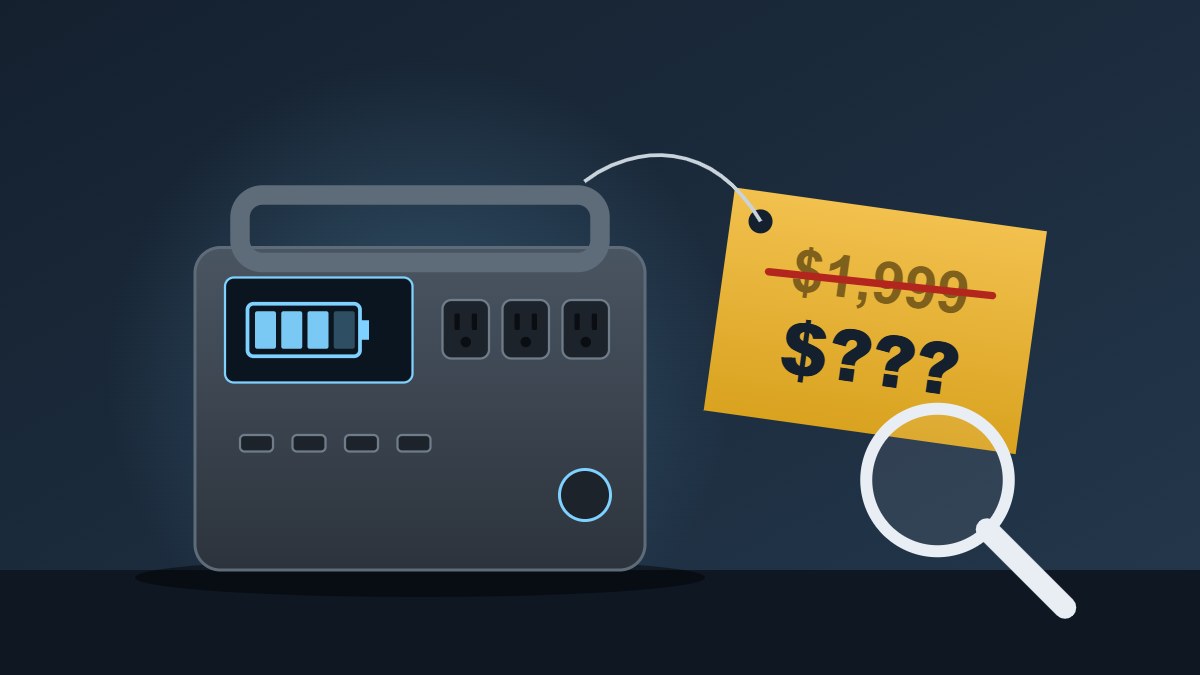
Every November, the same power station gets two prices: the crossed-out one and the one in red. The crossed-out number does most of the selling. It makes $850 feel like a rescue.
Here’s a real one. The Anker SOLIX F2000 is a 2,048Wh station with a list price of $1,999. Slickdeals logged it at Amazon for $839.99 in October 2025, “58% off” the list price (Slickdeals). In June 2026, DealNews tracked it at $750 with Prime (DealNews). So if you see it this week for $849 “down from $1,999,” the honest comparison isn’t $1,999. It’s $750.
That doesn’t mean Black Friday deals are fake. Some are the best price of the year. It means the banner can’t tell you which ones. You can, with six questions and about ten minutes.
Short answer
A power station deal is good when it passes six checks: the price beats its own recent low (not the list price), the cost per usable watt-hour is fair, the battery is LiFePO4 if you want it to last years, the continuous watts cover your biggest appliance, any solar bundle is priced honestly per watt, and the warranty and return window hold up for where you’re buying. If it fails one of those, wait. Another sale will come.
A quick note: prices change hourly during sales, and every figure here is a dated example, not a promise. Check the seller’s page before you buy.
1. Check the price against its own history, not the list price
The list price is the most persuasive number on the page and the least useful one. Many power stations rarely sell at list. The real question is: what has this exact model sold for in the last 90 days?
US federal guidance is clear about the idea, even if enforcement isn’t. The FTC’s Guides Against Deceptive Pricing say a “former price” comparison is genuine when that price was openly offered to the public for a reasonably substantial period of time, and that an inflated price set up just to advertise a big cut makes the bargain a false one (16 CFR 233.1). In practice, you’re the one who has to check.
How to do it in two minutes:
- Paste the Amazon link into a price tracker like Keepa or camelcamelcamel and look at the 90-day low.
- Search the exact model on a deal site such as Slickdeals or DealNews. Their posts are dated, so you can see what it sold for last spring.
- Compare the brand’s own store with Amazon, Best Buy and Home Depot. The same unit is often priced differently in each.
- Read the model name twice. “Gen 2,” “Plus” and “V2” versions can have very different specs from the older unit in the photo.
So what? If today’s price isn’t at or near the recent low, the deal is a normal price with a red banner. You lose nothing by waiting.
2. Work out the price per usable watt-hour
Price per watt-hour (Wh) lets you compare a $500 station with a $1,500 one on equal terms. Divide the price by the capacity. The F2000 at $750 is about $0.37 per Wh.
But the number on the box isn’t what you get out of the wall outlets. Power goes through an inverter to become 120V AC, and some of it turns into heat. Independent capacity tests put real AC output for most stations somewhere around 75% to 95% of the rated capacity, with typical results in the mid-80s (Watt Power Station, HomePowerFacts). Small loads can do worse, because the inverter uses power just by being switched on.
| Example | Rated capacity | Price | $ per rated Wh | Usable at 85% | $ per usable Wh |
|---|---|---|---|---|---|
| F2000 at its June 2026 low | 2,048 Wh | $750 | $0.37 | ~1,740 Wh | $0.43 |
| Same unit at $849 | 2,048 Wh | $849 | $0.41 | ~1,740 Wh | $0.49 |
There’s no universal “good” price per Wh, and anyone who gives you one for 2026 is guessing. The useful move is comparing two or three stations you’re actually considering, side by side, the same way.
So what? A cheaper station isn’t cheaper if it gives you less energy out. Run the number on usable Wh, then use our outage calculator to see whether that energy covers your fridge, phones and furnace blower for the hours you need.
3. Check the battery chemistry and the cycle rating
Most new home-backup stations use LiFePO4 (lithium iron phosphate). Older or very light units may still use NMC. The difference shows up years later.
Read the cycle rating closely, because brands measure it differently. Jackery lists the Explorer 1000 v2 at 4,000 cycles to 70% capacity (Jackery). Anker lists the SOLIX C1000 at 3,000 cycles to 80% (Anker SOLIX). DJI rates the Power 2000 at over 80% capacity after 4,000 cycles (DJI). “70%” and “80%” are not the same finish line, so compare like with like.
Also check the charging temperature range. Jackery and Anker both list charging from about 32°F (0°C) for those models, so a station stored in a cold garage may refuse to charge until it warms up. If winter outages are your main worry, our winter battery guide and the AGM vs LiFePO4 comparison cover this in detail.
So what? A discounted NMC station can still be the right buy for camping. For home backup you’ll keep for years, LiFePO4 is usually worth a little more.
4. Read continuous watts, not peak watts
Two power numbers sit on every listing. Continuous (rated) output is what the station can deliver for as long as the battery lasts. Peak or surge is a short burst, often for a fraction of a second, for motors that need a kick to start.
Your biggest appliance has to fit under the continuous number. A sump pump, a well pump or a microwave can each need more than a small station gives. If you’re not sure what yours draw, our guide to what to look for in a portable power station shows how to read the labels.
Watch for boost modes. EcoFlow’s X-Boost lets a station run some appliances rated above its inverter by lowering the voltage it delivers (EcoFlow). EcoFlow’s own manual says it suits heating devices and isn’t compatible with appliances that have strict voltage requirements (EcoFlow DELTA mini manual). Other brands have similar features under different names. They are useful for a kettle or a hair dryer. They are not a reason to buy a smaller station for your fridge or medical equipment.
Some stations also offer a UPS or “EPS” mode that switches to battery when the grid drops, usually quoted in milliseconds. DJI says the Power 2000 starts powering devices within 0.01 seconds (DJI). That’s handy for a router or a desktop PC. Most makers don’t certify it as a medical-grade UPS, so check the manual before relying on it for anything critical.
5. Price solar bundles per watt, and expect less than the label
Bundles with solar panels look generous because the “you save” figure adds both list prices together. Strip the bundle apart instead:
- Find the price of the station alone in the same sale.
- Subtract it from the bundle price. That’s what you’re paying for the panels.
- Divide by the panels’ rated watts to get a price per watt, and compare it with the same panels sold alone.
Then lower your expectations for the output. A panel’s rating comes from lab conditions. Outdoors, with heat, angle and winter sun, real-world output is usually well below the label. Also check the station’s maximum solar input. A 400W panel set doesn’t help much if the station only accepts 200W through its solar port.
So what? A bundle is a good deal only if the panels are fairly priced and the station can actually use them. Otherwise you’re paying for a box in the closet.
6. Read the warranty and the return policy before you click Buy
Warranty length is the headline, but the conditions decide whether it helps you. Three examples worth knowing this year:
- DJI: the Power 2000 has a three-year warranty when bought from the DJI Store, extendable by two years after you first connect it to the DJI Home app (DJI Store). Skip the app step and you have three years, not five.
- Jackery: its warranty doesn’t cover the battery cell unless you fully charge it within seven days of purchase and at least once every six months after that (Jackery FAQ). Jackery’s 30-day return applies to its own website and its Amazon store; other retailers use their own policies (Jackery).
- EcoFlow: its US warranty policy is written for products bought and used in the US (EcoFlow). An imported or grey-market unit may not qualify.
Return windows matter just as much. Best Buy says most purchases made between October 30 and December 31 can be returned through January 15 (Money Talks News). That gives you time to test the station at home: charge it fully, run your fridge on it overnight, and see what you actually get. Our guide on how long a 1000Wh station runs a fridge explains how to run that test.
So what? The deal that comes with a long return window and a clear warranty is often worth $50 more than the one that doesn’t.
Two checks that have nothing to do with price
Is it under a recall?
Old stock gets discounted, and some old stock has a recall attached. In October 2025, EcoFlow and the CPSC recalled about 25,030 Delta Max 2000 units (model EFD310) because they could overheat and ignite (CPSC). The fix is a free firmware update, but a used or marketplace unit may never have received it. In August 2026, Goal Zero recalled about 46,200 YETI 3000X stations after four reports of fire, overheating and smoking; that remedy is also a firmware update (CPSC).
Before you buy any older model, search its name on cpsc.gov/Recalls. It takes a minute.
Is the seller real?
The best “deal” you’ll see this week may be in a Facebook or Instagram ad for a big-name station at a third of the price. The FTC reports that people lost $2.1 billion in 2025 to scams that started on social media, and shopping scams were the most reported type (FTC). Over 40% of people who lost money that way said they had ordered something they saw in an ad (FTC).
If a 2,000Wh LiFePO4 station is listed for $199 on a site you’ve never heard of, you already know the answer. Type the brand’s address yourself, or buy from a retailer you’d be happy to return it to.
Is Black Friday even the cheapest time to buy?
Sometimes, but not reliably. The UK consumer group Which? tracked 175 home, tech and health products for a year and found that 83% were the same price or cheaper at least once outside the four-week Black Friday period (Which?). Power stations weren’t studied specifically, and US pricing differs. But the F2000 example at the top tells the same story: its lowest tracked price came in June, not November.
So treat Black Friday as one good window, not the only one. If you need backup power before winter storms arrive, a fair price now beats a perfect price in spring. If you can wait, set a price alert and let the deal come to you.
Your 60-second deal test
- Price history: Is it at or near its 90-day low?
- Usable $/Wh: Price ÷ (capacity × 0.85). Is it fair next to the alternatives?
- Chemistry: LiFePO4, with a cycle rating you can compare?
- Continuous watts: Does it cover your biggest appliance without boost mode?
- Solar: Is the bundle priced fairly per watt, and can the station take that input?
- Warranty and returns: Any conditions (app, charging, region)? When does the return window close?
- Safety: No open recall, and a seller you trust.
If it passes all seven, buy it and stop scrolling. If it doesn’t, close the tab. The station isn’t going anywhere, and neither is the next sale.
When it arrives, charge it fully, test it with the appliances you care about, and put it on your winter outage kit list. A power station is only a deal if it works the night you need it.
Frequently asked questions
What is a good price per watt-hour for a power station? There’s no fixed number that holds across 2026, because prices move so fast. Compare the price per usable Wh (rated capacity × about 0.85) between the specific models you’re considering, and check each one’s recent low.
Is a bigger discount a better deal? Not necessarily. A 58% discount from a list price nobody pays can be worse than a 15% discount from a real recent price. Compare against the 90-day low, not the crossed-out number.
Should I buy LiFePO4 or NMC? For home backup you’ll keep for years, LiFePO4 is usually the better pick because of its longer cycle life. NMC is lighter and can make sense for occasional camping use.
Can a power station replace a generator during an outage? For phones, lights, a fridge and a furnace blower for a day or so, often yes, especially with solar. For whole-home loads over several days, a generator or a larger battery system is usually needed. Never run a fuel generator indoors.
What should I do when the power station arrives? Charge it fully right away (some warranties require it), register it if the brand asks you to, and run a real test with your appliances while the return window is still open.